The algae are divided into three main classes: 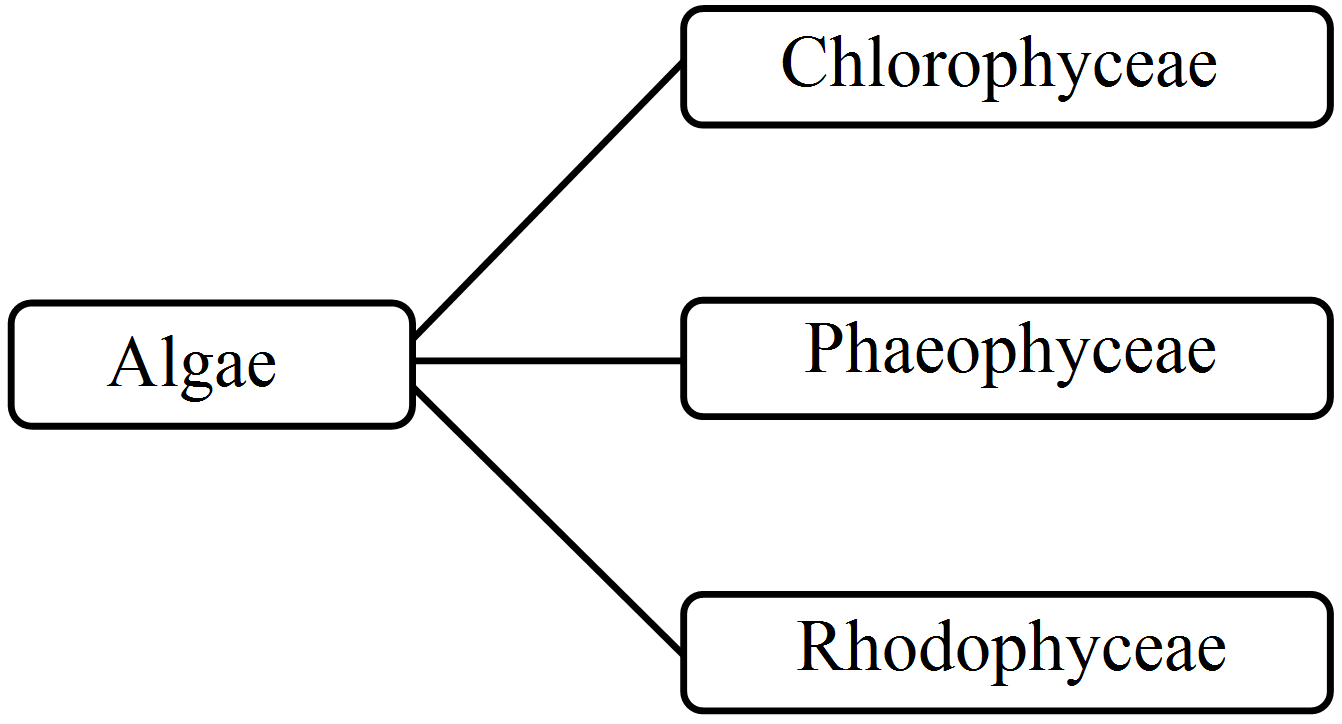
- Chlorophyceae:
Characteristics:
- They are commonly called green algae.
- The plant body may be unicellular, colonial or filamentous.
- They are usually grass green due to the dominance of pigments chlorophyll a and b. The pigments are localized in definite chloroplasts. The chloroplasts may be discoid, plate-like, reticulate, cup-shaped, spiral or ribbon-shaped in different species.
- Most of the members have one or more storage bodies called pyrenoids located in the chloroplasts. Pyrenoids contain protein besides starch. Some algae may store food in the form of oil droplets.
- Green algae usually have a rigid cell wall made of an inner layer of cellulose and an outer layer of pectose.
Reproduction:
- Vegetative reproduction usually takes place by fragmentation or by formation of different types of spores.
- Asexual reproduction is by flagellated zoospores produced in zoosporangia.
- The sexual reproduction shows considerable variation in the type and formation of sex cells and it may be isogamous, anisogamous or oogamous.
Common Examples: Chlamydomonas, Volvox, Ulothrix, Spirogyra and Chara.
- Phaeophyceae:
Characteristics:
- They are also known as brown algae and are found primarily in marine habitats.
- They range from simple branched, filamentous forms (Ectocarpus) to profusely branched forms as represented by kelps, which may reach a height of 100 metres.
- They possess chlorophyll a, c, carotenoids and xanthophylls. They vary in colour from olive green to various shades of brown depending upon the amount of the xanthophyll pigment, fucoxanthin present in them.
- Food is stored as complex carbohydrates, which may be in the form of laminarin or mannitol.
- The vegetative cells have a cellulosic wall usually covered on the outside by a gelatinous coating of algin. The protoplast contains, in addition to plastids, a centrally located vacuole and nucleus.
- The plant body is usually attached to the substratum by a holdfast, and has a stalk, the stipe and leaf like photosynthetic organ - the frond.
Reproduction:
- Vegetative reproduction takes place by fragmentation.
- Asexual reproduction in most brown algae is by biflagellate zoospores that are pear-shaped and have two unequal laterally attached flagella.
- Sexual reproduction may be isogamous, anisogamous or oogamous. Union of gametes may take place in water or within the oogonium (oogamous species).
- The gametes are pyriform (pear-shaped) and bear two laterally attached flagella.
Common Examples: Ectocarpus, Dictyota, Laminaria, Sargassum and Fucus.
- Rhodophyceae:
Characteristics:
- They are commonly called red algae because of the predominance of the red E pigment, r-phycoerythrin in their body.
- Majority of the red algae are marine with greater concentrations found in the warmer areas. They occur in both well-lighted regions close to the surface of water and also at great depths in oceans wiicre relatively little light penetrates.
- The red thalli of most of the red algae are multiceiiular. Some of them have et complex body organisation.
- The food is stored as floridean starch which is very similar to amylopectin and glycogen in structure.
Reproduction:
- The red algae reproduce vegetatively by fragmentation.
- They reproduce asexually by non-motile spores and sexually by non-motile gametes.
- Sexual reproduction is oogamous and accompanied by complex post fertilization state developments.
Common Examples: Polysiphonia, Porphyra, Gracilaria and Gelidium.