Question
Describe experiment of two coils explaining electromagnetic induction.

Answer

Image

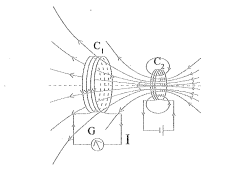
As shown in figure, two coils $C _1$ and $C _2$ are kept facing each other.
Galvanometer is connected with $C _1$ and Battery is connected with $C _2$.
On passing steady current through coil $C _2$, magnetic field is produced around it.
On moving $C _2$ towards $C _1$, galvanometer shows deflection. It indicates that electric current is induced in $C _1$.
On moving $C _2$ away from $C _1$, galvanometer shows deflection in opposite direction.
Keeping $C _2$ stationary, on moving $C _1$ closer to or away from $C _2$, we get same results as above.
Thus, here electric current is induced due to relative motion between both coils.

Need a full question paper?

Generate a complete, print-ready paper with questions like this in minutes — across 16+ boards, with answer keys.
Start Generating Free

Similar questions

Derive the equation of electric potential due to a system of electric charges.
Write any three characteristics, a ferromagnetic substance should possess if it is to be used to make a permanent magnet. Give one example of such a material.
Free electron density of copper is $8.5 \times 10^{28}$ per $m ^3$. Find out the current in copper wire of length 0.1 m and area of cross-section $1 mm^2$ when a battery of 3 V is joined across its ends. (Given mobility of electrons = $4.5 \times 10^{-6} m^2 V^{-1} s^{-1}$, charge on electron, $e=1.6 \times 10^{-19} C$ )
Derive an expression for drift velocity of free electrons in a conductor in terms of relaxation time.
A short bar magnet has a magnetic moment of $0.50 JT ^{-1}$. Calculate the magnitude of the magnetic field produced by the magnet at a distance of 10 cm from the centre of the magnet on
(a) the axis of the magnet and
(b) the equatorial line of the magnet
The wavelength of light in a medium is $\lambda=\frac{\lambda_0}{\mu},$ where $\lambda$ is the wavelength in vacuum. A beam of red light $(\lambda_0=720\text{nm})$ enters into water. The wavelength in water is $\lambda=\frac{\lambda_0}{\mu}=540\text{nm}.$ To a person under water does this light appear green?
  1. An electrostatic field line is a continuous curve. That is, a field line cannot have sudden breaks. Why not?
  2. Explain why two field lines never cross each other at any point?
Answer the following question:
Does the apparent depth of a tank of water change if viewed obliquely? If so, does the apparent depth increase or decrease?
You are given a low resistance $R_1$, a high resistance $R_2$ and a galvanometer. How will you make such instruments from them which can measure (i) current, (ii) potential difference?
Consider two particles A and B having equal charges and placed at some distance. The particle A is slightly displaced towards B. Does the force on B increase as soon as the particle A is displaced? Does the force on the particle A increase as soon as it is displaced?