Question
The wavelength of light in a medium is $\lambda=\frac{\lambda_0}{\mu},$ where $\lambda$ is the wavelength in vacuum. A beam of red light $(\lambda_0=720\text{nm})$ enters into water. The wavelength in water is $\lambda=\frac{\lambda_0}{\mu}=540\text{nm}.$ To a person under water does this light appear green?
Answer

Colour of light will depend only on the frequency of light and not on the wavelength of the light. So, light will appear red to an observer under water.

Need a full question paper?

Generate a complete, print-ready paper with questions like this in minutes — across 16+ boards, with answer keys.

Start Generating Free

Similar questions

The objective of a telescope is large and the eyepiece is small, whereas the objective of a microscope is small and the eyepiece is large. If a telescope is turned upside down, can it be used like a microscope? Can a microscope be used like a telescope in the same way?
An optical fibre $(\mu=1.72)$ is surrounded by a glass coating $(\mu=1.50).$ Find the critical angle for total internal/ reflection at the fibre-glass interface.
Give an example for which $\overrightarrow{\text{A}}.\overrightarrow{\text{B}}=\overrightarrow{\text{C}}.\overrightarrow{\text{B}}$ but $\overrightarrow{\text{A}}\neq\overrightarrow{\text{C}}.$
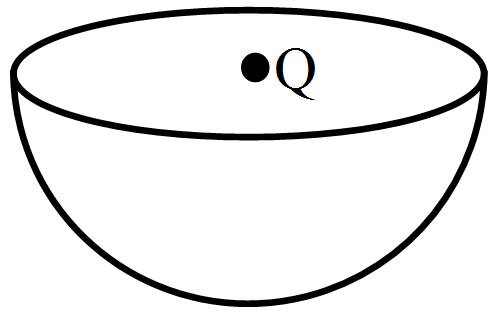
A charge Q is placed at the centre of an imaginary hemispherical surface. Using symmetry arguments and the Gauss's law, find the flux of the electric field due to this charge through the surface of the hemisphere (figure).

Why is exposure to X-rays injurious to health but not exposure to visible light, when both are electromagnetic waves?
A platinum resistance thermometer reads 0°when its resistance is $80\Omega$ and 100° when its resistance is $90\Omega$. Find the temperature at the platinum scale at which the resistance is $86\Omega$.
Find the moment of inertia of a pair of spheres, each having a mass m and radius r, kept in contact about the tangent passing through the point of contact.
Let $\vec{\text{a}}=4\vec{\text{i}}+3\vec{\text{j}}$ and $\vec{\text{b}}=3\vec{\text{i}}+4\vec{\text{j}}.$ (a) Find the magnitudes of:

  1. $\vec{\text{a}}$

  2. $\vec{\text{b}}$

  3. $\vec{\text{a}}+\vec{\text{b}}$

  4. $\vec{\text{a}}-\vec{\text{b}}$

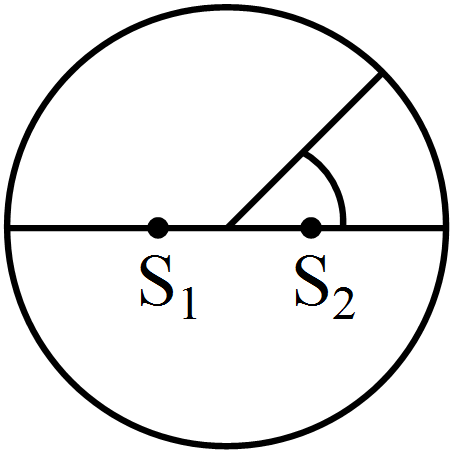
Figure, shows two coherent sources S1 and S2 which emit sound of wavelength $\lambda$ in phase. The separation between the sources is $3\lambda.$ A circular wire of large radius is placed in such a way that S1S2 lies in its plane and the middle point of S1S2 is at the centre of the wire. Find the angular positions $\theta$ on the wire for which constructive interference takes place.

What facts are obtained by the scattering with angle more than $90^{\circ}$.