Question
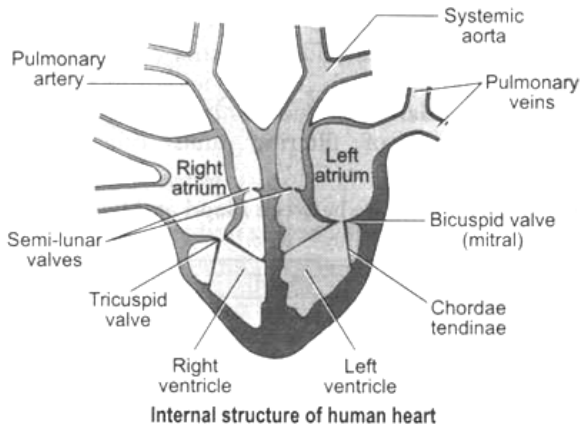
Describe internal structure of a human heart.

Answer

The heart lies in the thoracic cavity between the lungs. The heart is also protected within the thorax by the double-layered pericardium, which is fluid filled to prevent friction inside the chest cavity.
The human heart consists of 4 chambers- 2 upper chambers called atria and 2 lower chambers called ventricles.
The two auricles or atria are thin-walled and are separated from each other by a thin inter-atrial septum.
The right atrium receives venous blood (deoxygenated blood having very little O₂) from the entire body through a superior and inferior vena cava. The left smaller atrium receives oxygenated blood from the lungs through pulmonary veins.
The two auricles (atria) are separated from the ventricles by the auriculo-ventricular septum guarded by membranous valves. The valve separating right atrium from right ventricle is called right atrio-ventricular valve or tricuspid valve made up of three flaps.
The valve separating left atrium from left ventricle is called left atrio-ventricular valve or mitral valve, formed of two flaps. These valves are attached with fine cords with the papillary muscles of the ventricular wall. These valves only allow blood flow from auricles into ventricles and not in opposite direction.
Image
Both the ventricles are separated from each other by a thick inter-ventricular septum. The wall of left ventricle is much thicker than that of right ventricle. The left ventricle pushes blood into aorta which supplies blood to entire body. The opening of aorta is also guarded by a valve formed of 3 semilunar flaps. The right ventricle pumps venous blood into lungs by a pulmonary aorta. Its opening is also guarded by a valve, having 3 semilunar flaps. These valves allow the flow of blood from ventricles into the aorta and not back. Heart is formed of cardiac muscle fibres, which rhythmically contract the heart without feeling fatigue.

Need a full question paper?

Generate a complete, print-ready paper with questions like this in minutes — across 16+ boards, with answer keys.

Start Generating Free

Similar questions

A man having blood group ' $O ^{\prime}\left(\left(^{\circ} 0^{\circ}\right)\right.$ marries a woman with blood group ' $B ^{\prime}\left(\left(^B 1^{\circ}\right)\right.$. what will be the blood group of their children?
What happens when an acid reacts with a base? Explain by taking the example of hydrochloric acid and sodium hydroxide. Give equation of the chemical reaction which takes place. What is the special name of such a reaction?
If the image formed by a lens for all positions of an object placed in front of it is always erect and diminished, what is the nature of this lens? Draw a ray diagram to justify your answer. If the numerical value of the power of this lens is 10 D, what is its focal length in the Cartesian system?
How far should an object be placed from the pole of a converging mirror of focal length 20cm to form a real image of the size exactly$\frac{1}{4}$ th the size of the object?
An object of 5.0cm size is placed at a distance of 20.0cm from a converging mirror of focal length 15.0cm. At what distance from the mirror should a screen be placed to get the sharp image? Also calculate the size of the image.
A person got his eyes tested. The optician prescription for the spectacle read. Left eye = -3D are right eye = -3.5D Discuss the defects of which person is suffering.
A student sitting at the back of the classroom cannot read clearly the letters written on the blackboard. What advice will a doctor give to her? Draw ray diagram for the correction of this defect.
How much energy is consumed when a current of 5 amperes flows through the filament (or element) of a heater having resistance of 100 ohms for two hours? Express it in joules.
An electric lamp of 100 Ω, a toaster of resistance 50 Ω, and a water filter of resistance 500 Ω are connected in parallel to a 220 V source. What is the resistance of an electric iron connected to the same source that takes as much current as all three appliances, and what is the current through it?
What is feedback mechanism of hormonic regulation. Take the example of insulin to explain this phenomenon.