Questions

[3 Mark Questions]

🎯

Test yourself on this topic

8 questions · timed · auto-graded

Question 13 Marks
a. What is the meaning of electric power of an electrical device? Write its SI unit.
b. An electric kettle of 2 kW is used for 2h. Calculate the energy consumed in (i) kilowatt hour and (ii) joules.
Answer
a. Electric power of an electrical device is defined as its rate of consumption of electrical energy.
i.e., $P =\frac{E}{t}$
The SI unit of electrical power is watt (W)
b. We know,
work $=\frac{\text { energy }}{\text { time }}$
$\Rightarrow$ energy $=$ work $\times$ time
$\Rightarrow$ energy $=2 kW \times 2 h=4 kWh$
Now,
1 kWh = 3600000 joules
$\Rightarrow 4 kWh =11,400,000$ joules
∴ Energy consumed = 4 kWh or 11,400,000 joules.
View full question & answer
Question 23 Marks
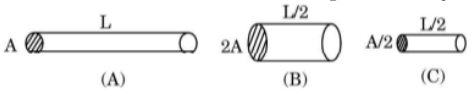
$i.$ In the following figure, three cylindrical conductors $A, B$ and $C$ are shown along with their lengths and areas of cross$-$section. If these three conductors are made of the same material and $R_A, R_B$ and $R_C$ be their respective resistances$,$ then find $(a) \frac{R_A}{R_B},$ and $(b) \frac{R_A}{R_C}$.

Image
$ii.$ If the conductor $A$ is made of copper and the conductor $C$ is made of constantan $($alloy of copper and nickel$),$ then which one of the two will have more electrical resistance and why?
Answer
$i.$ Since$,$ all three conductor are made up of same material therefore their resistivity will be same
$R _{ A }=\frac{\rho L}{A}$
$R _{ B }=\frac{\rho\left(\frac{L}{2}\right)}{\frac{A}{2}}$
$R _{ C }=\frac{\rho\left(\frac{L}{2}\right)}{\frac{A}{2}}$
$a. \frac{R_A}{R_B}=\frac{\frac{\rho L}{A}}{\frac{\rho\left(\frac{L}{2}\right)}{2 A}}$
$=\frac{\rho L(2 A)}{\rho L(A)}$
$=\frac{4}{1}$
$\frac{R_A}{R_B}=4$
$b. \frac{R_n}{R_c}=\frac{\frac{\rho L}{A}}{\frac{\rho\left(\frac{L}{2}\right)}{\frac{A}{2}}}$
$\frac{\rho L \times 2 \times A}{A \times \rho L \times 2}$
$\frac{R_A}{R_C}=1$
$ii.$ Conductor $'\ C\ '$ has more electrical resistance as its resistivity is more than conductor $'\ A\ '.$
View full question & answer
Question 33 Marks
i. Name the spherical mirror used as:
a. shaving mirror
b. Rear view mirror in vehicles
c. Reflection in search-light.
ii. Write any three difference between a real and a virtual image.
Answer
i. a) Shaving mirror- Concave mirror
b) Rear view mirror - Convex mirror
c) Reflection in search-lights - Concave mirror.
ii. The three differences are:
a) Real image can be obtained on screen but a virtual image cannot be obtained.
b) Reflected/Refracted rays actually meet where the real image is formed while for virtual they only appear to meet.
c) A Real image is always inverted while the virtual image is always erect.


View full question & answer
Question 43 Marks
Give the respective scientific terms used for studying
 i. The mechanism by which variations are created and inherited.
ii. the development of new types of organisms from the existing ones.
Answer
i. Genetics is the study of mechanism by which variations are created and inherited. These variations are far more in sexual reproduction due to crossing over in meiosis and also new diploid recombination.
ii. Evolution is used for studying the development of new species of organisms from the existing ones through accumalation of
variation.
View full question & answer
Question 53 Marks
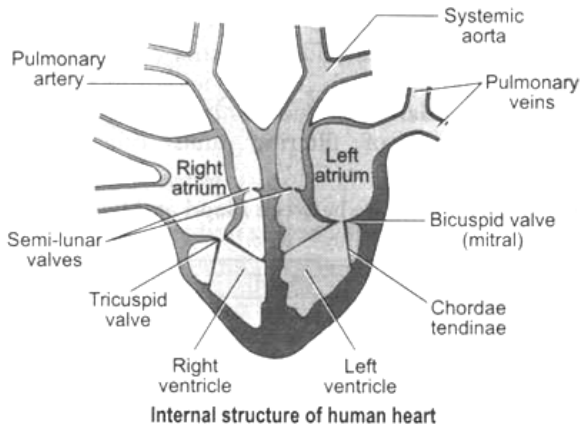
Describe internal structure of a human heart.
Answer
The heart lies in the thoracic cavity between the lungs. The heart is also protected within the thorax by the double-layered pericardium, which is fluid filled to prevent friction inside the chest cavity.
The human heart consists of 4 chambers- 2 upper chambers called atria and 2 lower chambers called ventricles.
The two auricles or atria are thin-walled and are separated from each other by a thin inter-atrial septum.
The right atrium receives venous blood (deoxygenated blood having very little O₂) from the entire body through a superior and inferior vena cava. The left smaller atrium receives oxygenated blood from the lungs through pulmonary veins.
The two auricles (atria) are separated from the ventricles by the auriculo-ventricular septum guarded by membranous valves. The valve separating right atrium from right ventricle is called right atrio-ventricular valve or tricuspid valve made up of three flaps.
The valve separating left atrium from left ventricle is called left atrio-ventricular valve or mitral valve, formed of two flaps. These valves are attached with fine cords with the papillary muscles of the ventricular wall. These valves only allow blood flow from auricles into ventricles and not in opposite direction.

Image
Both the ventricles are separated from each other by a thick inter-ventricular septum. The wall of left ventricle is much thicker than that of right ventricle. The left ventricle pushes blood into aorta which supplies blood to entire body. The opening of aorta is also guarded by a valve formed of 3 semilunar flaps. The right ventricle pumps venous blood into lungs by a pulmonary aorta. Its opening is also guarded by a valve, having 3 semilunar flaps. These valves allow the flow of blood from ventricles into the aorta and not back. Heart is formed of cardiac muscle fibres, which rhythmically contract the heart without feeling fatigue.

View full question & answer
Question 63 Marks
$i$. How do you classify elements into metals and non $-$ metals on the basis of their electronic configuration ? Choose metal and non $-$ metal out of the following : ${ }_{11}^{23} A,{ }_9^{19} B,{ }_{12}^{24} C,{ }_{15}^{31} D,{ }_{17}^{35} E$
$ii$. What type of bond will be formed if
$a.\ 'A\ '$ combines with $'B\ '$ ?
$b.\ 'A\ ' $ combines with $'E\ '$ ?
$c.\ 'C\ ' $ combines with $'E\ '$ ?
$d.\ 'D\ '$  combines with $'E\ '$ ?
Answer
$i$. Elements which contain $1$ to $3$ electrons in their outermost shell are metals.
Elements containing $4$ to $7$ electrons in their valence shell are non $-$ metals.
Electronic configurations:
${ }_{11}^{23} N a(Z=11)=2,8,1$
${ }_9^{19} B(Z=9)=2,7$
${ }_2^{24} C(Z=12)=2,8,2$
${ }_{31}^{21} D(Z=15)=2,8,5$
${ }_{35}^{15} E(Z=17)=2,8,7$
Hence $A$ and $C$ are metals whereas, $B, D$ and $E$ are non $-$ metals.
$ii.$ Type of bonds
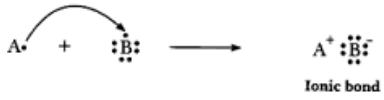
$a.\ 'A\ '$ is metal and $'B\ '$ is non $-$ metal, so the bond formed will be ionic.
$A=2, 8,1 B = 2, 7$
Image
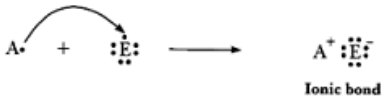
$b.\ 'A\ '$ is metal and $'E\ '$ is non $-$ metal, so the bond formed is ionic.
$A=2, 8, 1 B=2, 7$​​​​​​​
Image
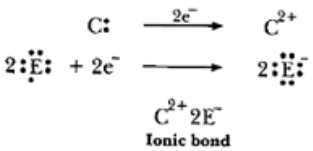
$c.\ 'C\ ' $ is metal and $'E\ '$ is non $-$ metal, so the bond formed is ionic.
$C=2, 8, 2 E= 2, 8, 7$​​​​​​​
Image
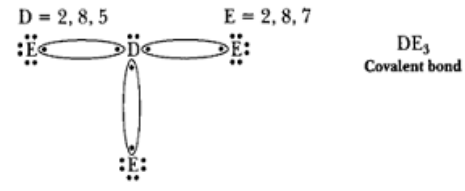
$d.\ 'D\ '$ is a non $-$ metal and $'E\ '$ is also a non $-$ metal, so the bond formed will be covalent.
$D= 2,8,5    E= 2,8,7$
Image
View full question & answer
Question 73 Marks
How is copper obtained from its ore $(Cu_2S)$? Write only the chemical equations. How is copper thus obtained refined? Name and explain the process alongwith a labelled diagram.
Answer
Copper is obtained from its ore Copper glance $(Cu_2S)$ in two steps$:$
$2 Cu _2 S( s )+3 O _2(g) \xrightarrow{\text { Heat }} 2 Cu _2 O ( s )+2 SO _2(g)$
$2 Cu _2 O ( s )+ Cu _2 S( s ) \xrightarrow{\text { Heat }} 6 Cu ( s )+ SO _2(g)$
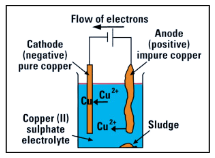
The Copper thus obtained is refined by the process called "Electrolytic Refining". In this, the impure copper is made anode by connecting to the positive terminal of the battery and a thin plate of pure copper is made cathode by connecting to the negative terminal of the battery. The copper sulphate $($acidified$)$ solution is taken in the tank which acts as an electrolyte. When an electric current is passed through the solution, the pure copper from the anode passes into the solution and an equivalent amount of $Cu^+$ ions from the solution are deposited on the cathode as pure copper. Impure copper usually contains the impurities $\text{(Fe, Ag, Au)}$ which collects below the anode as "Anode mud".
At cathode $: Cu ^{2+}( aq )+2 e ^{-} \rightarrow Cu ( s )$
At anode $: Cu ( s ) \rightarrow Cu ^{2+}( aq )+2 e ^{-}$
The diagram shown below is of electrolytic refining of copper

Image
View full question & answer
Question 83 Marks
The atomic number of an element is $20.$ Write its electronic configuration. State whether this element is a metal or a non$-$metal. What is its valency? Write the name and formula of the compound which this element forms with chlorine.
Answer
The element with an atomic number of $20$ is calcium $($Ca$)$.
The electronic configuration of calcium is $: 1s^2 \ 2s^2 \ 2p^6 \ 3s^2 \ 3p^6 \ 4s^2.$
Calcium is a metal because it is located in Group $2\  ($or Group $\text{IIA})$ of the periodic table$,$ which consists of metals known as alkaline earth metals.
The valency of calcium is $+2.$
The compound that calcium forms with chlorine is calcium chloride. The chemical formula for calcium chloride is $CaCl_2.$
View full question & answer
[3 Mark Questions] - Science STD 10 Questions - Vidyadip