Question
Describe sex-determination in birds with example.

Answer

Sex chromosomes in birds are determined as Z and W. The male is homomorphic (ZZ) and the female is heteromorphic (ZW). The W-chromosome carries female sex-determining genes, and the duplication of Z-chromosomes indicates the male sex.

Need a full question paper?

Generate a complete, print-ready paper with questions like this in minutes — across 16+ boards, with answer keys.
Start Generating Free

Similar questions

  1. Explain sex determination in humans.
  2. How do human males with 'XXY' abnormality suffer?
Mention the function of mitochondria in sperm.
Bio-diversification of life started to occur almost 3 billion years ago. Since then new species have been evolving and then disappearing en masse from earth.
a. How many episodes of mass extinctions of species have already taken place and which one is in progress in the current era?
b. How is current episode in progress different from the previous episodes and why? Explain.
Discuss the factors which affect the rate of decomposition.
Given below are the events that are observed in an artificial hybridisation programme. Selection of parents → Emasculation → Bagging → Collection of pollen from other male plant → Dusting of pollen on stigma — Rebagging.
While, planning for crop improvement involving dioecious plants, which of the above mentioned steps would not be relevant?
How do antibiotic-resistance genes function as selectable markers? Explain with the help of E.coli cloning vector pBR 322.
  1. Differentiate between analogous and homologous structures.
  2. Select and write analogous structures from the list given below:
  1. Wings of butterfly and birds.
  2. Vertebrate hearts.
  3. Tendrils of bougainvillea and cucurbita.
  4. Tubers of sweet potato and potato.
Explain the concept of co-extinction by taking two examples.
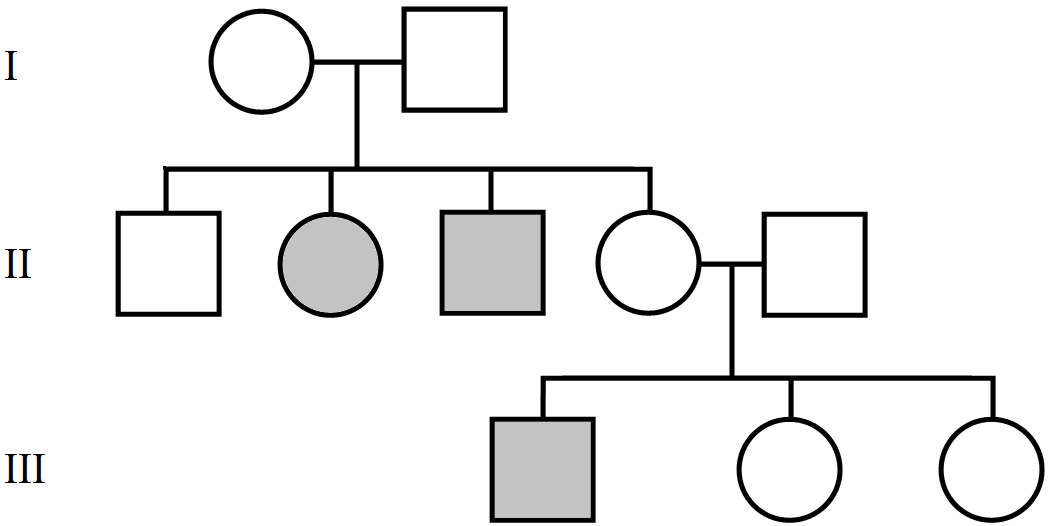
Study the given pedigree chart and answer the questions that follow.

  1. Is the trait recessive or dominant?
  2. Is the trait sex linked or autosomal?
  3. Give the genotypes of the parents in generation I and of their third and fourth child in generation II.
Given below are the events that are observed in artificial hybridisation programme. Arrange them in the correct sequential order in which they are followed in the hybridisation programme.
(a) Re-bagging; (b) Selection of parents; (c) Bagging; (d) Dusting the pollen on stigma; (e) Emasculation; (f) Collection of pollen from male parent.