Question
  1. Differentiate between analogous and homologous structures.
  2. Select and write analogous structures from the list given below:
  1. Wings of butterfly and birds.
  2. Vertebrate hearts.
  3. Tendrils of bougainvillea and cucurbita.
  4. Tubers of sweet potato and potato.

Answer

  1.  
 
Analogous Organs
Homologous Organs
i.
Those organs which are structurally dissimilar but functionally similar are called analogous organs.
Those organs, which are structurally similar but functional dissimilar are called homologous organs.
ii.
They lead to convergent evolution.
They lead to divergent evolution.
iii.
Eg. Wings of birds and insects.
Eg. Forelimbs of terrestrial vertebrates such as frog, lizard, bird, bat, horse, man.
  1. Following are the analogous structure from the given list:
  1. Wings of butterfly and birds.
  2. Tubers of sweet potato and potato.

Need a full question paper?

Generate a complete, print-ready paper with questions like this in minutes — across 16+ boards, with answer keys.

Start Generating Free

Similar questions

Why do all the fresh water organisms have contractile vacuoles whereas majority of marine organisms lack them?
Describe the experiment of S.L. Miller on the origin of life. Write the conclusion drawn at the end of the experiment.
Name the type of curve that characterises most populations growing in favourable environment. Define carrying capacity.
List the disadvantages of insulin obtained from the pancreas of slaughtered cow and pigs.
The enzyme DNA polymerase in E.coli is a DNA dependent polymerase and also has the ability to proof-read the DNA strand being synthesised. Explain. Discuss the dual polymerase.
Organisms at a higher trophic level have less energy available. Comment.
Discuss in your own words why the government is popularising the slogan-'Hum Do Humare Do' in both rural and urban areas of the country.
In a maternity clinic, for some reasons the authorities are not able to hand over the two new-borns to their respective real parents. Name and describe the technique that you would suggest to sort out the matter.
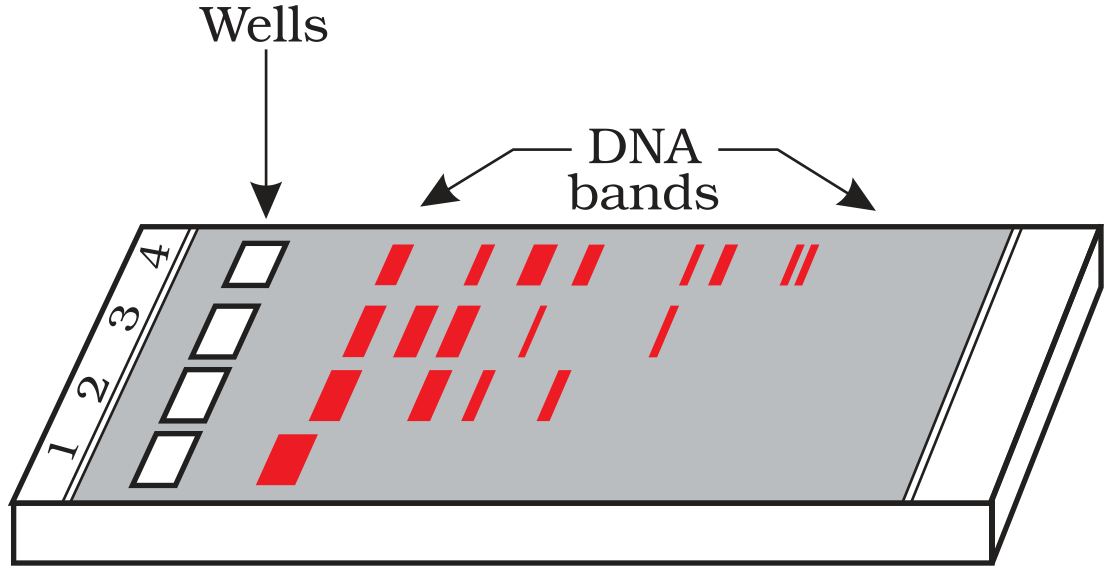
Rajesh was doing gel electrophoresis to purify DNA fragments. Given below is the sketch of the observations of the experiment performed by him.

  1. At which end he would have loaded the samples and where?
  2. Analyse the reason for different positions taken up by the DNA bands.
  3. Elaborate the step he would have followed to visualise DNA bands.
A student on a school trip started sneezing and wheezing soon after reaching the hill station for no explained reasons. But, on return to the plains the symptoms disappeared. What is such a response called? How does the body produce it?