Question
Describe stress-strain relationship for a loaded steel wire and hence explain the terms : Elastic limit, yield point, tensile strength.
Answer

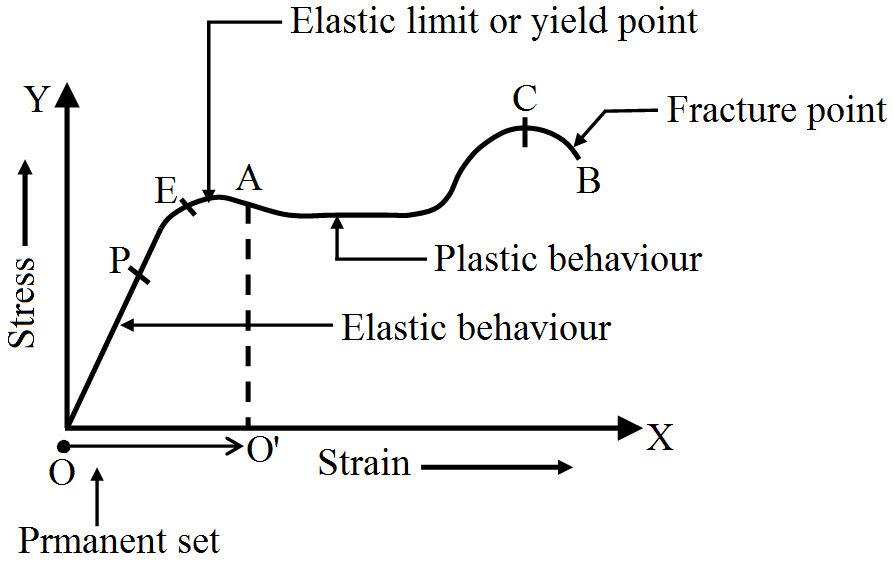
In figure. Elastic region : O to E. Plastic region : E to B. Upto the point E, the steel wire will regain its status immediately on the removal of stress and the ratio of $\frac{\text{Stress}}{\text{Strain}}$ will be a constant.
  1. Strain increases in proportion to the load upto P. But beyond P, it increases by an increasingly greater amount for a given increase in the load. Beyond the elastic limit E, it does not retrace the curve backward. The wire is unloaded but returns to 'O' along the dotted line 'AO'. Point 'O' corresponding to zero load which implies a permanent strain in wire.
  2. From C to B, strain increases even if the wire is being unloaded and at B it fractures. Stress upto that corresponding to C can be applied without causing fracture.

Need a full question paper?

Generate a complete, print-ready paper with questions like this in minutes — across 16+ boards, with answer keys.
Start Generating Free

Similar questions

The motion of a particle executing simple harmonic motion is described by the displacement function,$\text{x(t)}=\text{A}\cos(\omega\text{t}+\phi).$
If the initial (t = 0) position of the particle is 1cm and its initial velocity is $\omega\text{ cm/s,}$ what are its amplitude and initial phase angle? The angular frequency of the particle is $\pi\text{s}^{-1}.$ If instead of the cosine function, we choose the sine function to describe the SHM: $\text{x}=\text{B}\sin(\omega\text{t}+\alpha),$ what are the amplitude and initial phase of the particle with the above initial conditions.
The time constant of an LR circuit is 40ms. The circuit is connected at t = 10 and the steady-state current is found to be 2.0A. Find the current at:
  1. t = 10ms
  2. t = 20ms
  3. t = 100ms
  4. t = 1s.
Mercury has an angle of contact equal to $140^{\circ}$ with soda lime glass. A narrow tube of radius $1.00$ mm made of this glass is dipped in a trough containing mercury. By what amount does the mercury dip down in the tube relative to the liquid surface outside? Surface tension of mercury at the temperature of the experiment is $0.465 \mathrm{~N} \mathrm{~m}^{-1}$. Density of mercury $=13.6 \times 10^3 \mathrm{~kg} \mathrm{~m}^{-3}$.
A small block of mass $200g$ is kept at the top of a frictionless incline which is $10m$ long and $3.2m$ high. How much work was required.
  1. To lift the block from the ground and put it at the top.
  2. To slide the block up the incline? What will be the speed of the block when it reaches the ground.
  3. It falls off the incline and drops vertically on the ground.
  4. It slides down the incline? Take $g = 10m/s^2$.
Consider the situation shown in figure. The system is released from rest and the block of mass $1.0kg$ is found to have a speed $0.3m/s$ after it has descended through a distance of $1m$. Find the coefficient of kinetic friction between the block and the table.
Quite often, connecting wires carrying currents in opposite directions are twisted together in using electrical appliances. Explain how it avoids unwanted magnetic fields.
A metal sphere cools from $62^{\circ}\text C $ to $50^{\circ}\text C $ in first 10 minutes and in next 10 minutes it cools up to $42^{\circ}\text C.$ Calculate its temperature next 10 minutes according to Newton law of cooling.
A ball of mass m moving at a speed v makes a head-on collision with an identical ball at rest. The kinetic energy of the balls after the collision is three fourths of the original. Find the coefficient of restitution.
When a $300g$ mass is hung from a vertical spring, it stretches from equilibrium by $10cm$. What work is required to stretch it by next 5cm?
On the basis of the first law of thermodynamics establish Mayer's relation $C_P-C_V=R$.