Question
A metal sphere cools from $62^{\circ}\text C $ to $50^{\circ}\text C $ in first 10 minutes and in next 10 minutes it cools up to $42^{\circ}\text C.$ Calculate its temperature next 10 minutes according to Newton law of cooling.

Answer

According to Newton law of cooling,
$\frac{T_1-T_2}{t}=K\left[\frac{T_1+T_2}{2}-T_0\right]$
According to question,
$\begin{array}{l}T_1=62^{\circ} C, T_2=50^{\circ} C, t=10 \text { minute } \\\therefore \frac{62-50}{10}=K\left[\frac{62+50}{2}-T_0\right] \\\Rightarrow\left[\frac{12}{10}\right]=K\left[56-T_0\right]\ldots\ldots (1)\end{array}$
In next 10 minutes, $T_1=50^{\circ} C , T_2=42^{\circ} C$
$\begin{array}{l}\therefore \frac{50-42}{10}=K\left[\frac{50+42}{2}-T_0\right] \\\Rightarrow \frac{8}{10}=K\left[46-T_0\right]\ldots\ldots (2)\end{array}$
Let in next $t=10$ minutes if temperature bacome $T$, then
$\frac{42-T}{10}=K\left[\frac{42+T}{2}-T_0\right]\ldots\ldots (3)$
Dividing equation (1) by (2)
$\begin{array}{ll}& \frac{12}{10} \times \frac{10}{8}=\frac{K\left(56-T_0\right)}{K\left(46 - T_0\right)}=\left(\frac{56-T_0}{46-T_0}\right) \\& \frac{3}{2}=\frac{56-T_0}{46-T_0} \\\Rightarrow & 3\left(46-T_0\right)=2\left(56-T_0\right) \\\Rightarrow & 138-3 T_0=112-2 T_0 \\\Rightarrow \quad & 138-112=-2 T_0+3 T_0 \\\therefore \quad & T_0=26\end{array}$
Putting the value of $T_0$ in eq. (1)
$\begin{array}{l}\frac{12}{10}=K(56-26)=30 K \\\therefore K=\frac{12}{10 \times 30}=\frac{12}{300}=\frac{1}{25} \\K=\frac{1}{25}\end{array}$
Putting the values of $T _6$ and K in eq. (3)
$\Rightarrow \quad \frac{42-T}{10}=K\left[\frac{42+T}{2}-T_0\right]$
$\begin{array}{l}\frac{42- T }{10}=\frac{1}{25}\left[\frac{42+ T }{2}-26\right] \\ \frac{42- T }{10}=\frac{1}{25} \times \frac{ T -10}{2}=\frac{ T -10}{50} \\ \Rightarrow \frac{42- T }{10}=\frac{ T -10}{50}\end{array}$
$\Rightarrow \quad \frac{42- T }{1}=\frac{ T -10}{5}$
$\Rightarrow \quad 210-5 T= T -10$
$\begin{array}{ll}\Rightarrow & 220=6 T \\ \Rightarrow & T =\frac{220}{6}=36.36^{\circ} C \end{array}$

Need a full question paper?

Generate a complete, print-ready paper with questions like this in minutes — across 16+ boards, with answer keys.
Start Generating Free

Similar questions

A car starting from rest, accelerates uniformly with $5m/s^2$ for sometime and then decelerates to come to rest with $3m/s^2$. Find the maximum velocity attained during the motion and the distance covered in a total time of 6 seconds of the journey.
Find the magnitude of the electric field at the point P in the configuration shown in figure for d >> a. Take 2qa = p.
A point particle of mass $0.1kg$ is executing S.H.M. of amplitude of $0.1m$. When the particle passes through the mean position, its kinetic energy is $8 \times 10^{-3}$ joule. Obtain the equation of motion of this particle if the initial phase of oscillation is $45^\circ$
Explain the difference between static friction, kinetic friction and rolling friction.
An air bubble of radius $2.0mm$ is formed at the bottom of a $3.3m$ deep river. Calculate the radius of the bubble as it comes to the surface. Atmospheric pressure = $1.0 \times 10^5$ Pa and density of water = $1000kg/m^{-3}$.
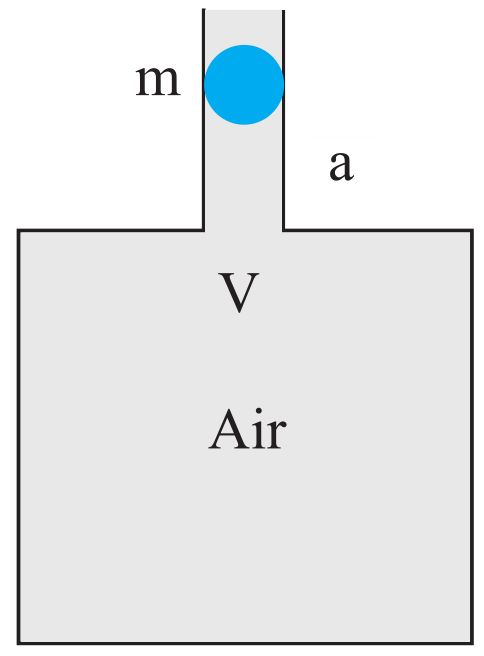
An air chamber of volume V has a neck area of cross section a into which a ball of mass m just fits and can move up and down without any friction (Fig.). Show that when the ball is pressed down a little and released , it executes SHM. Obtain an expression for the time period of oscillations assuming pressure-volume variations of air to be isothermal [see Fig.].
A composite slab is prepared by pasting two plates of thicknesses $L_1$ and $L_2$ and thermal conductivities $K_1$ and $K_2$. The slabs have equal cross-sectional area. Find the equivalent conductivity of the composite slab.
Two molecules of a gas have speeds of $9 \times 10^{16} ms^{-1}$ and $1 \times 10^6ms^{-1}$ respectively. What is the root mean square speed of these molecules?
Find the acceleration of the blocks A and B in the three situations shown in figure.


A copper wire of radius 0.1mm and resistance $1\text{k}\Omega$ is connected across a power supply of 20V.
(a) How many electrons are transferred per second between the supply and the wire at one end? (b) Write down the current density in the wire.