Question
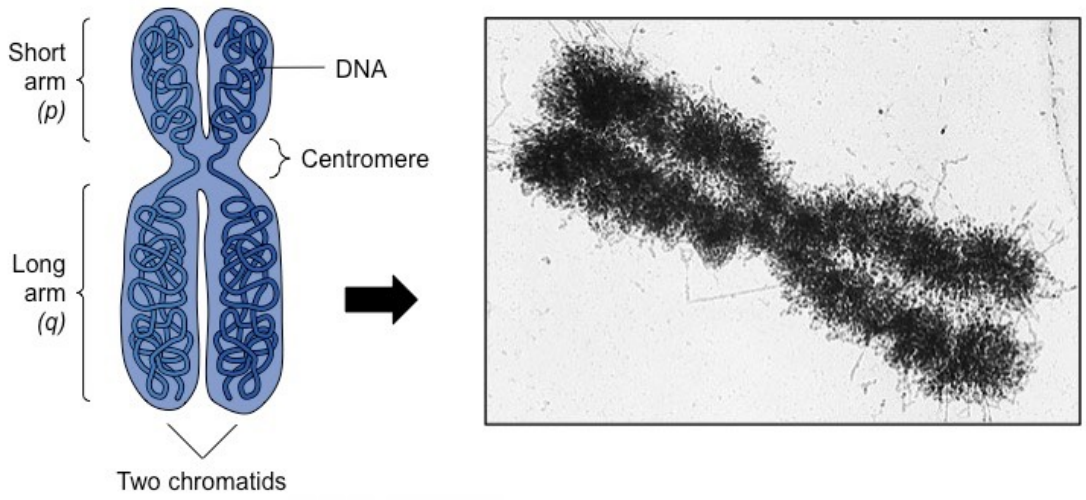
Describe structure of a chromosome.

Need a full question paper?

Generate a complete, print-ready paper with questions like this in minutes — across 16+ boards, with answer keys.

Start Generating Free

Similar questions

What is feed? What are different type of feed? How is it differ with respect to age and functions?
Give two examples each of longitudinal waves and transverse waves.
Obtain a relation for the distance travelled by an object moving with a uniform acceleration in the interval between 4th and 5th seconds.
How will you separate the components of a mixture containing two miscible liquids? Give experimental details.
Which contains more molecules, 10g of sulphur dioxide (SO2) or 10g of oxygen (O2)?
(Atomic masses: S = 32u; O = 16u)

Write down the characters of bee variety suitable for bee keeping.
Which contains more molecules, 10g of sulphur dioxide (SO2) or 10g of oxygen (O2)?
(Atomic masses: S = 32u; O = 16u)
How will you separate common salt, sand and iron filings from their mixture?
Why are we able to sip hot tea or milk faster from a saucer rather than from a cup?
A, B and C are all liquids. Liquid A has a comparatively low boiling point. On heating, liquid a vaporizes completely without leaving behind any residue. Liquid A is being used increasingly as a fuel in motor vehicles either alone or by mixing with petrol. Liquid B has a very high boiling point. It also vaporizes completely on heating, without leaving any residue. Liquid B is a conductor of electricity and used in making thermometers. Liquid c has a moderate boiling point. On heating, liquid C vaporises leaving behind a white solid D which is used in cooking vegetables. The condensation of vapours from C give a liquid E which turns anhydrous CuSO4 to blue.
  1. Which liquid could be an element? Name this element.
  2. Which liquid could be a mixture? Name this mixture.
  3. Which liquid could be a compound? Name this compound.
  4. What could the solid D be?
  5. What do you think is liquid E?