Question
Describe the activity that shows that a current-carrying conductor experiences a force perpendicular to its length and the external magnetic field. How does Fleming’s left-hand rule help us to find the direction of the force acting on the current carrying conductor?

Answer

The activity is as follows:

Take a small aluminium rod AB. Using two connecting wires suspend it horizontally from a stand, as shown in figure given below.
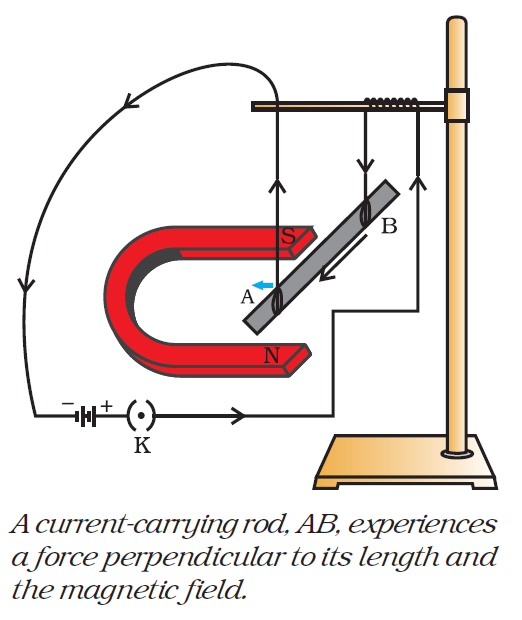
Place a strong horse-shoe magnet in such a way that the rod lies between the two poles with the magnetic field directed upwards. For this put the North Pole of the magnet vertically below and South Pole vertically above the aluminium rod.

Connect the aluminium rod in series with a battery, a key and a rheostat.

Now pass a current through the aluminium rod from end B to end A.

It is observed that the rod is displaced towards the left and rod gets displaced.

Reverse the direction of current flowing through the rod and observe the direction of its displacement. It is now towards the right.

Need a full question paper?

Generate a complete, print-ready paper with questions like this in minutes — across 16+ boards, with answer keys.

Start Generating Free

Similar questions

  1. Explain the following terms related to spherical lenses:
  1. Optical centre.
  2. Centres of curvature.
  3. Principal axis.
  4. Aperture.
  5. Principal focus.
  6. Focal length.
  1. A converging lens has focal length of 12 cm. Calculate at what distance should the object be placed from the lens so that it forms an image at 48 cm on the other side of the lens.
  1. Write the function of each of the following parts of human eye:
  1. Cornea.
  2. Iris.
  3. Crystalline lens.
  4. Ciliary muscles.
  1. Why does the sun appear reddish early in the morning? Will this phenomenon be observed by an astronaut on the Moon? Give reason to justify your answer.
What is Joule’s heating effect? How can it be demonstrated experimentally? List its four applications in daily life.
The descriptions of five kinds of images are given below:
  1. Diminished and virtual.
  2. Enlarged and real.
  3. Enlarged and erect.
  4. Real and inverted.
  5. Virtual and the same size.
Which one of these describes the image formed:
  1. On the retina of the eye?
  2. By a magnifying glass?
  3. By a convex driving mirror on a car?
  4. By a plane mirror?
  5. on the screen of a slide projector?
Make a diagram to show how hypermetropia is corrected. The near point of a hypermetropic eye is 1 m. What is the power of the lens required to correct this defect? Assume that the near point of the normal eye is 25 cm.
An object 3cm high is placed at a distance of 8cm from a concave mirror which produces a virtual image 4.5cm high:
  1. What is the focal length of the mirror?
  2. What is the position of image?
  3. Draw a ray-diagram to show the formation of image.
Define the term dispersion of white light. Name the colour of light which bends (i) the most, (ii) the least, while passing through a glass prism Draw a ray diagram to Justify your answer.
An electric heater which is connected to a 220V supply line has two resistance coils A and B of $24 Ω$ resistance each. These coils can be used separately (one at a time), in series or in parallel. Calculate the current drawn when:
  1. Only one coil A is used.
  2. Coils A and B are used in series.
  3. Coils A and B are used in parallel.
  1. What is a magnetic field? How can the direction of magnetic field lines at a place be determined?
  2. State the rule for the direction of the magnetic field produced around a current carrying conductor. Draw a sketch of the pattern of field lines due to a current flowing through a straight conductor.
i. What is meant by resistance of a conductor? Define its SI unit.
ii. List two factors on which the resistance of a rectangular conductor depends.
iii. How will the resistance of a wire be affected if its
I. length is doubled, and
II. radius is also doubled?
Give justification for your answer.