Question
Describe the advantages of sub-dividing the Journal.

Answer

The advantages of sub division of Journal are given below.
  1. Division of work: The lack of sub-division of Journal may lead to chaos and confusions, if large numbers of transactions are to be recorded through Journal entry by more than one accountant. There will be more inflexibility and lack of accountability among the accountants. Sub-division of Journal into Subsidiary Books facilitates division of work. Sub-division enables different accountants to work on different books. This will not only avoid confusions but also enhance the sense of accountability among the accountants.
  2. Time saving: The art of recording through subsidiary book is time efficient and more effective as compared to recording through Journal entries.
  3. Prompt information: The transactions of similar nature are recorded in a particular Subsidiary Book. This acts as a ready source to access information quicker than through Journal entry.
  4. Creates Accountability: Sub-division of Journal entrusts accountants with higher degree of responsibility and accountability for maintaining subsidiary book that are assigned to them.
  5. Easy checking: In case discrepancies or errors arise, they can be easily located and rectified, as lesser number of transactions is recorded in a Subsidiary Book than in a Journal.
  6. Specialisation: The accountability, responsibility and division of work together enhance the specialisation of each accountant. This is because, routine and repetitive tasks are performed by each accountant.

Need a full question paper?

Generate a complete, print-ready paper with questions like this in minutes — across 16+ boards, with answer keys.
Start Generating Free

Similar questions

Journalise the following transactions:
  1. Bought goods from Arun for 2,00,000 at a trade discount of 15% and cash discount of 2%. Paid 80% amount immediately.
  2. Purchased foods for 20,000 from X and supplied it to Y for ₹ 26,000.
  3. Cash withdrawn from bank 5,000 for personal use and 25,000 for office use.
  4. Goods destroyed by fire: Cost Price 40,000.
  5. Provide 20% depreciation on machinery costing 50,000.
  6. Out of insurance paid this year, 3,000 is related to next year.
  7. Allow 5,000 as interest on capital and charge 1,000 as interest on drawings.
  8. Sohan who owed us 25,000 was declared insolvent and a cheque of 40 paise in a is received from him in full settlement.
  9. Paid Income Tax 10,000 by cheque.
  10. Salary paid 80,000 and Salary Outstanding 20,000.
On 1st August, 2010, Hindustan Toys Ltd. purchased a plant for ₹ 12,00,000. The firm writes off depreciation at 10% p.a. on the diminishing balance and the books are closed on 31st March each year. On 1st July, 2012, a part of this plant of which the original cost was ₹ 1,80,000 was sold for ₹ 1,00,000 and on the same date a new plant was purchased for ₹ 4,00,000. Show the Plant Account and Provision for Depreciation Account for three years ending 31st March, 2013.
What do you understand by the classification of accounts? Explain the different types of accounts.
Vishal sold goods for ₹ 7,000 to Manju on Jan 05, 2016 and drew upon her a bill of exchange payable after 2 months. Manju accepted Vishal’s draft and handed over the same to Vishal after acceptance. Vishal immediately discounted the bill with his bank @ 12% p.a. On the due date Manju met her acceptance. Journalise the above transactions in the books of Vishal and Manju.
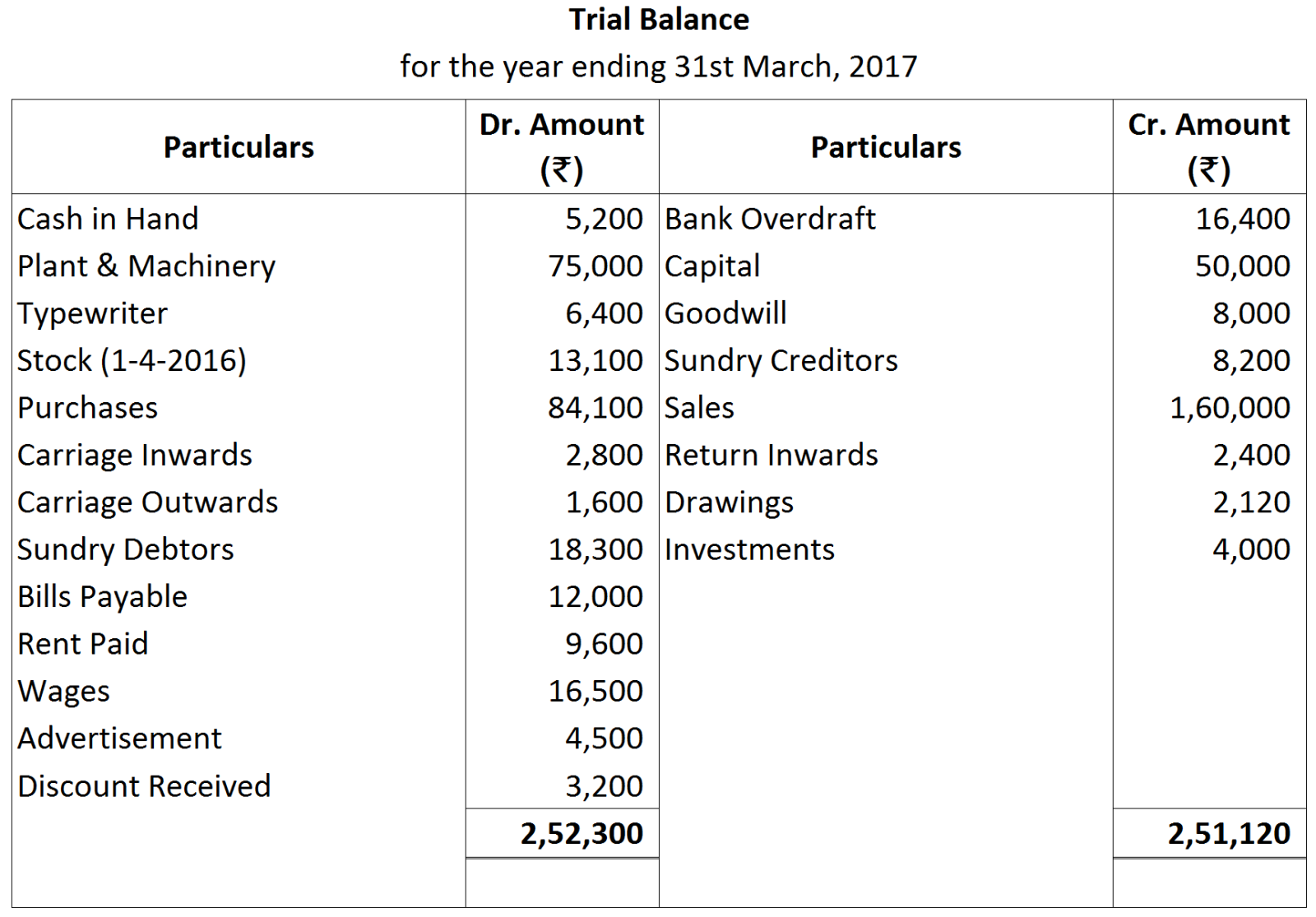
The following is the Trial Balance prepared by an inexperienced accountant. Redraft it in a correct form and give necessary notes :-
Rectify the following errors:-
  1. Goods for ₹ 5,500 were purchased from Modern Traders on credit, but no entry has yet been passed.
  2. Purchase Return for ₹ 1,500 not recorded in the books.
  3. Goods for ₹ 2,000 sold to 'Geeta Traders' on Credit were entered in the sales book as ₹ 200 only.
  4. Goods of the value of ₹ 1,800 returned by Sunil & Co. were included in stock, but no entry was passed in the books.
  5. Goods purchased for ₹ 900, entered in the purchases book as ₹ 9,000.
  6. An invoice for goods sold to X was overcast by ₹ 100.
The following balances appear in the books of Crystal Ltd, on Jan 01, 2015.
 
Machinery account on
15,00,000
Provision for depreciation account
5,50,000
On April 01, 2015 a machinery which was purchased on January 01, 2012 for ₹ 2,00,000 was sold for ₹ 75,000. A new machine was purchased on July 01, 2015 for ₹ 6,00,000. Depreciation is provided on machinery at 20% p.a. on Straight line method and books are closed on December 31 every year. Prepare the machinery account and provision for depreciation account for the year ending December 31, 2015.
The accountant of X prepared the Trial Balance at the end of the year on 31st March, 2015. But there was a difference and the accountant put the difference in a Suspense Account. Rectify the following errors found and prepare the Suspense Account:
  1. The total of the returns outward book ₹ 420 has not been posted in the ledger.
  2. A purchase of ₹ 350 from Y has been entered in the sales book. However Y's Account has been correctly entered.
  3. A sale of ₹ 390 to Z has been credited to his account ₹ 290.
  4. Old furniture sold for ₹ 5,400 had been posted as ₹ 4,500 in Sales Account.
  5. Goods taken by the proprietor ₹ 500 have not been entered in the books at all.
Pass the rectifying entries for the following:
  1. Sales of goods ₹ 6,000 to Madan were recorded as ₹ 600 in the Sales Book.
  2. Credit purchase of goods from Mohan amounting to ₹ 2,000 has been wrongly passed through the Sales Book.
  3. Return of goods worth ₹ 500 by a customer was entered in ‘Purchases Return Book’.
  4. Cheque of ₹ 400 received from Ranjan was dishonoured and debited to the Discount Account.
  5. Bill for ₹ 820 received from Ramesh for repair of machinery was entered in the Purchases Book as ₹ 720.
Journalise the following trasactions:
 
 
1.
Charge depreciation on Machinery
20,000
2.
Salary due to Office Clerks
1,00,000
3.
Received cash for Bad-Debts written off last year
5,000
4.
Purchased goods from Ashok & Co. for 50,000 at 20% Trade Discount. Half the payment was made in cash.
 
5.
Issued cheque to Ashok & Co. in full settlement
19,500
6.
Paid Life Insurance Premium by cheque
6,000
7.
Proprietor used goods for household purposes
20,000
8.
Goods given free to a hospital out of business
10,000