Question
Describe the common name system and IUPAC system of naming amines.

Answer

SELF

Need a full question paper?

Generate a complete, print-ready paper with questions like this in minutes — across 16+ boards, with answer keys.

Start Generating Free

Similar questions

Draw the structures of optical isomers of :
(i) $\left[ Cr \left( C _2 O _4\right)_3\right]^{3-}$
(ii) $\left[ PtCl _2( en )_2\right]^{2+}$
(iii) $\left[ Cr \left( NH _3\right)_2 Cl _2( en )\right]^{+}$
a. Amongst the following, the most stable complex is:
i. $\left[ Fe \left( H _2 O \right)_6\right]^{3+}$
ii. $\left[ Fe \left( NH _3\right)_6\right]^{3+}$
iii. $\left[ Fe \left( C _2 O _4\right)_3\right]^{3-}$
iv. $\left[ FeCl _6\right]^{3+}$
b. What will be the correct order for the wavelength of absorption in the visible region for the following:
$
\left[Ni\left(NO_2\right)_6\right]^{4-},\left[Ni\left(NH_3\right)_6\right]^{2+},\left[Ni\left(H_2 O\right)_6\right]^{2+}
$
Write the IUPAC names of the following coordination compounds:
a. $\left[ Pt \left( NH _3\right)_2 Cl \left( NO _2\right]\right.$
b. $K _3\left[ Cr \left( C _2 O _4\right)_3\right]$
c. $\left[ CoCl _2( en )_2\right] Cl$
d. $\left[ Co \left( NH _3\right)_5\left( CO _3\right)\right] Cl$
e. $Hg \left[ Co ( SCN )_4\right]$
Attempt any five of the following:
(a) Name the enzyme which convert surcrose into glucose and fructose.
(b) i. Name any two bases which are common to both DNA and RNA.
     ii. Which vitamin deficiency causes:
1. Bone deformities in children?
2. Pernicious anaemia?
(c) What are heterocyclic bases?
(d) Write the name of linkage joining two monosaccharides.
(e) Name the purines present in DNA.
(f) Give an example of fibrous protein.
(g) Of the two bases named below, which one is present in RNA and which one is present in DNA?
i. Thymine
ii. Uracil
  1. How are lipids classified? Give an example of each class.
  2. Explain the following terms:
  1. Mutarotation.
  2. Avitaminosis.
  1. Define the following terms:
  1. Ideal solution.
  2. Azeotrope.
  3. Osmotic pressure.
  1. A solution of glucose (C6H12O6) in water is labelled as 10% by weight. What would be the molality of solution?

(Molar mass of glucose = 180 g mol-1).
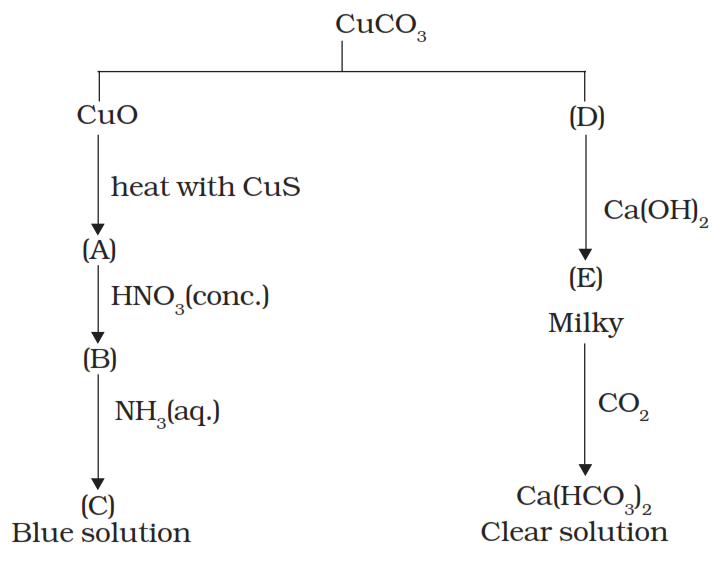
What is meant by the following terms ? Give an example in each case :
(i) Cyanohydrin, (ii) Acetal, (iii) Oxime (iv) Ketal, (v) Imine, (vi) 2,4-DNP derivatives, (vii) Schiff's Base.
What do you mean by elevation of boiling point and molal elevation constant? Give the formula or equation to determine the molar mass from elevation of boiling point.
Explain the various methods of determining the order of a reaction.