Term 'Ecosystem was at first used by an English scientist Sir AG Tansely in 1935. The word ecosystem consists of two words, where 'Eco' means environment. 'system' means interacting and interdependent complex. According to Tansley, "Ecosystem is an integrated system resulting from interaction of living and non-living factors of environment."
Ecosystem is that system of nature in which the ecological relationship between the structures and functions of biotic and abiotic components remains in dynamic equilibrium based on certain rules and the flow of energy and cycling of materials occur continuously through planned routes.
Structure of Ecosystem:
Two major components of ecosystem are:
I. Biotic Components
II. Abiotic Components
I. Biotic Components: Biotic components have the first place in the ecosystem. In ecosystem, there are communities of populations of different species of animals and plants which are interrelated in various ways. On the basis of functions of ecosystem and food relationship amongorganisms, biotic factors are divided into two groups:
(1) Autotrophs or Producers: In ecosystem, those living organisms which are able to synthesise organic food from inorganic raw material with the help of solar radiation through the process of photosynthesis, are called producers. As they are capable of producing their food, hence are called autotrophic components. Green plants, photosynthetic bacteria and chemosynthetic bacteria have the capability to synthesise their food. That is why autotrophic components are also called producers. Green plants produce food and store it. This stored food is used directly or indirectly by all other living organisms. Plants produce carbohydrates not the energy. Energy contained in solar radiation is transformed into chemical potential energy of complex organic compounds by chlorophyll of photosynthetic plants. Therefore, producers are called transducers or converter by Koromondy.
Herbs, shrubs, large sized trees in terrestrial ecosystem and microscopic, free floating phytoplanktons, algae and large sized plants in aquatic ecosystem are included in the catagory of producers.
(2) Heterotrophs or Consumers: These includes those organisms which cannot prepare their own food and directly or indirectly dependent on the producers for food. Such organisms are called hetrotrophs. As they use the food synthesized by producers, hence are called consumers. They are also divided into two categories on the basis of their size:
(a) Macroconsumers or Phagotrophs: The organisms which obtain their food from plants and other living organisms, are called macro-comsumers or phagotrophs (Phago = to eat). These consumers consume their food and digest it inside their bodies. Herbivores are plant eating animals, carnivores are flesh eating animals while omnivores are those animals who obtain food from plants and other animals.
Consumers are divided into three catagories:
(i) Primary Consumers: The organisms which are directly dependent on green plants i.e. producers are primary consumers. These are mainly herbivores e.g. insects, rabbits, cattle, deer, goat, rat etc. In terrestrial ecosystem herbivores are primary consumers.
(ii) Secondary Consumers: Consumers of this category obtain their food by eating primary consumers. These are mainly carnivores eg fox, frog, dog, wild cats, tiger etc.
(iii) Tertiary Consumers: These consumers get their food by eating primary carnivores as well as by eating herbivores and omnivores. Some consumers are top carnivores because they can eat other carnivores but cannot be eaten by any other animals. Hence, are called top consumers e.g. lion, tiger, eagle, vulture etc.
Therefore, it is clear from the above categories of consumers that food passes from producers to different trophic levels and reaches upto top consumers in a sequence or a series. Hence, this chain or sequence of food is called food chain.
(b) Micro Consumers or Decomposers: Micro-consumers are also important components of an ecosystem They break down the complex organic compounds into their simpler components. These are also called decomposers or saprotrophs or osmotrophs. These secrete digestive enzymes to digest the organic compounds and absorb some of the decomposed products. These include fungi, bacteria, saprophytes and actinomycetes.
Composers break down the complex organic compounds of dead bodies of both plants and animals, and convert into simple organic substances which are furthur reduced into inorganic compounds (minerals) by reducers.
These organisms absorb some of the decomposed products for their nutrition while release most of the inorganic compounds into the environment from where these are recessed by the producers. Thus help in material cycling.
In this way, the green plants in which food was produced and stored, were used by the consumers. After the death of consumers and producers, these micro-consumers perform the process of decomposition and thereby maintain the recycling of material by releasing the inorganic substances back into the environment. Hence, decomposers or converter play an important role in maintaining the existance of ecosystem.
II. Abiolic Component: These include the non-living physico-chemical factors of environment. In an ecosystem abiotic components are as important as biotic components are. This physical environment is divided into three categories
(a) Inorganic Substances: Such as soil, water, carbon, oxygen, nitrogen, CO₂, calcium carbonate and phosphate etc. which pass through the cyclic pathway of ecosystem that is known as biogeochemical cycles.
(b) Organic Substances: These include carbohydrates, proteins, lipids, humus, chlorophyll, nucleic acid etc. and these provide a link between living and non-living factors.
(c) Climatic Factors: Light, temperature, humidity, wind, rainfall etc. are physical factors of environment. Among all these physical factors, solar radiation in the most important energy source for the ecosystem.
All the inorganic substances present at a given time in an ecosystem are said to be its standing state whereas the total amount of organic matter produced by biotic components especially the producers is called standing crop. When it is expressed in terms of weight per unit area it is said to be biomass.
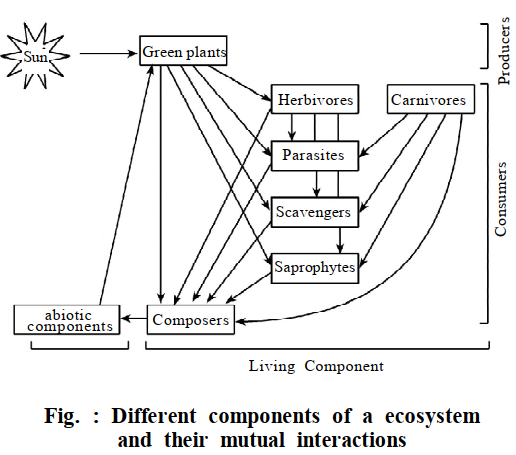
The above mentioned abiotic components ensure the nature of the ecosystem and control its functions by delimiting the living organisms in it. Plants absorb the minerals present in soil and utilize them in building the plants' parts, besides plant also synthesise the food by the energy absorbed from the sun through process of photosynthesis. Of the minerals especially the C, H, N, P etc. are indispensible for body building of organisms which remix into the soil after their death by the process of decomposition. This whole mechanism maintains the cycling of minerals in the ecosystem and thereby it is said to be mineral flow. To keep thes mineral flow running, both biotic and abiotic components remain active continuously. Hence along with the mineral flow, it is calso called biogeochemical cycle.