Question
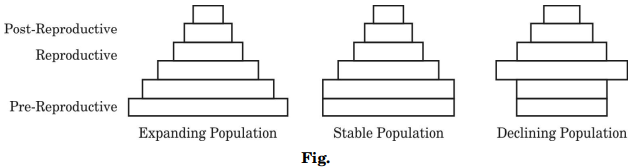
(a) Represent diagrammatically three kinds of age-pyramids for human populations.
(b) How does an age pyramid for human population at given point of time helps the policymakers in planning for future.
Answer

(a) A population at any given time is composed of individuals' ages. If the age distribution (per cent individuals of a given age or age group) is plotted for these population, the resulting structure is called an age pyramid.
Age distribution depends upon the natality and mortality and determines the population growth. With regard to age distribution, there are three kinds of population :
(1) Rapidly growing or expanding population :
It has high birth rate and low death rate, so there is more number of young individuals in the population. According to a recent survey, more than 36% of the Indian population consists of children below the age of 14 years, so the Indian population is called young population.
(2) Stationary or stable population : It has equal birth and death rates, so the population shows zero population growth.
(3) Declining population : It has higher death rate than birth rate, so the population of young members is lower than that of old members, e.g., Japan (ageing population).
Image
(b) The structure of the age pyramid helps to determine the growing status of the population and helps us to make an opinion saying if the population is groing or stablizing or declining.
On the basis of this information the government and policy makers would be able to form an informed conclusion on making policies for that particular kind of population.
The ideal population that is looked after by all the policy makers in order to build up a policy is a population pyramid in which the population of pre-reproductive population would show a stable and would not lead to either depletion of earthly resources or human resources.

Need a full question paper?

Generate a complete, print-ready paper with questions like this in minutes — across 16+ boards, with answer keys.

Start Generating Free

Similar questions

What does an Ecological Pyramid indicate? Explain the three different types of Upright Pyramids in nature with the help of an example of each.
Describe in sequence the process of spermatogenesis in humans.
What is ecosystem? Mention its biotic components. Draw a diagram of four trophic levels food chain for a grassland ecosystem.
Discuss in detail the contributions of Morgan and Sturvant in the area of genetics.
Name and describe the steps involved in the technique widely used in forensics that serves as the basis of paternity testing in case of disputes.
  1. A true breeding pea plant, homozygous for inflated green pods is crossed with another pea plant with constricted yellow pods (ffgg). What would be the phenotype and genotype of F1 and F2 generations? Give the phenotype ratio of generation.
  2. State the generalisation proposed by Mendel on the basis of the above–Mentioned cross.
Describe the process of Oogenesis with suitable diagram.
  1. Describe the characteristics a cloning vector must possess.
  2. Why DNA cannot pass through the cell membrane? Explain. How is a bacterial cell made ‘competent’ to take up recombinant DNA from the medium?
  1. What is “population” according to you as a biology student?
  2. “The size of a population for any species is not a static parameter.” Justify the statement with specific reference to fluctuations in the population density of a region in a given period of time.
Do you think that friends can influence one to take alcohol/ drugs? If yes, how may one protect himself/ herself from such an influence?