Question
Describe the components of an ecosystem.

Answer

The components of an ecosystem can be divided into two categories: biotic and abiotic.
  1. Biotic components:
  1. Producers- Green plants which can synthesize their own food.
  2. Consumers- They do not synthesize their food. They may be,
  • Primary consumer/ herbivores - consuming plants as food.
  • Secondary and tertiary consumers or carnivores- They feed on either herbivores or carnivores.
  1. Decomposers- These organisms breakdown the dead bodies or waste products of plants and animals into simpler inorganic compounds.
  1. Abiotic components:
  1. Climatic components.
  • Light
  • Temperature
  • Wind
  • Atmospheric gases
  • Rain
  • Atmospheric humidity
  1. Soil factors
  • Organic materials
  • Minerals
  • Soil, water
  • Soil air
  1. Topographic factors
  • Altitude
  • Direction and steepness slope

Need a full question paper?

Generate a complete, print-ready paper with questions like this in minutes — across 16+ boards, with answer keys.

Start Generating Free

Similar questions

  1. Write an equation for Verhaulst-Pearl Logistic Growth, where.
N - Population density at a timet E.

r - Intrinsic rate of natural increase.

K - Carrying Capacity.
  1. Draw a graph for a population whose population density has reached the carrying capacity.
  2. Why is this logistic growth model considered a more realistic one for most animal populations?
  3. Draw a growth curve where resources are not limiting to growth of a population.
Discuss the role of lymphoids in the immune response. Explain the different types of lymphoid organs giving two examples of each type in human.
Rose plants produce large, attractive bisexual flowers but they seldom produce fruit. On the other hand, Lady’s finger produces plenty of fruits. Analyse the reasons for failure of fruit formation in rose.
More than 25% of human population is suffering from hunger and malnutrition. Scientists have developed techniques where microbes are grown on industrial scale as a source of good protein which can be grown from waste water, animal manure and even sewage.
Based on the above information answer the following questions.
  1. In what ways would it be helpful to humans?
  2. What can be the response to such new ventures?
  3. What values have been manifested in the above case?
Draw a neat labelled sketch of Graafian follicle.
Answer the following questions:
How did Morgan show the deviation in inheritance pattern in Drosophila with respect to this law?
List 10 modern-day animals and using the internet resources link it to a corresponding ancient fossil. Name both.
What do you understand by Parturition? Discuss the parturition and lactation process in human.
Explain insertional inactivation.
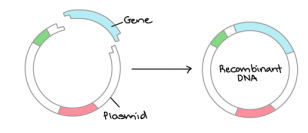
A vector is a way to take a sequence of DNA, usually, and introduce it into another place. So what vectors do is allow you to propagate the DNA you're interested in, in the organism you've chosen to propagate it in. So the simplest one is the origins of recombinant DNA technology: They made copies of RNAs, and they were able to insert these into what is known as plasmids.
Image
Unless the vector and source DNA are cut, fragments separated and joined, the desired recombinant vector molecule cannot be created.
i. How are the desirable DNA sequences cut?
ii. Explain the technique used to separate the cut fragments.
iii. How are the resultant fragments joined to the vector DNA molecule?