Question
  1. Write an equation for Verhaulst-Pearl Logistic Growth, where.
N - Population density at a timet E.

r - Intrinsic rate of natural increase.

K - Carrying Capacity.
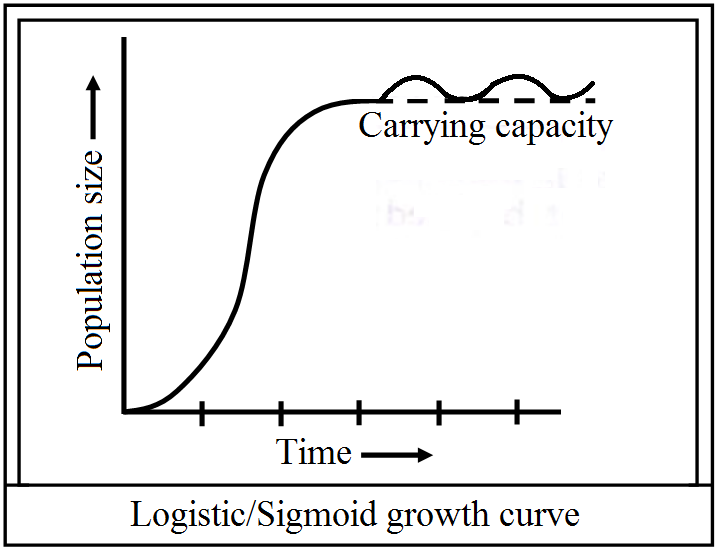
  1. Draw a graph for a population whose population density has reached the carrying capacity.
  2. Why is this logistic growth model considered a more realistic one for most animal populations?
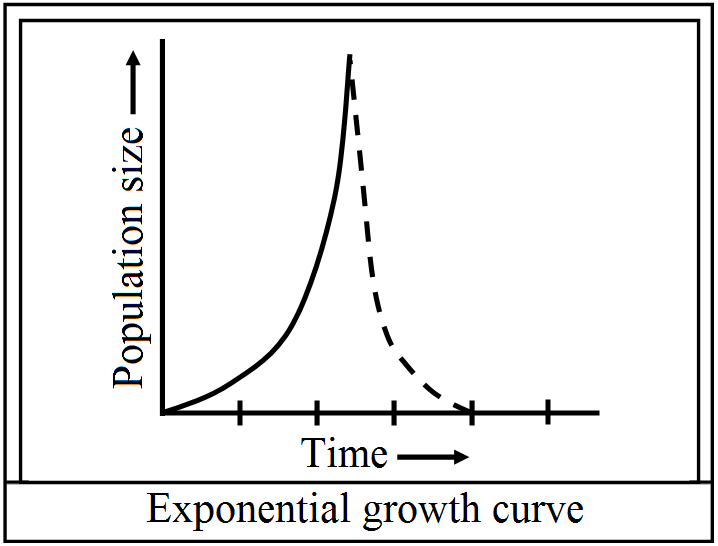
  3. Draw a growth curve where resources are not limiting to growth of a population.
Answer

  1. $\text{dN/dt}=\Big(\frac{\text{K}-\text{N}}{\text{K}}\Big)$

  2. This growth model is more realistic in nature, because, no population can sustain the exponential growth indefinitely, as there will be competition for basic needs.

Need a full question paper?

Generate a complete, print-ready paper with questions like this in minutes — across 16+ boards, with answer keys.

Start Generating Free

Similar questions

Arrange the following in the decreasing order (most important first) of their importance, for the welfare of human society. Give reasons for your answer.
  1. Represent diagrammatically three kinds of age-pyramids for human populations.
  2. How does an age pyramid for human population at given point of time helps the policymakers in planning for future?
Describe the different methods of treatment of cancer.
Do you think that friends can influence one to take alcohol/ drugs? If yes, how may one protect himself/ herself from such an influence?
Discuss the types of seeds. Also describe its structure.
Sometimes due to biotic/ abiotic factor the climax remain in a particular seral stage (pre climax) without reaching climax. Do you agree with this statement. If yes give a suitable example.
Explain the difference between prokaryotic and eukaryotic DNA.
  1. State one difference and one similarity between geitonogamy and xenogamy.
  2. Explain any three devices developed in flowering plants to discourage self pollination and encourage cross-pollination.
  1. Draw a diagram of a mature embryo sac of an angiosperm and label the following parts in it:
  1. Filiform apparatus.
  2. Synergids.
  3. Central cell.
  4. Egg cell.
  5. Polar nuclei.
  6. Antipodals.
  1. Write the fate of egg cell and polar nuclei after fertilisation.
i. How are the characteristic features of pollen, anther and stigma of a maize plant suited for pollination by wind?
ii. How do you justify that:
1. Pollen grains are recovered from fossils?
2. Micropyle remains as a small pore in the seed coat of a fully developed seed?