Question
Describe the evidence of evolution from comparative anatomy and morphology?

Answer

Morphological and comparative anatomical evidences:
  • The phylogenetic history can be revealed by comparative study of external and internal structures.
  • The organs with same structural design and origin but different functions are called homologous organs. For example, the forelimbs of some animals like whales, bats and cheetah have similar anatomical structure, i.e., humerus, radius, ulna, carpals, metacarpals and phalanges.
  • Due to different needs, some structures developed differently. This is called divergent evolution.
  • Other examples include vertebrate hearts or brains in animals; thorn and tendrils of Bougainvillea and cucurbita in plants.
  • The organs which are anatomically different but functionally similar are called analogous organs. For example, wings of butterfly and birds.
  • Due to same function, different structures evolve similarly. This is called convergent evolution.
  • Other examples include eye of octopus and mammals; flippers of penguins and dolphins; sweet potato (root modification) and potato (stem modification).

Need a full question paper?

Generate a complete, print-ready paper with questions like this in minutes — across 16+ boards, with answer keys.
Start Generating Free

Similar questions

Write the full name of the word AIDS. By what name is the virus that causes this disease known? Explain the symptoms and prevention measures of AIDS disease. Draw a labelled diagram of the replication of the AIDS virus.
(i) What is called immunity?
(ii) Write the difference between active immunity and passive immunity. (Sr. Sec. Board Exam., 2023)
(iii) Explain passive immunization. (iv) Make a labeled diagram of the stages of life cycle of Plasmodium in mosquito host.
Correct the following statements:
  1. Surgical methods of contraception prevent gamete formation.
  2. All sexually transmitted diseases are completely curable.
  3. Oral pills are very popular contraceptives among the rural women.
  4. In E. T. techniques, embryos are always transferred into the uterus.
Try to trace the various components of human evolution (hint: brain size and function, skeletal structure, dietary preference, etc.)
Fitness is the end result of the ability to adapt and get selected by nature. Explain with suitable example.
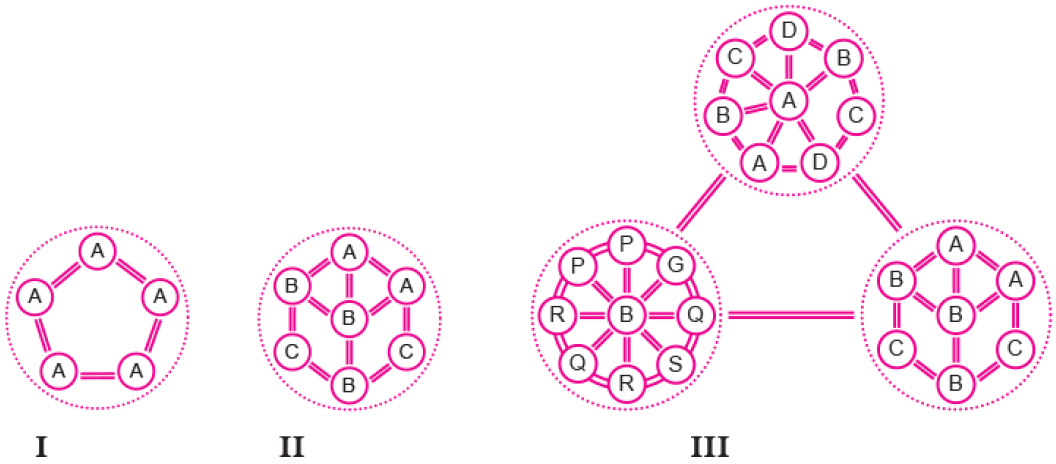
Comment on the following diagrams: A, B, C, D, G, P, Q, R, S are species.
Ganga has recently been declared the national river. Discuss the implication with respect to pollution of this river.
Answer the following questions:
Give a schematic representation of spermatogenesis in humans.
  1. Why are herbivores considered similar to predators in the ecological context? Explain.
  2. Differentiate between the following interspecific interactions in a population:
  1. Mutualism and Competition.
  2. Commensalism and Amensalism.
Draw a labelled schematic structure of a transcription unit. Explain the function of each component in the unit in the process of transcription.