Question
Describe the human female reproductive system.

Answer


Image
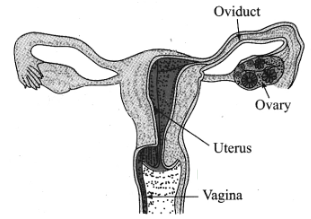
  • All the organs of the human female reproductive system are located inside the lower abdomen.
  • There are pair of ovaries, pair of fallopian ducts and a single median uterus.
  • The uterus opens out by vagina. In vaginal walls there are Bartholin’s glands.
  • The urethra in female body is separate and not a common passage as in male body.
  • The free end of fallopian duct is funnel-like having an opening in the centre. The oocyte released from the ovary due to ovulation is picked up by this funnel.
  • The other end of fallopian duct opens into uterus. There are cilia on inner surface of oviduct. With the help of the cilia the oocyte is pushed to the uterus through the fallopian duct.
  • The fertilization of oocyte can take place only in the middle’part of the fallopian duct.
  • The lower end of uterus opens into vagina. The contractions of uterus help in the process of parturition.
  • Vagina is the birth canal as well as copulatory passage. It is also a passage for menstrual flow.

Need a full question paper?

Generate a complete, print-ready paper with questions like this in minutes — across 16+ boards, with answer keys.
Start Generating Free

Similar questions

Differentiate between nuclear fission and nuclear fusion.
Pure-bred tall pea plants are first crossed with pure-bred dwarf pea plants. The pea plants obtained in $F_1$ generation are then cross-bred to produce $F_2$ generation of pea plants.
  1. What do the plants of $F_1$ generation look like?
  2. What is the ratio of tall plants to dwarf plants in $F_2$ generation?
  3. Which type of plants were missing in $F_1$ generation but reappeared in $F_2$ generation?
i. Identify the following symbols and state their significance:
Image
ii. How the biodiversity can be conserved?
A person first crossed pure-bred pea plants having round-yellow seeds with pure-bred pea plants having wrinkled-green seeds and found that only $A-B$ type of seeds were produced in the $F_1$ generation. When $F_1$ generation pea plants having $A-B$ type of seeds were cross-bred by self-pollination, then in addition to the original round-yellow and wrinkled-green seeds, two new varieties $A-D$ and $C-B$ type of seeds were also obtained.
  1. What are $A-B$ type of seeds$?$
  2. State whether $A$ and $B$ are dominant traits or recessive traits.
  3. What are $A-D$ type of seeds$?$
  4. What are $C-B$ type of seeds$?$
  5. Out of $A-B$ and $A-D$ types of seeds, which one will be produced in $(i)$ minimum numbers, and $(ii)$ maximum numbers, in the $F_2$ generation?
Explain the working of an astronomical telescope using refraction of light.
What is a synapse? What happens at the synapse between two neurons? How are the messages carried across a synapse? Explain with the help of a labelled diagram.
What will you do?
i. You are spending more time on internet.
ii. Child of your neighbour is addicted to tobacco chewing.
iii. Your sister has become incommunicative.
iv. You have to use free space around your home for good purpose.
v. Your brother studying in XII has developed
Explain that why is it said like that? - Effective disaster management makes us well prepared for future.
Explain the hydraulic separation method with a neat labelled diagram.
If the distance between two bodies is increased by a factor of $5$, (i) by what factor will the gravitational force change if the masses are kept constant? (ii) by what factor will the mass of one of them have to be altered, keeping the other mass the same, to maintain the same gravitational force between the two bodies?