Question
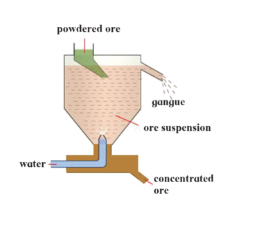
Explain the hydraulic separation method with a neat labelled diagram.
Answer

  • This method is based on the working of a mill.
  • It has a tapering vessel similar to that used in grinding mill. The tapering vessel opens up in a tank-like container that is tapering on the lower side. The tank has a water inlet on the lower side and a water outlet on the upper side.
  • The powdered ore is released in the tank and forceful stream of water is introduced into the tank through the water inlet at the bottom.
  • The lighter particles of the gangue are carried up by the water jet and pass out along with water flowing out from the outlet near the top and get collected separately while the heavier ore particles are collected at the bottom from the lower side of the tank.
  • The reservoir is constructed in a conical shape so that the velocity of the water jet is reduced, thus preventing ore particles from being carried away along with the stream of water.
  • This method is based on the principle of gravitation law, wherein particles of identical size are separated by their weight with the help of water.
Image
Hydraulic separation method

Need a full question paper?

Generate a complete, print-ready paper with questions like this in minutes — across 16+ boards, with answer keys.

Start Generating Free

Similar questions

Write short note: White revolution.
P is a cell (or group of cells) in the human body which is sensitive to a particular type of stimulus and conveys the messages to CNS through nerves Q. On the other hand, R is a part of the human body which can respond to a stimulus according to the instructions sent from the CNS through nerves S.
  1. What is P? Name five organs which contain cells (or group of cells) like P.
  2. Name the nerves Q.
  3. What is R? Give two examples of R.
  4. Name nerves S.
  5. How do messages travel through the nerves Q and S?
Explain how the formula for critical velocity $(v_c)$ is derived?
Match the columns in the following table and explain them:
Column 1 Column 2 Column 3
Farsightedness Nearby object can be seen clearly Bifocal lens
Presbyopia Faraway object can be seen clearly Concave lens
Nearsightedness Problem of old age Convex lens
Where are such sacred groves in Maharashtra? Make a list and visit with your teachers.
Read the following paragraph and answer the questions:
If heat is exchanged between a hot and cold object, the temperature of the cold object goes on increasing due to gain of energy and the temperature of the hot object goes on decreasing due to loss of energy.

The change in temperature continues till the temperatures of both the objects attain the same value. In this process, the cold object gains heat energy and the hot object loses’ heat energy. If the system of both the objects is isolated from the environment by keeping it inside a heat resistant box (meaning that the energy exchange takes place between the two objects only), then no energy can flow from inside the box or come into the box.
(1) Heat is transferred from where to where?
(2) Which principle do we learn about from this process?
(3) How will you state the principle briefly?
(4) Which property of the substance is measured using this principle?

Taking into consideration the period of the elements given below, answer the following questions:
ElementAtomic radius (pm)
O66
B88
C77
N74
Be111
Li152
i. Arrange the above elements in a decreasing order of their atomic radii.
ii. State the period to which the above elements belong.
iii. Why this arrangement of elements is similar to the above period of the modern periodic table?
iv. Which of the above elements have the biggest and the smallest atom?
v. What is the periodic trend observed in the variation of atomic radius while going from left to right within a period?
Express the magnification produced by a lens in terms of the focal length of the lens and (1) the object distance (2) the image distance.
Identify the class of given animals and write one characteristic of each animal:
i. Kangaroo
ii. Penguin
iii. Crocodile
iv. Frog
v. Sea-horse
Bring out the contribution of India’s space missions.