Question
Describe the logistic population growth.

Answer

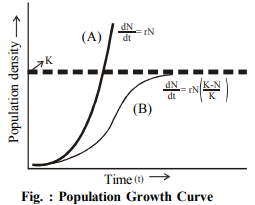
Logistic Growth : No population of any species in nature has at its disposal unlimited resources to permit exponential growth. This leads to competition between individuals for limiting resources. Eventually, the 'fittest' individual will survive and reproduce. A population growing in a habitat with limited resources show initially a lag phase, followed by phases of acceleration and deceleration and finally an asymptote, when the population density reaches the carrying capacity. A plot of N in relation to time (t) results in a sigmoid curve. This type of population growth is called Verhulst-Pearl Logistic Growth and is described by the following equation;
$dN / dt =\frac{ rN ( K - N )}{ K }$
Where, N = Population density at time t
r = Intrinsic rate of natural increase
K = Carrying capacity
Since resources for growth for most animal populations are finite and become limiting sooner or later, the logistic growth model is considered a more realistic one.
Image
(A) When responses are not limiting the growth, plot is exponential. 
(B) When responses are limiting the growth, plot is logistic, K is carrying capacity.

Need a full question paper?

Generate a complete, print-ready paper with questions like this in minutes — across 16+ boards, with answer keys.
Start Generating Free

Similar questions

What is called immunity? How many types are there? Describe innate immunity.
A.
(i) Why is there a need to conserve biodiversity? (Any two reasons)
(ii) Name and explain any two causes that are responsible for the loss of biodiversity.
Describe the change that occur in ovaries and uterus in human female during the reproductive cycle.
Describe the structure of human sperm.###Describe the structure of sperm with suitable diagram. Also define supermatogenesis.
  1. A garden pea plant bearing terminal, violet flowers, when crossed with another pea plant bearing axial, violet flowers produced axial, violet flowers and axial, white flowers in the ratio of 3 : 1. Work out the cross showing the genotypes of the parent pea plants and their progeny.
  2. Name and state the law that can be derived from this cross and not from a monohybrid cross.
Write about the various theories of evolution.
Give reasons why:
Most zygotes in angiosperms divide only after certain amount of endosperm is formed.
Thalassemia and haemophilia are both Mendelian disorders related to blood. Write the symptoms of the diseases. Explain with the help of crosses the difference in the inheritance pattern of the two diseases.
OR
Why are thalassemia and hemophilia categorised as Mendelian disorders? Write the symptoms of these diseases. Explain their pattern of inheritance in humans. Write the genotypes of the normal parents producing a haemophilic son.
Differentiate between the following:
  1. Polygenic inheritance and Pleiotropy.
  2. Dominance, Codominance and Incomplete dominance.
Explain the efforts for the conservation of biodiversity at international level.