Question
Describe the main chemical changes which occur during photosynthesis in:
Light reaction

Answer

The light reaction occurs in two main steps:
(1) Activation of chlorophyll - On exposure to light energy, chlorophyll becomes activated by absorbing photons.
(2) Splitting of water - The absorbed energy is used in splitting the water molecule into hydrogen and oxygen, releasing energy. This reaction is known as photolysis of water.
$2 H _2 O \xrightarrow{\text { energy of } 4 \text { photons }} 4 H ^{+}+4 e ^{-}+ O _2$
The fate of $H ^{+}, e ^{-}$and $( O )$ component are as follows:
The hydrogen ions $\left( H ^{+}\right)$obtained from above are picked up by a compound NADP (Nicotinamide adenine dinucleotide phosphate) to form NADPH.
$NADP ^{+}+ e ^{-}+ H ^{+} \xrightarrow{\text { enzyme }} NADPH$
The oxygen $( O )$ component is given out as molecular oxygen $\left( O _2\right)$.
$'2"O" -> "O"_2'$
The electrons ( $e ^{-}$) are used in converting ADP into energy rich ATP by adding one inorganic phosphate group $P _{ i }$.
$"ADP" + "P" -> "ATP"`$
This process is called photophosphorylation.

Need a full question paper?

Generate a complete, print-ready paper with questions like this in minutes — across 16+ boards, with answer keys.
Start Generating Free

Similar questions

Distinguish between the following:
Osmosis and diffusion
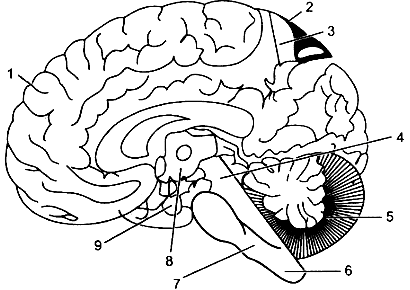
The below diagram represents a longitudinal section of the human brain. Label its parts 1-9 as shown with guidelines.

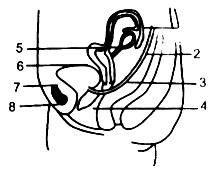
The below diagram represents the vertical view of the human female reproductive system.

(i) Label the parts indicated by the guidelines 1 to 8.
(ii) How does the uterus prepare for the reception of a zygote?
(iii) What happens to the uterus if fertilization takes place?
(iv) What happens to the uterus if fertilization has failed to take place?
What causes acidic deposition?
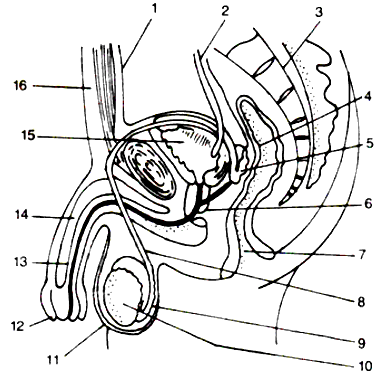
Given on the right is a diagram which represents the reproductive organs of a man:
(i) Write the names of the parts numbered 1 to 16.
(ii) Give two functions of the part 6.
(iii) Name three components of the fluid which may be found in the tube labeled 2.
(iv) What is the main function of the part labelled 3?
List the events taking place in the photo-chemical phase of Photosynthesis.
Match the terms given in column I with terms in Column II:
Column IColumn Il
(i) Left-auricle(a) Clotting
(ii) Right auricle(b) Thebasius valve
(iii) Left ventricle(c) Pulmonary vein
(iv) Right-ventricle(d) Aorta
(v) Fibrin(e) Pulmonary arch
Column ‘II’ is a list of items related to ideas in Column ‘I’. Match the term in Column ‘II’ with a suitable idea given in Column ‘I’.
Column AColumn B
(i) Pituitary(a) produces male sex characteristics
(ii) Ovaries(b) decreases blood sugar level
(iii) Thyroid(c) increases heart and breathing rate raises blood pressure
(iv) Thymus(d) produces female sex characteristics
(v) Adrenals(e) is known as emergency hormone
(vi) Hypothalamus(f) regulates the level of calcium and phosphorus
(vii) Pancreas(g) increases the rate of metabolism
(viii) Testes(h) maintains the level of calcium
(ix) Parathyroidregulates the amount of water excreted in the urine.
(x) Cretinism(j) simulates skeletal growth
(xi) Diabetes mellitus(k) regulates the activities of other glands
(xii) Insulin shock(l) stimulates the development of male and female sex organs
(xiii) Gigantism(m) Shortage of glucose in the blood.
(xiv) Enlargement of breasts in adult males(n) Over-secretion of growth hormone
(xv) Exophthalmic goiter(o) Excess of glucose in the blood
(xvi) Acromegaly(p) Over-secretion of thyroxin
(xvii) Addison’s disease(q) Dwarfism and mental retardation
(xviii)Cretinism(r) Over-secretion of cortical hormones
(xix) Dwarfism(s) Under-secretion of the adrenal cortex
(xx) Adrenalin(t) Under-secretion of thyroxin in children
(xxi) Vasopressin(u) Over-secretion of growth hormones in adults
Complete the following:
Gland/OrganHormoneFunction
(i) Stomach____________________
(ii) Parathyroid____________________
(iii) ____________________Lowers blood sugar level.
(iv) Adrenal medulla____________________
(v) Pancreas (Alpha cells)____________________
(vi) Testes____________________
A homozygous tall plant (TT) bearing red coloured $(R R)$ flowers is crossed with a homozygous dwarf plant (tt) bearing white flowers (rr) :
(i) Give the genotype and phenotype of the $F_1$ generation.
(ii) Give the possible combinations of the gametes that can be obtained from the $F_1$ hybrid.
(iii) Give the dihybrid ratio and the phenotype of the offspring of $F_2$ generation when two plants of above $F_1$ generation are crossed.