Question
What causes acidic deposition?

Answer

Acid Deposition: Commonly called acid rain is caused by emissions of sulphur dioxide and nitrogen oxides. Although natural sources of sulphur oxides and nitrogen oxides do exist, more than 90% of the sulphur and 95% of the nitrogen emissions occurring in eastern North America are of human origin. These primary air pollutants arise from the use of coal in the production of electricity, from base-metal smelting, and from fuel combustion in vehicles. Once released into the atmosphere, they can be converted chemically into such secondary pollutants as nitric acid and sulfuric acid, both of which dissolve easily in water. The resulting acidic water droplets can be carried long distances by prevailing winds, returning to Earth as acid rain, snow, or fog.

Need a full question paper?

Generate a complete, print-ready paper with questions like this in minutes — across 16+ boards, with answer keys.
Start Generating Free

Similar questions

Explain the functioning of kidney.
The diagram represents the ‘closed system’ or ‘double circulation’ of blood in mammals.

Justify the above statement.
State two structural and two functional differences between the arteries and veins.
State the changes in the composition of blood as it passes through the following organs:
(a) Lungs (b) Gut (c) Liver (d) Kidneys.
Complete the following by filling in the blanks numbered 1 to 10 with the appropriate word/term:
Photosynthesis involves light reaction and dark reaction. During light reaction, the chlorophyll present in the (1) ______ gets activated by absorbing light energy. This energy splits (2) ______ molecules to (3) ______ and oxygen and releases two electrons. This process is called (4) ______. The (5) ______ ions are picked up by NADP to form (6) ______. The ADP is converted to (7) ______. This process is called (8) ______. During the dark phase, the compound produced at the end of the light reaction reacts with carbon dioxide to form (9) ______. This product is converted to starch. The process is called (10) ______.
Column 2 is a list of items related to ideas in Column 1. Match the term in Column 2 with the suitable idea given in Column 1.
Column 1 Column 2
i Liver a basic unit of the brain
ii Ova b stimulated by light
iii Alveoli c deoxygenated blood
iv Cochlea d part of the sclera
v Vein e haploid cell
vi Neuron f blind sacs
vii Stomata g found in the kidney
viii Grana h audio receptors
i diffusion of gases
j breakdown of proteins
k diploid cell
Name the hormones secreted by the following glands:
(i) Anterior pituitary
(ii) Testes
(iii) Ovary
(iv) Adrenal cortex
(v) Pancreas
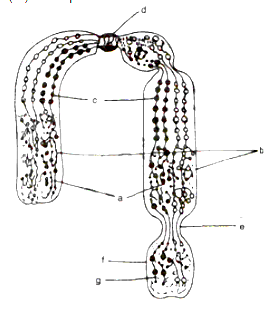
Label the lettered parts of the given figure and answer the following questions:
(i) What does this diagram represent?
(ii) What is the importance of'd'?
(iii) What are the 'staining' properties of 'b' and 'c'?
(iv) Who gave the term used for this structure today?
(v) What is a?
(vi) Is 'e' present in all chromosomes?
Briefly discuss Lamarckian Theory of Inheritance citing an appropriate example.
How does carbon dioxide return to the atmosphere? Explain.
A student in order to study the importance of certain factors of photosynthesis took a potted plant and kept it in the dark for over 24 hours. Then in the early hours of the morning the student covered one of the leaves with black paper in the centre only. Student placed the potted plant in the sunlight for a few hours, and then tested the leaf which was covered with black paper for starch.
(i) What aspect of photosynthesis was being investigated?
(ii) Is there any control in this experiment? If so, state the name.
(iii) Why was the plant kept in the dark before the experiment?
(iv) Describe step by step how the candidate proceeded to test the leaf for the presence of starch.
Give five main differences between mitosis and meiosis.
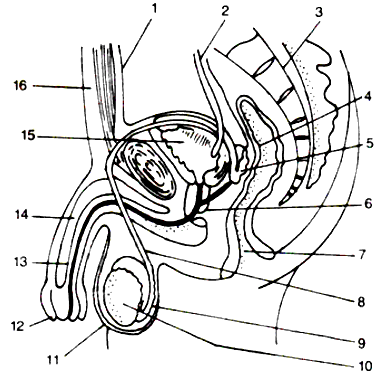
Given on the right is a diagram which represents the reproductive organs of a man:
(i) Write the names of the parts numbered 1 to 16.
(ii) Give two functions of the part 6.
(iii) Name three components of the fluid which may be found in the tube labeled 2.
(iv) What is the main function of the part labelled 3?