Question
Describe the modification of stem in:
  1. Chrysanthemum.
  2. Eichhornia.
  3. Jasmine.

Answer

  1. In Chrysanthemum: the lateral branches arise from the basal and underground part of the main stem, grow horizontally below the soil and emerge obliquely above the soil to give rise to leafy shoots.
  2. In Eichhornia: the lateral branches of the stem have short internodes and each node bears a rosette of leaves and a tuft of roots.
  3. In Jasmine: a slender lateral branch arises from the base of the main stem, grows aerially/ erect for sometime and then arches downwards to touch the ground; the part buried under the soil produces adventitious roots and new shoots at the nodes.

Need a full question paper?

Generate a complete, print-ready paper with questions like this in minutes — across 16+ boards, with answer keys.
Start Generating Free

Similar questions

Bile juice contains no digestive enzymes, yet it is important for digestion. Why?
Can there be DNA replication without cell division?
Name the scientists who proposed the cell theory. Also, list its main postulates.
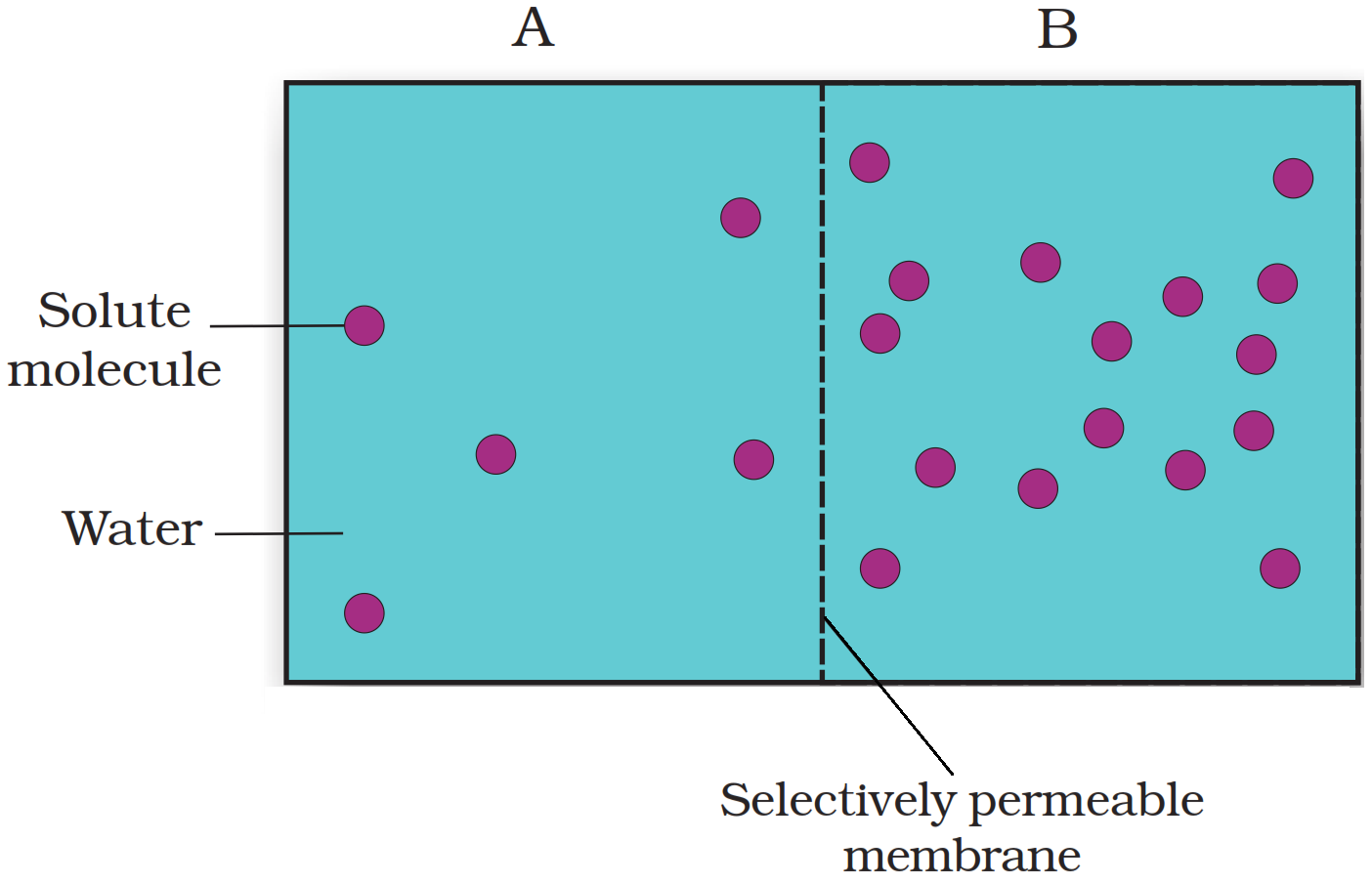
Study the figure given above, in which the two chambers A and B containing solutions are separated by a semipermeable membrane.
  1. Solution of which chamber has a lower water potential?
  2. Solution of which chamber has a lower solute potential?
  3. In which direction will osmosis occur?
  4. Which solution has a higher solute potential?
  5. At equilibrium which chamber will have lower water potential?
  6. If one chamber has a $\Psi$ of -2000 kPa and the other -1000 kPa, which is the chamber that has the higher $\Psi?$
Eukaryotic cells have organelles which may not be bound by a membrane. Group the various sub-cellular organelles into these categories.
Write the appropriate type of tissues in Column B according to the functions mentioned in Column A.
  1. Secretion and absorption __________.
  2. Protective covering ____________.
  3. Linking and supporting framework ____________.
Answer the following with reference to the anatomy of dicot root:
  1. Where is pericycle located?
  2. How are xylem vessels arranged?
  3. What do you call such an arrangement?
  4. Which type of cells constitute the cortex?
Cyanobacteria and heterotrophic bacteria have been clubbed together in Eubacteria of kingdom Monera as per the “Five Kingdom Classification” even though the two are vastly different from each other. Is this grouping of the two types of taxa in the same kingdom justified? If so, why?
  1. What is termed as first messenger and second messenger in the target cells.
  2. How do protein hormones act on target cells?
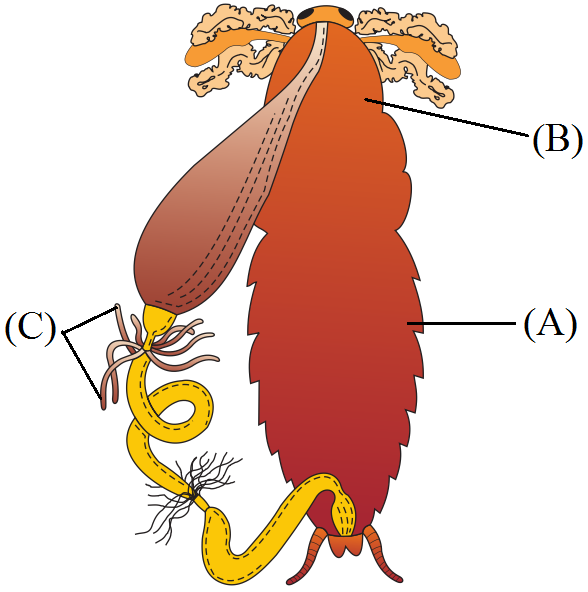
In the figure, some parts of alimentary canal of cockroach are shown. Name the organs A, B and C. State the function each of these organs.