Question
Describe the process of Oogenesis with suitable diagram.

Answer

Oogenesis : The process of formation of female gametes, ova from germinal epithelium is called oogenesis. Oogenesis occurs in graaffian follicle. In this process the number of chromosomes are reduced to half.
This process is divided into three phases. 
(a) Multiplication Phase : This phase is initiated during embryonic developmental stage. In females during the embryonic development, some of the germinal epithilial cell undergoes mitotic division and form germ cells called egg mother cells or oogonia. The egg mother cells oogonia are diploid (2n). The oogania undergoes mitotic division to form the primary oocytes. Each of these primary oocyte gets covered with layers of granulose cells and called primary follicle.
(b) Growth phase : The primary follicles gets surrounded by more layers of granulosa cells and a new and are then called secondary follicles. The secondary follicle soon changes into tertiary follicle and is filled by a fluid cavity, antrum.
(c) Maturation phase : In this phase, the primary oocyte within the tertiary follicle grows in size and undergoes first meiotic unequal division on to form a large haploid secondary oocyte and a haploidtiny polar body. The tertiary follicle further changes into the Graafian follicle, it is a mature follicle. The secondary occyte forms a membrance called zona pellucida surrounding it. The Graafian follicle ruptures to release the secondary oocyte from the ovary. On the time of fertilization when sperm enter into the secondary oocyte, secondary oocyte undergoes meiosis-II Resulted two cells are, one large sized ovum and another smaller haploid secondary body.
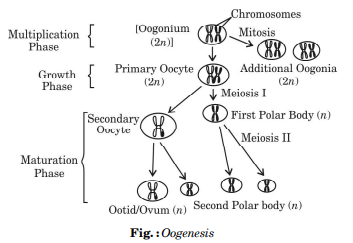
Image
So, in a complete oogenesis process, one egg cell and three polar bodies are formed.

Need a full question paper?

Generate a complete, print-ready paper with questions like this in minutes — across 16+ boards, with answer keys.

Start Generating Free

Similar questions

Give reasons why:
Most zygotes in angiosperms divide only after certain amount of endosperm is formed.
What do you understand by crossing over? Describe the mechanism of crossing over with suitable diagram.
Describe the Darwin's theory of natural selection.
What is mycorrhiza? Write its main advantages.
Highlights the reproductive health issues and strategies.
Read the following and answer any four questions from (i) to (v) given below:

Transgenic animals can serve as factories that in some cases, may produce large amount of proteins more efficiently. Transgenic mice have been engineered to express human antibodies by introducing large segment of human DNA encoding human immunoglobulin genes. In transgenic large animals such as cow or sheep proteins of pharmaceutical value can be produced in large quantities in milk which is later purified. Transgenesis can be used to alter many phenotypic properties including growth rate, fat composition, milk production, hair texture, etc.

  1. The production of transgenic animals includes
  1. Identification and separation of desired gene.
  2. Combining the desired gene with appropriate vector.
  3. Introduction of vector in cells, tissues or embryos.
  4. All of these.
  1. In transgenic animals, i.e., cow and sheep proteins of pharmaceutical value are produced in large quantities in the
  1. Blood.
  2. Accumulated fat.
  3. Mammary glands.
  4. None of these.
  1. Mouse is mostly preferred animal for studies on gene transfer because.
  1.  Short oestrous cycle.
  2. Long gestation period.
  3. Short generation time.
  4. Production of one or two offspring per pregnancy.
  1. Both (A) and (C)
  2. Both (A) and (B)
  3. Only D
  4. Both (C) and (D).
  1. Transgenic genes alter many phenotypic properties including:
  1. Growth rate.
  2. Fat composition.
  3. Milk production.
  4. All of these.
  1. Assertion: Transgenic mice have been engineered to express human antibodies.

Reason: Large segment of human DNA encoding human immunoglobulin have been transferred to mice.

  1. Both assertion and reason are true and reason is the correct explanation of assertion.
  2. Both assertion and reason are true but reason is not the correct explanation of assertion.
  3. Assertion is true but reason is false.
  4. Both assertion and reason are false.
Describe in detail the multiple allelism by the help of inheritance of human blood group.
find out how to distinguish between: RNA and DNA
Draw a diagram and briefly describe the life cycle of Plasmodium.###Make a labeled diagram and briefly describe the various stages of the life cycle of Plasmodium.
Write the name of any one water-borne disease. Explain the measures to prevent water-borne diseases.