Question
Describe the structure and functions of nucleus.

Answer


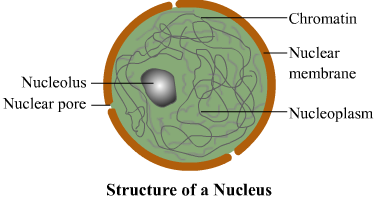
Structure of Nucleus: Nucleus is a dense, spherical or oval, dot like structure located centrally in the cell. It is bounded by two nuclear membranes, both forming nuclear envelope. Nuclear envelope separates the nucleus from the cytoplasm. It contains large number of pores which control the passage of substances outside or inside the nucleus.
Inside the nuclear envelope is the nucleoplasm or nuclear sap. It is transparent, semi-fluid and contains a large number of enzymes which are required for the synthesis and functioning of RNA and DNA. Within the nucleoplasm, two structures are embedded-chromatin material and nucleolus.
Chromatin material is a tangled fibrous mass. The chromatin material condenses to form chromosomes during cell division. Chromosomes contain information for inheritance of features from parents to next generation in the form of DNA (Deoxyribo Nucleic Acid) molecules. Chromosomes are composed of DNA and protein. DNA molecules contain the information necessary for constructing and organising cells. Functional segments of DNA are called genes.
Nucleolus may be one or more in number and is not bounded by any membrane. It is rich in protein and RNA molecules. Nucleolus acts as the site for ribosome formation, hence it is known as factory of ribosomes.
Functions of nucleus:
  1. Nucleus plays a central role in cellular reproduction, the process by which a single cell divides to form two new cells.
  2. Nucleus controls cell metabolism and other activities of cell, hence it is also called Master or Director of the cell.
  3. Along with the environment, nucleus directs the chemical activities of the cell. It determines the development and future form of the cell.
  4. It is concerned with the transmission of hereditary traits from the parent to offsprings.
Need a full question paper?

Generate a complete, print-ready paper with questions like this in minutes — across 16+ boards, with answer keys.

Start Generating Free

Similar questions

Iron powder and sulphur powder were mixed together and divided into two parts A and B. When part A was heated strongly over a burner, then a substance C was formed. The part B was, however, not heated at all. When dilute hydrochloric acid was added to substance C, then gas D was evolved and when dilute hydrochloric acid was added to part B then gas E was evolved.
  1. What type of substance is B?
  2. What type of substance is C?
  3. Name the gas (i) D, and (ii) E?
  4. Write one characteristic property of gas D.
Carry out the following osmosis experiment:
Take four peeled potato halves and scoop each one out to make potato cups, one of these potato cups should be made from a boiled potato. Put each potato cup in a trough containing water. Now,
  1. Keep cup A empty.
  2. Put one teaspoon sugar in cup B.
  3. Put one teaspoon salt in cup C.
  4. Put one teaspoon sugar in the boiled potato cup D.
Keep these for two hours. Then observe the four potato cups and answer the following:
  1. Explain why water gathers in the hollowed portion of B and C.
  2. Why is potato A necessary for this experiment?
  3. Explain why water does not gather in the hollowed out portions of A and D.
Describe Bohr’s model of the atom. How did Neils Bohr explain the stability of atom?
Velocity versus time graph of a ball of mass $50g$ rolling on a concrete floor is shown in Fig. Calculate the acceleration and frictional force of the floor on the ball.
What should be do to get maximum benefit from a crop field?
A boy walks from his classroom to the bookshop along a straight corridor towards North. He covers a distance of 20m in 25 seconds to reach the bookshop. After buying a book, he travels the same distance in the same time to reach back in the classroom. Find (a) average speed, and (b) average velocity, of the boy.
How will you separate a mixture of mercury, oil and water?
A gun of mass $3\ kg$ fires a bullet of mass $30g.$ The bullet takes $0.003s$ to move through the barrel of the gun and acquires a velocity of $100\ m/s.$ Calculate:
  1. The velocity with which the gun recoils.
  2. The force exerted on gunman due to recoil of the gun.
In an experiment, Anhad studies sound waves. He sets up a loudspeaker to produce sound as shown below:
Anhad adjusts the signal to the loudspeaker to give a sound of frequency 200Hz.
  1. What happens to the air in-between Anhas and the loudspeaker?
  2. Explain how Anhad receives sound in both ears.
Describe with a diagram the fluid mosaic organisation of the plasma membrane.