Question
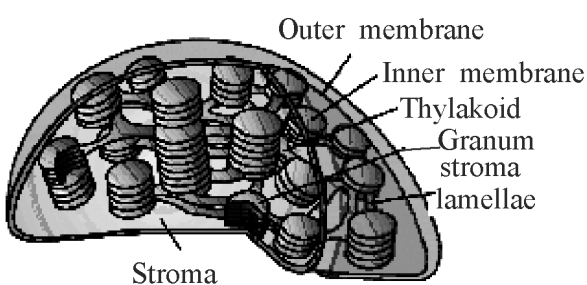
Describe the structure of chloroplast graphically.

Answer

Chloroplast: It was discovered by Schimper in 1864. Majority of the chloroplasts of the green plants are found in the mesophyll cells of the leaves. These are lens- shaped, oval, spherical, discoid or even ribbon-like organelles having variable length (5-10µm) and width (2-4µm). Their number varies from 1 per cell of the Chlamydomonas, a green alga to 20-40 per cell in the mesophyll. The chlorophyll is surrounded by two membranes. The space between these two membranes is called periplastidial space. There are two main parts inside the membranes:
(a) Stroma: This is a colourless part in which different types of enzymes are found, where the dark reaction of photosynthesis takes place.
(b) Grana: It is a structure like a pack of coins of thylakoid lamellae which is called grana. Light reaction of photosynthesis occurs in grana. Two adjacent grana are connected to each other by intergranal lamellae or stroma lamellae. There are 40 to 60 grana in a chloroplast.
Image
Many enzymes are found in the stroma of chlorophyll which are necessary for carbohydrate and protein synthesis. Small, double-stranded circular DNA molecules and ribosomes are found in these. The ribosome (70S) found in chlorophyll is smaller than the cytoplasmic ribosome (80S).
Functions: The main functions of chloroplast are as follows:
(i) To absorb light energy.
(ii) Formation of NADHP-H2 by light reaction and release O2 .
(iii) Making starch from CO2 obtained from air.

Need a full question paper?

Generate a complete, print-ready paper with questions like this in minutes — across 16+ boards, with answer keys.

Start Generating Free

Similar questions

Polysaccharides or the macro molecules consisting of long chains of sugar. Only carbohydrates they are not sweet and are insoluble in water. The two ends of the polysaccharide chain are called reducing and non-reducing ends. Based upon their monomeric units these are homo polysaccharides or heteropolysaccharides. Depending upon their location polysaccharides play multiple functions in living world few examples of polysaccharides include Cellulose, chitin, inulin etc.

(1) All the listed polysaccharides are homopolymers except
(a) Starch (b) glycogen (c) Chitin (d) Cellulose

(2) Inulin is a polymer of
(a) glucose (b) fructose (c) glucose and sucrose (d) fructose and galactans

(3) Murein is a heteropolysaccharide like
(a) araban (b) xylan (c) hyaluronic acid (d) agar

(4) A polysaccharide found in the exoskeleton of crabs is
(a) Cellulose (b) pectin (c) murine (d) chitin

(5) The right end of the polysaccharide chain is called
(a) reducing end (b) non-reducing end (c) right end (d) none of these
Illustrate the taxonomical hierarchy with suitable examples of a plant and an animal.
Explain the difference between ligament and tendon.
Muscles and nerve fibers allow a person to move their body and enable the internal
organs to function. There are more than 600 muscles in the human body. A kind of
elastic tissue makes up each muscle, which consists of thousands, or tens of thousands,
of small muscle fibers. Each fiber comprises many tiny strands called fibrils.
Impulses from nerve cells control the contraction of each muscle fiber. A muscle’s
strength depends mainly on how many fibers are present.

(1). Major protein constituent of muscle fibre is
(a)Actin (b)Tropomyosin (c)Myosin (d)Calnexin

(2).Myofibrils show dark and light band in
(a) cardiac muscle
(b) Striped muscle
(c) cardiac muscle and unstriated muscle
(d) cardiac muscle and striped muscle

(3). Unstriped muscle present in the
(a) Intestinal muscle (b) Leg muscle (c) Muscle of fore limb (d) Heart muscle

(4). Which of the following muscle gets into fatigue very early
(a) Skeletal muscle (b) Smooth muscle (c) Cardiac muscle (d) All the above

(5). The structural and functional unit of the striated muscle fibre is called
(a) Sarcolemma (b) Sarcomere (c) Sarcoplasm (d) Myofibril
Differentiate between male frog and female frog.
What is heterospory? Briefly comment on its significance. Give two examples.
Write any four differences between cartilaginous fishes and bony fishes.
Alex used to go to vegetable market with his grandfather, a retired biology teacher. Grandfather told Alex that brinjal, chillies and tomato belong to the same family of plants and asked him to find out the similarity in these plants. Alex found that it's a large family, commonly called as the ' potato family'. Plants belonging to this family are mostly herbs, shrubs and rarely small trees. Many plants belonging to this family are source of food, spice, medicine, fumigatory, and ornamental.

(1).The name of this family is
(a) Solanaceae  (b) Fabaceae  (c) Liliaceae  (d) Brassica ear.

(2). Fruits of this family are known as
(a) Berry or capsule  (b) Legume  (c) Endosperm  (d) Cotyledon.

(3). Aestivation in calyx and corolla of this family is
(a) Valvate  (b) Imbricate  (c) Twisted  (d) Vexillary.

(4). Stamens of the flowers belonging to this family are mostly attached with petals.This condition is known as
(a) Epipetalous  (b) Epiphyllous  (c) Polyandrous  (d) Monoadelphous

(5). Medicinal plants belonging to this family are
(a) Belladonna, Ashwagandha
(b) Aloe, Asparagus
(c) Tobacco, Petunia
(d) Muliathi, Spice.