Question
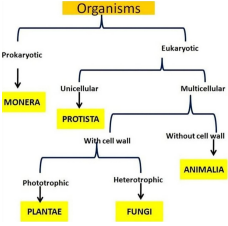
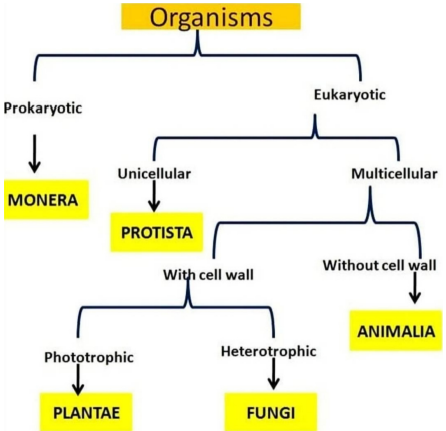
✓
Answer
i. All organisms are multicellular, eukaryotes with heterotrophic mode of nutrition.
ii.
iii. Linnaeus used artificial system kingdom of classification.
Drawbacks of Linnaeus two kingdom classification:
• Linnaeus developed a Two Kingdom system of classification with Plantae and Animalia kingdoms.
• This system did not distinguish between eukaryotes and prokaryotes, unicellular and multicellular organisms, photosynthetic (green algae) and non-photosynthetic (fungi) organisms.
OR
No, Fungi-Autotrophic (Photosynthetic) and Heterotrophic is not correct match. The walls of the fungi were made of chitin, whereas the green plants had a cellulose cell wall.
ii.
| Prokaryotic cell | Eukaryotic cell |
| Genetic material is not enclosed in a nuclear envelope and is present suspended in the cytoplasm in a region called nucleoid. | Genetic material is enclosed within the nucleus by a nuclear envelope and is not present in direct contact with cytoplasm. |
| Cell wall is made up of peptidoglycan. | Cell wall is made up of chitin in fungi and cellulose in plants. |
| Nucleolus is absent. | Nucleolus is present. |
Drawbacks of Linnaeus two kingdom classification:
• Linnaeus developed a Two Kingdom system of classification with Plantae and Animalia kingdoms.
• This system did not distinguish between eukaryotes and prokaryotes, unicellular and multicellular organisms, photosynthetic (green algae) and non-photosynthetic (fungi) organisms.
OR
No, Fungi-Autotrophic (Photosynthetic) and Heterotrophic is not correct match. The walls of the fungi were made of chitin, whereas the green plants had a cellulose cell wall.
Need a full question paper?
Generate a complete, print-ready paper with questions like this in minutes — across 16+ boards, with answer keys.
Explore more
Similar questions
→→→→→→→→→→
The conifer forests of the world cover huge areas of land and provide the largest terrestrial carbon sink. Conifers are also valued economically; their softwood is used for the production of timber, they are used to cultivate pine nuts, and the berries of the juniper bush are used to flavour gin. As in all other vascular plants, gymnosperms have a sporophyte dominant life cycle (the sporophyte is the diploid multicellular stage, which comprises the body of the plant, i.e., a leafy tree).The gametophyte phase is relatively short, and sees gametes produced on the reproductive organs.
(1) For a plant species to be 'dioecious', it must:
(a) Reproduce asexually
(b) Have both male and female organs
(c) Have separate male and female individuals
(d) Not reproduce
(2) Which division of the gymnosperms is most commonly used to create paper?
(a) Conifers (b) Cycads (c) Gnetophyta (d) Gingkophyta(3) What role does the cone have in the gymnosperm life cycle?
(a) It is the seed
(b) It is the male gametophyte
(c) It is the reproductive body
(d) It feeds the embryo
(4) Conifers are adapted to tolerate extreme environmental conditions because of
(a) broad hardy leaves.
(b) superficial stomata.
(c) thick cuticle
(d) presence of vessel(5) Cycas and Adiantum resemble each other in having:
(a) seeds (b) motile sperms (c) cambium (d) vessels
(1) For a plant species to be 'dioecious', it must:
(a) Reproduce asexually
(b) Have both male and female organs
(c) Have separate male and female individuals
(d) Not reproduce
(2) Which division of the gymnosperms is most commonly used to create paper?
(a) Conifers (b) Cycads (c) Gnetophyta (d) Gingkophyta(3) What role does the cone have in the gymnosperm life cycle?
(a) It is the seed
(b) It is the male gametophyte
(c) It is the reproductive body
(d) It feeds the embryo
(4) Conifers are adapted to tolerate extreme environmental conditions because of
(a) broad hardy leaves.
(b) superficial stomata.
(c) thick cuticle
(d) presence of vessel(5) Cycas and Adiantum resemble each other in having:
(a) seeds (b) motile sperms (c) cambium (d) vessels
Muscles and nerve fibers allow a person to move their body and enable the internal
organs to function. There are more than 600 muscles in the human body. A kind of
elastic tissue makes up each muscle, which consists of thousands, or tens of thousands,
of small muscle fibers. Each fiber comprises many tiny strands called fibrils.
Impulses from nerve cells control the contraction of each muscle fiber. A muscle’s
strength depends mainly on how many fibers are present.
(1). Major protein constituent of muscle fibre is
(a)Actin (b)Tropomyosin (c)Myosin (d)Calnexin
(2).Myofibrils show dark and light band in
(a) cardiac muscle
(b) Striped muscle
(c) cardiac muscle and unstriated muscle
(d) cardiac muscle and striped muscle
(3). Unstriped muscle present in the
(a) Intestinal muscle (b) Leg muscle (c) Muscle of fore limb (d) Heart muscle
(4). Which of the following muscle gets into fatigue very early
(a) Skeletal muscle (b) Smooth muscle (c) Cardiac muscle (d) All the above
(5). The structural and functional unit of the striated muscle fibre is called
(a) Sarcolemma (b) Sarcomere (c) Sarcoplasm (d) Myofibril
organs to function. There are more than 600 muscles in the human body. A kind of
elastic tissue makes up each muscle, which consists of thousands, or tens of thousands,
of small muscle fibers. Each fiber comprises many tiny strands called fibrils.
Impulses from nerve cells control the contraction of each muscle fiber. A muscle’s
strength depends mainly on how many fibers are present.
(1). Major protein constituent of muscle fibre is
(a)Actin (b)Tropomyosin (c)Myosin (d)Calnexin
(2).Myofibrils show dark and light band in
(a) cardiac muscle
(b) Striped muscle
(c) cardiac muscle and unstriated muscle
(d) cardiac muscle and striped muscle
(3). Unstriped muscle present in the
(a) Intestinal muscle (b) Leg muscle (c) Muscle of fore limb (d) Heart muscle
(4). Which of the following muscle gets into fatigue very early
(a) Skeletal muscle (b) Smooth muscle (c) Cardiac muscle (d) All the above
(5). The structural and functional unit of the striated muscle fibre is called
(a) Sarcolemma (b) Sarcomere (c) Sarcoplasm (d) Myofibril
As what is Equisetum commonly known? Write any four differences between Bryophytes and Pteridophytes.
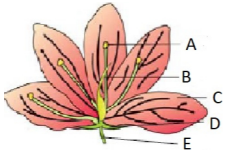
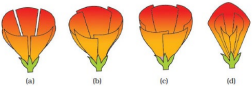
Write any four differences between cartilaginous fishes and bony fishes.
Write a note on bulliform cells. Write any three differences between exarch and endarch.
Define the following :
(i) Vasa Recta (ii) Homeostasis (iii) Podocytes (iv) Juxtamedullary Nephron.
(i) Vasa Recta (ii) Homeostasis (iii) Podocytes (iv) Juxtamedullary Nephron.
Match the following
| Column I | Column II | ||
| a. | Chlamydomonas | i. | Moss |
| b. | Cycas | ii. | Pteridophyte |
| c. | Selaginella | iii. | Algae |
| d. | Sphagnum | iv. | Gymnosperm |
Name the respiratory organ of the following animals and draw a labelled diagram of the cross section of an air alveolus of a pulmonary vessel.
1. Hydra, 2. Earthworms, 3. Cockroaches, 4. Pelaemon, 5. Fishes, 6. Pigeons.
1. Hydra, 2. Earthworms, 3. Cockroaches, 4. Pelaemon, 5. Fishes, 6. Pigeons.