Question
Describe the two experiments related to static friction with diagram.

Answer

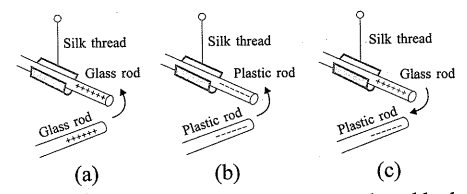
Image
►It was observed that if two glass rods rubbed with wool or silk cloth are brought close to each other, they will repel. [Fig. (a)].
►The two strands of wool or two pieces of silk cloth, with which the rods were rubbed, also repel each other.
►The glass rod and wool are attracted to each other.
►Similarly, two plastic rods rubbed with cat's fur will repell each other [Fig. (b)] but attract the fur.
►On the other hand, the plastic rod attracts the glass rod [Fig. (c)] and repels the silk or wool with which the glass rod is rubbed. The glass rod repels the fur.
Need a full question paper?

Generate a complete, print-ready paper with questions like this in minutes — across 16+ boards, with answer keys.

Start Generating Free

Similar questions

You are riding in a car. The driver suddenly applies the brakes and you are pushed forward. Who pushed you forward?
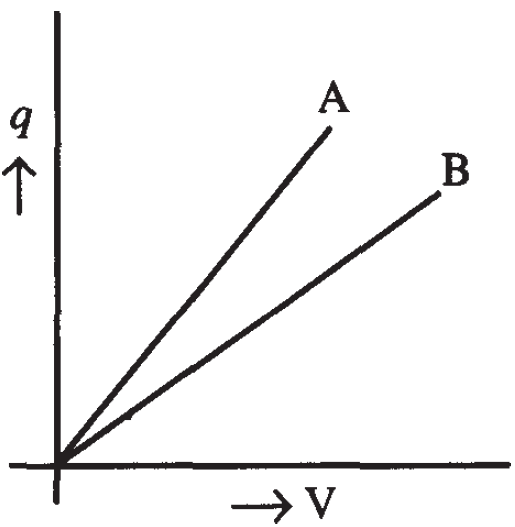
The given graph shows the variation of charge $q$ versus potential difference $V$ for two capacitors $C_1$ and $C_2.$ The two capacitors have same plate separation, but the plate area of $C_2$ is double than that of $C_1.$ Which of the lines in the graph correspond to $C_1$ and $C_2$ and why?
  1. Can two equipotential surfaces intersect each other? Give reasons.
  2. Two charges – q and +q are located at points A (0, 0, –a) and B (0, 0, +a) respectively. How much work is done in moving a test charge from point P (7, 0, 0) to Q (-3, 0, 0)?
An extended object is placed at a distance of 5.0cm from a convex lens of focal length 8.0cm.
  1. Draw the ray diagram (to the scale) to locate the image and from this, measure the distance of the image from the lens.
  2. Find the position of the image from the lens formula and see how close the drawing is to the correct result.
By looking at the construction of a compound microscope and a telescope, how will you distinguish which type of optical instrument is which?
The photoelectric cut-off voltage in a certain experiment is 1.5 V. What is the maximum kinetic energy of photoelectron emitted?
What is the focal length of a convex lens of focal length 30 cm in contact with a concave lens of focal length 20 cm? Is the system a converging or a diverging lens? Ignore thickness of the lenses.
An e.m. wave is travelling in a medium with a velocity v = $v \hat{i}$. The electric field oscillations, of this e.m. wave, are along the $y$-axis.
a. Identify the direction in which the magnetic field oscillations are taking place, of the e.m. wave.
b. How are the magnitudes of the electric field and magnetic fields in the electromagnetic wave related to each other?
A single lens is mounted in a tube. A parallel beam enters the tube and emerges out of the tube as a divergent beam. Can you say with certainty that there is a diverging lens in the tube?
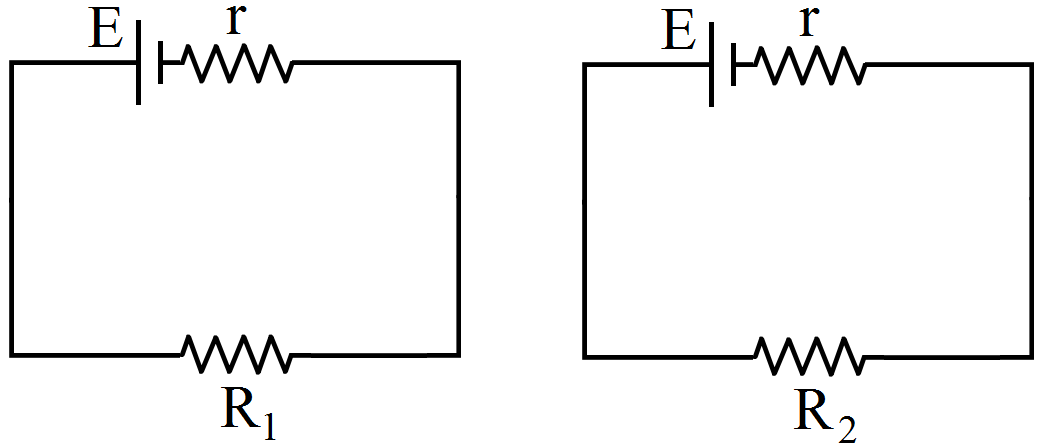
Two unequal resistances $R_1$ and $R_2$ are connected across two identical batteries of emf $\varepsilon$ and internal resistance $r$. Can the thermal energies developed in $R_1$ and $R_{2}$ be equal in a given time. If yes, what will be the condition?