Questions

2 Marks Questions

Take a timed test

46 questions · self-marked practice — reveal the answer and mark yourself.

Question 12 Marks
Write the characteristics of electric field lines.
Answer
►(i) Electric field lines are imaginary curves drawn in such a way that the tangent to it of each point shows the direction of electric field at that point.
  (ii) Field lines start from positive charges and end at negative charges. If there is a single charge, they may start or end at infinity.
  (iii) In a charge-free region, electric field lines can be taken to be continuous curves without any breaks.
  (iv) Two field lines never cross each other.
  (v) Electrostatic field lines do not form any closed loops.
  (vi) Distribution of electric field lines gives an idea of electric field intensity in that region.
  (vii) Field lines of a uniform electric field are mutually parallel and equidistant.
View full question & answer
Question 22 Marks
Explain electric field due to system of charges.
Answer
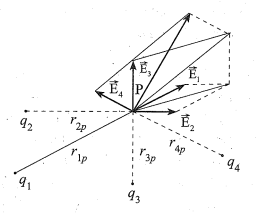
►Consider a system of charges $q_1, q_2, \ldots, q_n$ with position vectors $\vec{r}_1, \vec{r}_2, \ldots, \vec{r}_n$ relative to some origin O .
►We can use Coulomb's law and the superposition principle to determine this field at a point P denoted by position vector $\vec{r}$.
Image
►Electric field $\left(\overrightarrow{ E }_1\right)$ at point P due to $q_1$,
$\overrightarrow{ E }_1=\frac{1}{4 \pi \varepsilon_0} \frac{q_1}{r_{ IP }^2} \hat{r}_{ IP }$
►where $\hat{r}_{ IP }$ is a unit vector in the direction from $q_1$ to P . and $r_{1 P }$ is the distance between $q_1$, and P . In the same manner, electric field $\left(\vec{E}_2\right)$ at point P due to $q_2$.
$\overrightarrow{ E }_2=\frac{1}{4 \pi \varepsilon_0} \frac{q_2}{r_{2 P }^2} \hat{r}_{2 P }$
►where $\hat{r}_{2 P }$ is a unit vector in the direction from $q_2$ to P and $r_{2 P }$ is the distance between $q_2$ and P .
►Similar expressions hold good for fields $\vec{E}_3$, $\overrightarrow{ E }_4, \ldots, \overrightarrow{ E }_n$ due to charges $q_3, q_4, \ldots, q_n$.
►By the superposition principle, the electric field E at r due to the system of charges is (as shown in Fig.)
$\begin{aligned} \overrightarrow{ E }(r) & =\overrightarrow{ E }_1(r)+\overrightarrow{ E }_2(r)+\ldots+\overrightarrow{ E }_n(r) \\ & =\frac{1}{4 \pi \varepsilon_0} \frac{q_1}{r_{1 P }^2} \hat{r}_{1 P }+\frac{1}{4 \pi \varepsilon_0} \frac{q_2}{r_{2 PP }^2} \hat{r}_{2 P }+\ldots+\frac{1}{4 \pi \varepsilon_0} \frac{q_n}{r_{n P }^2} \hat{r}_{n P } \\ \overrightarrow{ E }(r) & =\frac{1}{4 \pi \varepsilon_0} \sum_{i=1}^n \frac{q_i}{r_{i P }^2} \hat{r}_{i P }\end{aligned}$
View full question & answer
Question 32 Marks
Explain conductors and insulators with example. (This question can also be asked as difference between conductors and insulators.)
Answer
►Those which allow electricity to pass through them easily are called conductors.
►They have electric charges (electrons) that are comparatively free to move inside the material.
►Metals, human and animal bodies and earth are conductors.
►Resistance of a conducting material is small.
►Substances which do not allow electricity to pass through them are called insulators.
►Resistance of a insulator material is very high. Glass, porcelain, plastic, nylon & wood are insulators.
►When some charge is transferred to a conductor, it readily gets distributed over the entire surface of the conductor. In contrast, if some charge is put on an insulator, it stays at the same place.
View full question & answer
Question 42 Marks
Explain quantisation of charge.
Answer
►Experimentally it is established that all fret charges are integral multiples of a basic unit of charge denoted by $e$. Thus charge $q$ on a body is always given by $q=n e$.
►where $n$ is any integer. This basic unit of charge is the charge that an electron or proton carries. By convention, the charge on an electron is taken to be negative; therefore charge on an electron is written as $-e$ and that on a proton as $+e$.
►The quantisation of charge was first suggested by the experimental laws of electrolysis discovered by english experimentalist Faraday.
View full question & answer
Question 52 Marks
Write and explain the law of conservation of electric charge.
Answer
►When bodies are charged by rubbing, there is transfer of electrons from one body to the other; no new charges are either created or destroyed.
►When we rub two bodies, what one body gains is the charge the other body loses.
►Within an isolated system consisting of many charged bodies, due to interactions amongst the bodies, charges may get redistributed but it is found that the total charge of the isolated system is always conserved.
►Sometimes nature creates charged particles: a neutron turns into a proton and an electron.
►The proton and electron thus created have equal and opposite charges and the total charge is zero before and after the creation.
${ }_0 n^1 \rightarrow{ }_1 P ^1+{ }_{-1} e^0+\bar{v}$
►The law of conservation of electric charge : "The total charge of electrically isolated system is conserved."
View full question & answer
Question 62 Marks
From what it can be said that the electric charge on any object is always an integral multiple of 'e' ?
Answer
►If the protons and electrons are the only basic charges in the universe, all the observable charges have to be integral multiples of $e$.
►Thus, if a body contains $n_1$ electrons and $n_2$ protons, the total amount of charge on the body is $n_2 \times e+n_1 \times(-e)=\left(n_2-n_1\right) e$. Since $n_1$ and $n_2$ are integers, their difference is also an integer.
►Thus the charge on any body is always an integral multiple of $e$ and can be increased or decreased in steps of e.
View full question & answer
Question 72 Marks
Write down the basic properties of electric charge.
Answer
►The basic properties of electric charge are given below:
(i)charges are additive in nature
(ii)A charge is a conserved quantity
(iii)Quantization of charge
View full question & answer
Question 82 Marks
What is point electric charge?
Answer
►If the sizes of the charged objects are very small compared to the distance between them, they are called point charges.
►For such an object, their entire charge is assumed to be concentrated at a point in the space.
View full question & answer
Question 92 Marks
Write down the Coulomb's law and explain its scalar form.
Answer
$\rightarrow $ Coulomb's law :
"The electric force $($Coulomb force$)$ between two stationary point charge is proporational to the product of the values of the charge and inversely proportional to the square of the distance between them the direction of this force is along the direction of the line joining the two charges."
$\rightarrow $ Two point charges $q_1, q_2$ are separated by a distance $r$ in vacuum, the magnitude of the force $( F )$ between them is given by
$F =k \frac{q_1 q_2}{r^2}$
Where $k$ is constant $k=9 \times 10^9 Nm ^2 / C ^2$
$\rightarrow $ To simplify many formulas related to electricity $\frac{1}{4 \pi \varepsilon_0}$ is taken in place of $k$ in $SI$ system.
From equation $(1) F =\frac{1}{4 \pi \varepsilon_0} \cdot \frac{q_1 q_2}{r^2}$
Where, $\varepsilon_0$ is called the permittivity of free space.
$\varepsilon_0=8.85 \times 10^{-12} C ^2 / Nm ^2$
$\quad\left( M ^{-1} L^{-3} T^2 Q ^2 OR M ^{-1} L^{-3} T^4 A^2\right)$
$\rightarrow $ Because the coulomb's force acts between two charges only, it is also called two body force.
$\rightarrow $ For coulomb's law F $\propto \frac{1}{r^2}$ that's why it is also called inverse square law.
View full question & answer
Question 102 Marks
State the types of electric charge. Who coined these names?
Answer
►Electric charges are of two types.
(1) Positive charge
(2) Negative charge
►These names are given by American scientist Benjamin Franklin.
►For simplicity the charge on proton is considered positive and charge on electron is considered negative.
►Charge is a unique fundamental property of matter itself.
►The property of object which causes an additional force between them except gravitational force is called charge on object.
View full question & answer
Question 112 Marks
Write and explain the law of conservation of electric charge.
Answer
►When bodies are charged by rubbing, there is transfer of electrons from one body to the other; no new charges are either created or destroyed.
►When we rub two bodies, what one body gains is the charge the other body loses.
►Within an isolated system consisting of many charged bodies, due to interactions amongst the bodies, charges may get redistributed but it is found that the total charge of the isolated system is always conserved.
►Sometimes nature creates charged particles: a neutron turns into a proton and an electron.
►The proton and electron thus created have equal and opposite charges and the total charge is zero before and after the creation.
${ }_0 n^1 \rightarrow{ }_1 P ^1+{ }_{-1} e^0+\bar{v}$
►The law of conservation of electric charge : "The total charge of electrically isolated system is conserved."
View full question & answer
Question 122 Marks
Explain the method of charging by friction briefly.
Answer
►Historically, the credit of discovery of frictional electricity goes to Thales of Miletus, Greece around 600 BC .
►The name electricity is coined from the Greek word 'elektron' meaning amber.
►Many such pairs of materials were known which, on rubbing could attract light objects like straw, pith balls and bits of papers.
We can explain it with an activity also : Cut out long thin strips of white paper and lightly iron them.
►Take them near a TV screen or computer monitor. You will see that the strips get attracted to the screen. In fact they remain stuck to the screen for a while.
View full question & answer
Question 132 Marks
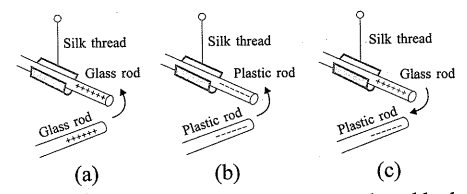
Describe the two experiments related to static friction with diagram.
Answer
Image
►It was observed that if two glass rods rubbed with wool or silk cloth are brought close to each other, they will repel. [Fig. (a)].
►The two strands of wool or two pieces of silk cloth, with which the rods were rubbed, also repel each other.
►The glass rod and wool are attracted to each other.
►Similarly, two plastic rods rubbed with cat's fur will repell each other [Fig. (b)] but attract the fur.
►On the other hand, the plastic rod attracts the glass rod [Fig. (c)] and repels the silk or wool with which the glass rod is rubbed. The glass rod repels the fur.
View full question & answer
Question 142 Marks
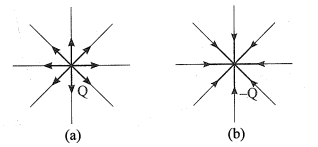
Give the characteristics of an electric field.
Answer
►(i) A force F equal to the charge $q$ multiplied by the electric field E at the location of $q$. Thus, $F (r)=q E (r)$
Image
►From Eq., we can infer that if q is unity, the electric field due to a charge Q is numerically equal to the force exerted by it.
If $q =1$ unit, $\therefore \overrightarrow{ F }=\overrightarrow{ E }$
►Thus, the electric field due to a charge $Q$ at a point in space may be defined as the force that a unit positive charge would experience if placed at that point.
►The charge Q , which is producing the electric field, is called a source charge and the charge q , which tests the effect of a source charge, is called a test charge.
►The source charge Q must remain at its original location. However, if a charge q is brought at any point around $Q , Q$ itself is bound to experience an electrical force due to q and will tend to move. A way out of this difficulty is to make q negligibly small. The force F is then negligibly small but the ratio $F / q$ is finite and defines the electric field:
$\overrightarrow{ E }=\lim _{q \rightarrow 0}\left(\frac{\overrightarrow{ F }}{q}\right)$
(ii) The electric field E due to Q , though defined operationally in terms of some test charge $q$, is independent of $q$. This is because F is proportional to $q$, so the ratio $F / q$ does not depend on $q$.
(iii) From figure (a) the electric field will be directly outward from the positive charge.
From figure (b) the electric field will be directed inward towards the negative charge.
(iv) Force between two charges depends on the distance between them, so magnitude of electric field is also inversely proportional to the square of distance.
$E \propto \frac{1}{r^2}$
View full question & answer
Question 152 Marks
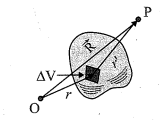
Obtain the expression of electric field at any point by continuous distribution of charge on a volume.
Answer
Image

►As shown in figure, the charge is uniformly distributed over volume. In this charge distribution, a point P is outside and we want to find electric field at this point.
►Take one small volume part in consideration. The volume of this part is $\Delta V$.
►A position vector of $\Delta V$ is $\vec{r}$ and point P is $\overrightarrow{ R }$ from origin.
►$\rho$ is volume density of electric charge on volume. So, charge on small part of volume is, $\Delta q=\varrho \Delta V$
►Electric field at point P due to this electric charge,
$\Delta \overrightarrow{ E }=\frac{1}{4 \pi \varepsilon_0} \cdot \frac{\rho \Delta V }{\left(r^{\prime}\right)^2} \cdot \hat{r}^{\prime}$
►According to super position theorem total electric field at point P ,
$\overrightarrow{ E }=\sum_{ V } \frac{1}{4 \pi \varepsilon_0} \cdot \frac{\rho \Delta V }{\left(r^{\prime}\right)^2} \cdot \hat{r}^{\prime}$
►If we take limit $\Delta V \rightarrow 0$ then above addition is converted into integration.
$\overrightarrow{ E }=\frac{1}{4 \pi \varepsilon_0} \int \frac{\rho d V}{\left(r^{\prime}\right)^2} \cdot \hat{r}^{\prime}$
View full question & answer
Question 162 Marks
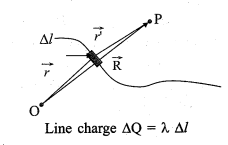
Obtain the expression of electric field at any point by continuous distribution of charge on a line.
Answer
Image
►As shown in figure, the charge is uniformly distributed over line.
►In this charge distribution, a point $P$ is outside the distribution and we want to find electric field at this point.
►To get the electric field at point P we have to divide whole line into small parts.
►Consider small part of length as $\Delta l$, Position vector of $\Delta l$ is $\vec{r}$ and point P is $\overrightarrow{ R }$ w.r.t. origin.
►$\lambda$ is linear density of electric charge on line. So, charge on small part of $\Delta l$ is, $\Delta q=\lambda \cdot \Delta l$
►Electric field at point P due to this electric charge,
$\Delta \overrightarrow{ E }=\frac{1}{4 \pi \varepsilon_0} \cdot \frac{\lambda \Delta l}{\left(r^{\prime}\right)^2} \cdot \hat{r}^{\prime}$
►Here, $\hat{r}$ is unit vector in the direction of electric field.
►To get the total electric field at point P we have to get electric field of all the small parts. Then we need to add all of them.
$\therefore$ Total electric field
$\overrightarrow{ E }=\frac{1}{4 \pi \varepsilon_0} \cdot \sum_{\Delta l} \frac{\lambda \Delta l}{r^{\prime 2}} \cdot \hat{r}^{\prime}$
►If we take $\Delta l \rightarrow 0$ then above addition is converted into integration.
$\therefore \overrightarrow{ E }=\frac{1}{4 \pi \varepsilon_0} \cdot \int_l \frac{\lambda d l}{\left(r^{\prime}\right)^2} \cdot \hat{r}^{\prime}$
View full question & answer
Question 172 Marks
Explain with example why matter particle acquires electric charge.
Answer
►All matter is made up of atoms and/or molecules. Although the materials are electrically neutral, they do contain charges; but their charges are exactly balanced.
►To electrify a neutral body, we need to add or remove one kind of charge. When we say that a body is charged, we always refer to this excess charge or deficit of charge.
►In solids, some of the electrons, being less tightly bound in the atom, are the charges which are transferred from one body to the other. A body can thus be charged positively by losing some of its electrons.
►Similarly, a body can be charged negatively by gaining electrons.
►When we rub a glass rod with silk, some of the electrons from the rod are transferred to the silk cloth. Thus the rod gets positively charged and the silk gets negatively charged.
View full question & answer
Question 182 Marks
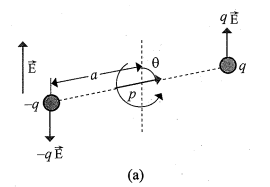
Derive the formula of torque for electric dipole placed in uniform electric field. $\#\#\#$ Explain behaviour of a dipole in a uniform electric field.
Answer
Image
$►$ As shown in figure, the electric dipole is placed in uniform electric field at $\theta$ angle.
$►$ The force exerted on $+q$ electric charge in electric field $\vec{E}$ is,
$\overrightarrow{ F }+=q \overrightarrow{ E }$
$►$ The force exerted on $-q$ electric charge
$\overrightarrow{ F }_{-}=-q \overrightarrow{ E }$
$►$ The net force on the dipole is zero, since E is uniform.
$►$ However, the charges are separated, so the forces act at different points, resulting in a torque on the dipole.
$►$ When the net force is zero, the torque (couple) is independent of the origin. Its magnitude equals the magnitude of each force multiplied by the arm of the couple (perpendicular distance between the two antiparallel forces).
$►$
$ \text { Magnitude of torque } =q E \times 2 a \sin \theta$
$ =(2 q a) E \sin \theta=p E \sin \theta$
$\vec{\tau}=\vec{p} \times \overrightarrow{ E }$
$►$ The magnitude of $\vec{p} \times \overrightarrow{ E }$ is also $p E \sin \theta$ and its direction is normal to the paper, coming out of it.
$►$ Special cases :
$(i)$ If electric dipole moment and electric field both are in one direction.
$\therefore \theta=0$
$\therefore \tau=0$
This condition is called stable equilibrium.
$(ii)$ Both electric dipole moment and electric field are perpendicular.
$\therefore \theta=\frac{\pi}{2}$
$\therefore \tau=p E \sin \frac{\pi}{2}$
$\therefore \tau=p E \rightarrow$ Which is maximum
$(iii)$ Electric dipole moment and electric field are arranged anti parallel direction.
$\therefore \tau= pE \sin \pi$
$\therefore \tau=0 \rightarrow$ Unstable equilibrium
View full question & answer
Question 192 Marks
Explain : "Electric charges are additive in nature."
Answer
→ If a system contains two point charges $q_1$ and $q_2$, the total charge of the system is obtained simply by adding them algebraically. i.e., total charge of the system is $q_1+q_2$.
→ If a system contains n charges $q_1, q_2, q_3, \ldots, q_n$, then the total charge of the system is $q_1+q_2+$ $q_3+\ldots+q_n$
→ Charge has magnitude but no direction, similar to mass. However, there is one difference between mass and charge. Mass of a body is always positive whereas a charge can be either positive or negative. Proper signs have to be used while adding the charges in a system.
→ For example, the total charge of a system containing five charges $+1,+2,-3,+4$ and -5 , in some arbitrary unit, is $(+1)+(+2)+(-3)+$ $(+4)+(-5)=-1$.
→ Thus, the total electric charge of any system is equal to the algebraic sum of the positive and negative electric charge at different points within the system.
View full question & answer
Question 202 Marks
Write down the phenomena seen or observed during the generation of static electricity.
Answer
► All of us have the experience of seeing a spark or hearing a crackle when we take off our synthetic clothes or sweater, particularly in dry weather.
► This is almost inevitable with ladies garments like a polyester saree.
►Another common example of electric discharge is the lightning that we see in the sky during thunderstorms.
► We also experience a sensation of an electric shock either while opening the door of a car or holding the iron bar of a bus after sliding from our seat.
► The reason for these experiences is discharge of electric charges through our body, which were accumulated due to rubbing of insulating surfaces.
► Static means anything that does not move or change with time.
View full question & answer
Question 212 Marks
Obtain the expression of electric field at any point by continuous distribution of charge on a surface.
Answer
Image
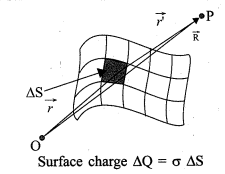
►As shown in figure, the charge is uniformly distributed over surface In this charge distribution a point P is outside and we want to find electric field at this point.
►To get the electric field at point P we have to divide whole surface into small surface parts.
►Take one small surface part in consideration. The area of this part is $\Delta S$.
►A position vector of $\Delta S$ is $\vec{r}$ and point P is $\vec{R}$ from origin.
►$\sigma$ is surface density of electric charge on surface, so charge on small part of area is, $\Delta q=\sigma \Delta S$
►Electric field on point P due to this electric charge,
$\Delta \overrightarrow{ E }=\frac{1}{4 \pi \varepsilon_0} \frac{\sigma \Delta S }{\left(r^{\prime}\right)^2} \cdot \hat{r}^{\prime}$
►According to super position theorem, total electric field at point $P$,
$\overrightarrow{ E }=\sum_{ S } \frac{1}{4 \pi \varepsilon_0} \cdot \frac{\sigma \Delta S }{\left(r^{\prime}\right)^2} \cdot \hat{r}^{\prime}$
►If we take limit $\Delta S \rightarrow 0$ then above addition is converted into integration.
$\overrightarrow{ E }=\frac{1}{4 \pi \varepsilon_0} \int_\rho \frac{\sigma d S}{\left(r^{\prime}\right)^2} \cdot \hat{r}^{\prime}$
View full question & answer
Question 222 Marks
In how many ways the continuous charges are distributed?
Answer
►There are three types of continuous electric charge distribution.
(1) Linear distribution.
(2) Surface distribution.
(3) Volume distribution.
View full question & answer
Question 232 Marks
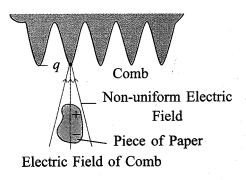
Why are small pieces of paper attracted by a dry comb rubbed against dry hair?
Answer
Image
►When a dry comb is rubbed against dry hair, it can attract small pieces of papers.
►When the charged comb is brought near the small pieces of papers, electric dipoles are induced along the direction of non uniform electric field in the small pieces of papers.
►This non-unifom electric field exerts a net force on the small pieces of paper dipoles and hence pieces of paper move in the direction of the comb.
View full question & answer
Question 242 Marks
Explain the behaviour of electric dipole in non-uniform electric field.
Answer
►If the electric field is unequal, the intensity of the electric field is different at different points, the forces on the positive and negative charges of an electric dipole will be unequal.
►Under these circumstances, both the resultant force and the torque are exerted on the dipole. Hence the rotation of dipole is accomplished by its linear displacement.
►When rotating dipole gets arranged in the direction of electric field, it will stop its rotation, but continue its linear motion.
View full question & answer
Question 252 Marks
What is called point dipole?
Answer
A dipole in which $q \rightarrow \infty$ and $a \rightarrow 0$ is called point dipole.
View full question & answer
Question 262 Marks
From what electric dipole of electric field is found and for which two cases is the result simple?
Answer
►The electric field of the pair of charges $(-q$ and q) at any point in space can be found out from Coulomb's law and the superposition principle.
►The results are simple for the following two cases: (i) when the point is on the dipole axis, and (ii) when it is in the equatorial plane of the dipole, i.e., on a plane perpendicular to the dipole axis through its centre.
View full question & answer
Question 272 Marks
Explain in short about electric dipole.
Answer
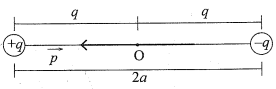
►A system consisting of two equal and opposite charges at some distance is called electric dipole.
►The total charge of the electric dipole is obviously zero. This does not mean that the field of the electric dipole is zero. Since the charge q and - q are separated by some distance, the electric fields due to them, when added, do not exactly cancel out.

Image
►The product of the magnitude of any electric charge on an electric dipole and the distance (2a) between them is called the electric dipole moment.
►Electric dipole moment $\vec{p}=\overrightarrow{2 a} q$
►SI unit of electric dipole moment is Cm (Coulomb meter), Dimensional formula is $M ^0 L^1 T^1 A^1$
View full question & answer
Question 282 Marks
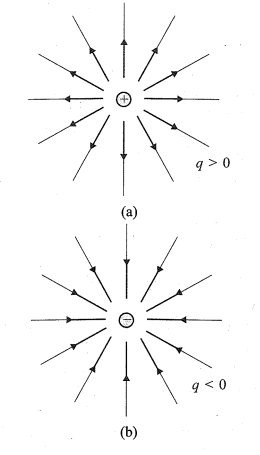
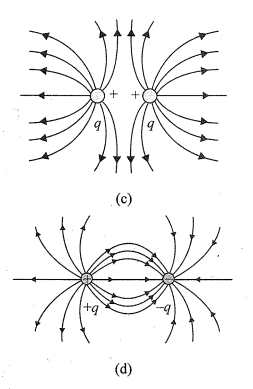
Draw the field lines of Simple electric charge distribution.
Answer
►Figure (a) shows the electric field lines for positive electric charge.
►Figure (b) shows the electric field lines for negative electric charge
►Figure (c) shows the electric field lines for two positive and equal value electric charge.
►Figure (d) shows the electric field lines for electric dipole.
Image
Image
View full question & answer
Question 292 Marks
On the basis of electric field lines, in space, how does the intensity ( $\vec{E}$ ) of electric field of a point charge depend on distance $r$ ? - explain.
###
How do electric field lines depend on area or the solid angle subtended by area element?
Answer
Image
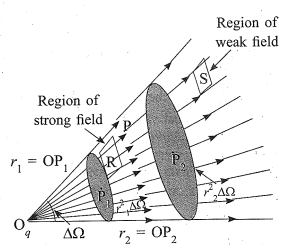
►Figure shows a set of field lines. We can imagine two equal and small elements of area placed at points R and S normal to the field lines there.
►The number of field lines in our picture cutting the area elements is proportional to the magnitude of field at these points.
►The picture shows that the field at R is stronger than at S .
►To understand the dependence of the field lines on the area, or rather the solid angle subtended by an area element, let us try to relate the area with the solid angle.
►The solid angle subtended by a small perpendicular plane area $\Delta S$, at a distance $r$, can be written as $\Delta \Omega=\Delta S / r^2$.
►In Fig. for two points $P_1$, and $P_2$ at distances $r_1$ and $r_2$ from the charge, the element of area subtending the solid angle $\Delta \Omega$ is $r_1^2 \Delta \Omega$ at $P_1$ and an element of area $r_2^2 \Delta \Omega$ at $P_2$, respectively.
►The number of field lines, cutting unit area element is therefore $n /\left(r_1^2 \Delta \Omega\right)$ at $P _1$ and $n /\left(r_2^2\right.$ $\Delta \Omega)$ at $P _2$, respectively. $\left[\begin{array}{c}
\because \text { Number of field lines cutting the unit area element } \\
=\text { Number of field lines passing } \\
\frac{\text { through the whole Area }}{\text { Area }}
\end{array}\right]$
►Since $n$ and $\Delta \Omega$ are common, the strength of the field clearly has a $1 / r^2$ dependence.
View full question & answer
Question 302 Marks
Explain characteristics of electric charge.
Answer
►(1) There are two types of electric charge :
         (i) Positive charge.
         (ii) Negative charge.
   (2) Heterogeneous electric charges repel and homogeneous charge attracts each other.
   (3) Electric charge without mass does not exist.
   (4) Charge is an internal property of matter.
View full question & answer
Question 312 Marks
When we can consider a charged particle as point electric charge ?
Answer
►When the linear size of charged bodies are much smaller than the distance separating them, the size may be ignored and the charged bodies are treated as point charges.
View full question & answer
Question 322 Marks
Give the SI unit and definition of electric charge and also write down the smaller unit.
Answer
►One coulomb is the charge flowing through a wire in 1 s if the current is 1 A (ampere). In this system, the value of the basic unit of charge is $e=1.602192 \times 10^{-19} C$
►Thus, there are about $6 \times 10^{18}$ electrons in a charge of $-1 C$. In electrostatics, charges of this large magnitude are seldom encountered and hence we use smaller units $1 \mu C$. (micro coulomb) $=10^{-6} C$ or 1 mC (milli coulomb) $=$ $10^{-3} C$.
►The SI unit of electric charge is coulomb, it is denoted as ' C '.
View full question & answer
Question 332 Marks
Explain electric field produced by the point electric charge.
Answer
Image
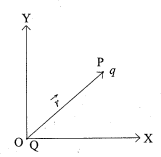
►Let us consider a point charge $Q$ placed in vacuum, at the origin $O$. If we place another point charge q at a point P , where $\overrightarrow{ OP }=\vec{r}$, then the charge $Q$ will exert a force on $q$ as per Coulomb's law.
►The external effect which produces force on charge q , is called electric field of charge $Q$.
►Electric field at point ' P '
$\overrightarrow{ E }(r)=\frac{1}{4 \pi \varepsilon_0} \cdot \frac{ Q }{r^2} \cdot \hat{r}$
Where $\hat{r}$ is the unit vector in the direction of electric field.
►The area around any electric charge or electric charge system where its effect prevails is called the electric field of the electric charge or electric charge system.
OR
►"In the region of an electric charge, or a system of charge, the electrostatic force acting on a unit positive charge placed at some point is called
the electric field of the given electric charge / system of charges."
►Electric field is a vector quantity.
►Its unit is $N / C$ or $V / m .\left( M ^1 L^1 T^{-3} A^{-1}\right)$
View full question & answer
Question 342 Marks
What is electrostatics?
Answer
The field of physics which studies the forces, fields and potential due to static electric charges is called electrostatics.
View full question & answer
Question 352 Marks
State the conclusion of experiments about Iriction charge.
Answer
►The experiments about friction charge suggested that there are two kinds of electrification : (i) like charges repel and (ii) unlike charges attract each other.
►The property which differentiates the two kinds of charges is called the polarity of the charges.
►The experiments also demonstrated that the charges are transferred from the rods to the pith balls on contact. It is said that the pith balls are electrified or are charged by contact.
►When a glass rod is rubbed with silk, the rod acquires one kind of charge and the silk acquires the second kind of charge.
►Now if the electrified glass rod is brought in contact with silk, with which it was rubbed, they no longer attract each other.
►Thus, the charges acquired after rubbing are lost when the charged bodies are brought in contact.
►These observations just tell us that unlike charges acquired by the objects neutralise or nullify each other's effect.
View full question & answer
Question 362 Marks
Explain the Construction and working of gold leaf electroscope.
Answer
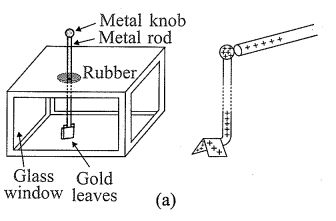
►A gold leaf electroscope is shown in figure.
►Its a simple apparatus to detect charge on a body [Fig. (a)].
►It consists of a vertical metal rod housed in a box, with two thin gold leaves attached to its bottom end.
►When a charged object touches the metal knob at the top of the rod, charge flows on to the leaves and they diverge.
►The degree of divergance is an indicator of the amount of charge.
Image
View full question & answer
Question 372 Marks
Explain : Why we can consider quantisation of charge for microscopic level but not for macroscopic level ?
Answer
►The size of e is, however, very small because at the macroscopic level, we deal with charges of a few $\mu C$.
►At this scale the fact that charge of a body can increase or decrease in units of $e$ is not visible.
►In this respect, the particle nature of the charge is lost and it appears to be continuous. This situation can be compared with the geometrical concepts of points and lines. A dotted line viewed from a distance appears continuous to us but is not continuous in reality. As many points very close to each other normally give an impression of a continuous line, many small charges taken together appear as a continuous charge distribution.
►At the macroscopic level, one deals with charges that are enormous compared to the magnitude of charge $e$. Since $e=1.6 \times 10^{-19} C$, a charge of magnitude, say $1 \mu C$, contains something like $10^{13}$ times the electronic charge.
►At this scale, the fact that charge can increase or decrease only in units of $e$ is not very different from saying that charge can take continuous values.
►Thus, at the macroscopic level, the quantisation of charge has no practical consequence and can be ignored. However, at the microscopic level, where the charges involved are of the order of a few tens or hundreds of e, i.e., they can be counted, they appear in discrete lumps and quantisation of charge cannot be ignored.
View full question & answer
Question 382 Marks
State the important points of Gauss's law.
Answer
►(i) Gauss's law is true for any closed surface, no matter what its shape or size is.
As per Gauss's law, $\phi=\int \overrightarrow{ E } \cdot \overrightarrow{ dS }=\frac{\sum q}{\varepsilon_0}$
(ii) The term q on the right side of Gauss's law, Eq. (1), includes the sum of all charges enclosed by the surface. The charges may be located anywhere inside the surface.
(iii) In the situation when the surface is so chosen that there are some charges inside and some outside, the electric field [whose flux appears on the left side of Eq. (1)] is due to all the charges, both inside and outside S . The term q on the right side of Gauss's law, however, represents only the total charge inside S .
(iv) The surface that we choose for the application of Gauss's law is called the Gaussian surface. You may choose any Gaussian surface and apply Gauss's law.
(v) Gauss's law is often useful towards a much easier calculation of the electrostatic field when the system has some symmetry. This is facilitated by the choice of a suitable Gaussian surface.
(vi) Finally, Gauss's law is based on the inverse square dependence on distance contained in the Coulomb's law.
View full question & answer
Question 392 Marks
Write the uses of Gauss's law.
Answer
►Applications of Gauss's theorem :
(1) To get field due to infinitely long straight uniformly charged wire.
(2) To get field due to a uniformly charged infinite plane sheet
(3) To get field due to uniformly charged thin spherical shell
(4) To get field due to uniformly charged sphere.
View full question & answer
Question 402 Marks
Explain physical meaning of electric field.
Answer
►Electric field is an elegant way of characterising the electrical environment of a system of charges.
►Electric field at a point in the space around a system of charges tells you the force a unit positive test charge would experience if placed at that point (without disturbing the system).
►Electric field is a characteristic of the system of charges and is independent of the test charge that you place at a point to determine the field.
►The term field in physics generally refers to a quantity that is defined at every point in space and may vary from point to point.
►Electric field is a vector field, since force is a vector quantity.
►The field picture is this: the accelerated motion of charge $q _1$ produces electromagnetic waves, which then propagate with the speed c , reach $q _2$ and cause a force on $q _2$.
►The concept of field was first introduced by Faraday.
View full question & answer
Question 412 Marks
Give the definition of 1 C from Coulomb's law.
Answer
►From Coulomb's law, the electric force acting on the two point charges at distance $r$ is, $F =\frac{ kq _1 q _2}{r^2}$
►If we put $q_1=q_2=1 C$ and take $r=1 m$ we get $F =9 \times 10^9 N$.
►1 C is the charge that, when placed at a distance of 1 m from another charge of the same magnitude in vacuum experiences an electrical force of repulsion of magnitude $9 \times 10^9 N$.
►One coulomb is evidently too big unit to be used. In practice, in electrostatics, one uses smaller units like 1 mC or $1 \mu C$.
View full question & answer
Question 422 Marks
Write down the limitations of Coulomb's law.
Answer
►The limitations of Coulomb's law are as follows :
(i) The electric charge should be point charge.
(ii) Charge must be constant.
(iii) This rule does not apply for distance less than $10^{-15} m$
(iv) This force is only applicable when the distance between two electric charges is not more than $10^{18} m$.
(v) From the coulomb's law we can only get the force between two electric charges.
View full question & answer
Question 432 Marks
How did Coulomb get the law of electric force between two point charges ?
Answer
►When the separation between two spheres is much larger than the radius of each sphere, the charged spheres may be regarded as point charges.
►However, the charges on the spheres in Coulomb's experiments were unknown, to begin with.
►Coulomb thought of the following simple way: Suppose the charge on a metallic sphere is $q$. If the sphere is put in contact with an identical uncharged sphere, the charge will spread over the two spheres. By symmetry, the charge on each sphere will be $\frac{q}{2}$.
►Repeating this process, we can get charges $\frac{q}{2}, \frac{q}{4}$, etc.
►Coulomb varied the distance for a fixed pair of charges and measured the force for different separations.
►From this he got $F \propto \frac{1}{r^2}$
►After that he changed the electric charge of pair but kept the distance constant.
►From this he got $F \propto q_1 q_2$
►From this, for different pairs and different distances he got the equation given below. $F =$ $k \frac{q_1 q_2}{r^2}$
View full question & answer
Question 442 Marks
What is called polar and non-polar atom ? Give example of it.
Answer
►In most molecules, the centres of positive charges and of negative charges lie at the same place. Therefore, their dipole moment is zero. This is know as non polar molecules.
► $CO _2$ and $CH _4$ are examples of this type of molecules.
►However, they develop a dipole moment when an electric field is applied.
►But in some molecules, the centres of negative charges and of positive charges do not coincide. Therefore, they have a permanent electric dipole moment, even in the absence of an electric field. Such molecules are called polar molecules.
Example : $HCl , H _2 O$
View full question & answer
Question 452 Marks
Give an explanation about electric field lines and explain how they can be drawn.
Answer
Image
►Electric field lines are the pictorial representation of an electric field.
►Electric field lines were first described by a scientist named Michael Faraday.
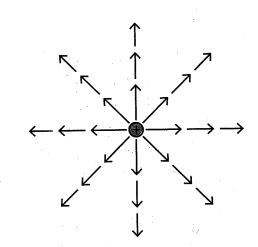
►Let the point charge be placed at the origin. Draw vectors pointing along the direction of the electric field with their lengths proportional to the strength of the field at each point.
►Since the magnitude of electric field at a point decreases inversely as the square of the distance of that point from the charge from $\left( E =\frac{k Q }{r^2}\right)$ the vector gets shorter as one goes away from the origin, always pointing radially outward. Figure shows such a picture.
►In this figure, each arrow indicates the electric field, i.e., the force acting on a unit positive charge, placed at the tail of that arrow.
►Connect the arrows pointing in one direction and the resulting figure represents a field line. We thus get many field lines, all pointing outwards from the point charge.
►The magnitude of the field is represented by the density of field lines. E is strong near the charge, so the density of field lines is more near the charge and the lines are closer.
►Away from the charge, the field gets weaker and the density of field lines is less, resulting in well-separated lines.
View full question & answer
Question 462 Marks
Explain by graph how the electric field by thin spherical shell depends on the distance, of point from centre.
View full question & answer