Question
Describe the various elements of a computer system and explain the distinctive features of a computer system and manual system.

Answer

A computer system is ideally composed of the following six elements:
  1. Hardware: It includes all the physical components of a computer such as, keyboard, mouse, monitor, processor, etc. These can be touched and a user inputs commands through them.
  2. Software: It is referred to a set of the programs that enables a computer to perform its tasks or commands given by the user. There are following six types of software.
  1. Operating System: It is an integrated set of specialised programs that are meant to manage and control the resources of a computer. They make the computer user–interactive, i.e. user-friendly. It means that operating system forms an interactive link between the user and the computer hardware.
  2. Utility Programs: Utility Programs refer to the set of pre-written computer programs that are designed to perform certain supporting operations. Most of the utility software are highly specialised and are specially designed to perform a single task or a small range of tasks.
  3. Application Software: These are user-oriented programs that are designed and developed for performing certain specified tasks.
  4. Language Processors: These are the software that interpret or translate a program language into a machine language.
  5. System Software: These are the software that controls the internal functions of the system such as reading data from the input devices.
  6. Connectivity Software: These are the software that creates and controls the connection between a computer and a server with the purpose of sharing the data.
  1. People: It constitutes the most important part of a computer system. It basically refers to the individuals or the users who interact with the computer through the use of hardware and software. The following are the people who are involved in a computer system.
  1. System Analyst: They are the people who design the data processing system.
  2. Operators: They are the people who write programs to implement the data processing system.
  3. Programmers: They are the people who participate in operating the computers.
  1. Procedures: A series of operations that are executed in a certain manner in order to achieve a desired set of results is known as 'Procedures'. There are mainly following three types of procedures.
  1. Hardware Oriented Procedures: Hardware Oriented Procedures provide details about various components of a computer and their uses.
  2. Software Oriented Procedures: Software Oriented Procedures provide detailed set of instructions required for using the software of a computer system.
  3. Internal Procedures: These procedures help in sequencing the operation or working of each sub-set of overall computer system.
  1. Data: It refers to the facts that are gathered and entered into a computer system. It may comprise of numbers, text, graphics, etc.
  2. Connectivity: This refers to the manner, in which a computer system is connected to the other electronic devices through telephone lines, microwave transmission, satellite link, etc., is known as 'Connectivity'.
The mentioned below are some distinctive features of a computer system and a manual system:
  1. Accuracy: The computations and operations performed by a computer are highly accurate and correct. If any error is detected it may be due to input of the wrong data or wrong command by the user.
As against this, in manual system the results generated or produced by the human beings are not very accurate due to carelessness, boredom and fatigue.
  1. Speed: Computer systems require far less time than the manual systems in performing a task. Modern computers can perform 100 million calculations per second.
  2. Reliability: It may be beyond the human capabilities to work continuously for long hours. Often people get tired, lack concentration and may feel mental stress while working out huge volume of data that involves tedious calculations. Computer systems overcome these limitations very easily. A computer can easily perform variety of tasks with great precision and accuracy, thereby making the results highly reliable.
As against this, the reliability of the manual system is little doubtful in case of voluminous data.
  1. Versatility: Computers are designed to perform a variety of task and has wide application in various areas such as, business, industry, etc. As against this, in manual systems human beings can perform only a few specialised tasks and thus are lesser versatile.
  2. Storage: Computers have a huge storage capacity and can store huge volume of data in a very small physical space. For example a typical main frame computer can store bullions of characters and thousands of graphic images. As against this, the capabilities of manual system are no where close to this.

Need a full question paper?

Generate a complete, print-ready paper with questions like this in minutes — across 16+ boards, with answer keys.
Start Generating Free

Similar questions

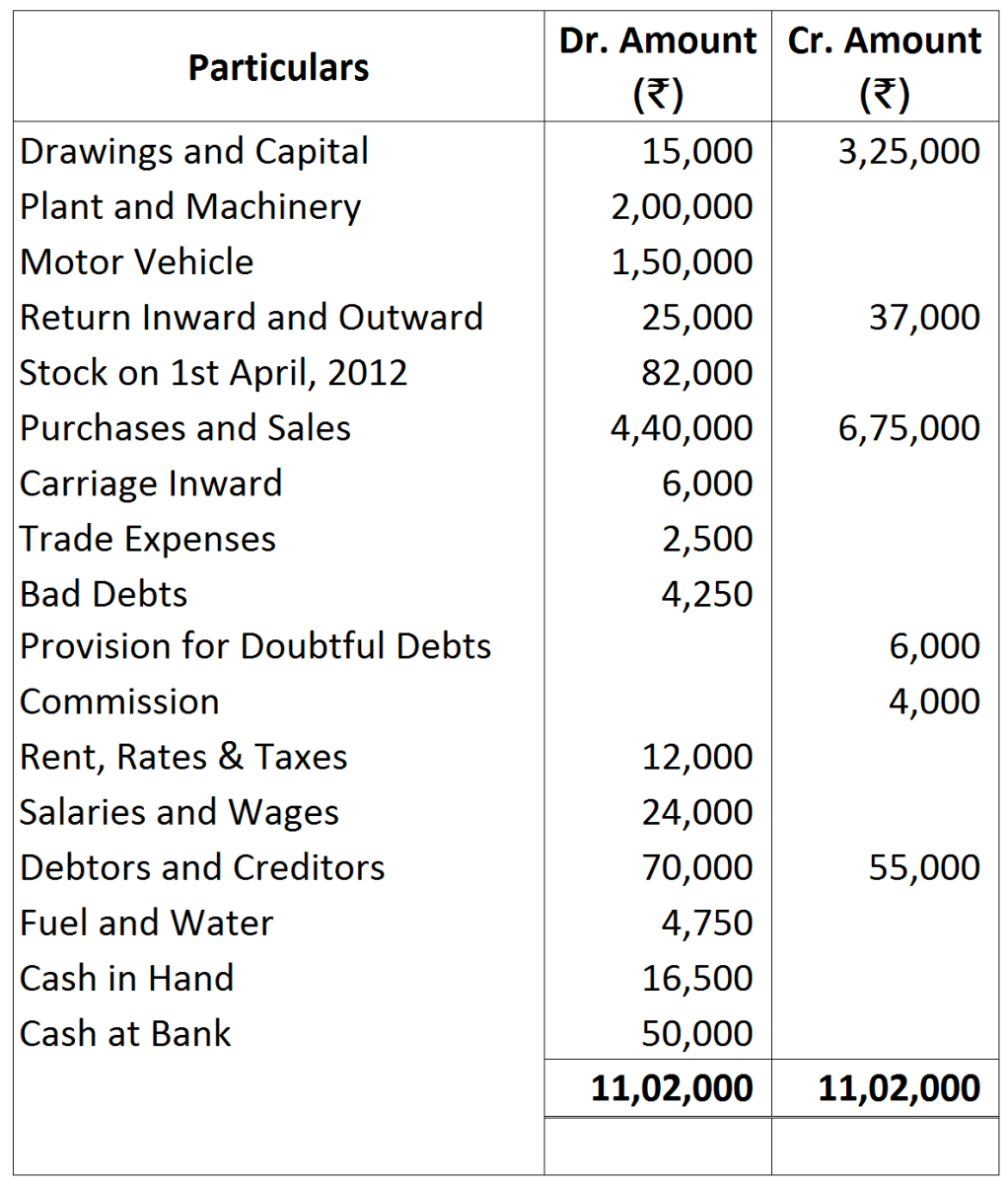
Prepare Trading and Profit and Loss Account and Balance Sheet from the following Trial Balance and information as on 31st March, 2019:

Adjustments:
  1. Closing Stock was valued at ₹ 1,12,500.
  2. Commission include ₹ 1,200 being commission received in advance.
  3. Salaries and wages is outstanding for the month of Feb. & March, 2019.
  4. Depreciate Plant & Machinery by 15% and Motor Vehicle by 20%.
  5. Write off ₹ 500 as further Bad Debts and maintain provision for doubtful debts at 1% on debtors.
Distinguish between Profit and Loss Account and Balance Sheet on any six basis.
Explain the process of Company Creation.
A company whose accounting year is a financial year, purchased on 1st July, 2015 machinery costing ₹ 30,000.
It purchased further machinery on 1st January, 2016 costing ₹ 20,000 and on 1st October, 2016 costing ₹ 10,000.
On 1st April, 2017, one-third of the machinery installed on 1st July, 2015 became obsolete and was sold for ₹ 3,000.
Show how Machinery Account would appear in the books of the company. It being given that machinery was depreciated by Fixed Instalment Method at 10% p.a. What would be the value of Machinery Account on 1st April, 2018?
Write a note on relationship between Accounting Information System, Manufacturing Information System and Human Resource System.
Govind keeps incomplete records. On 1st April, 2022, his position was as follows:
LiabilitiesAmount (₹)AssetsAmount (₹)
Bank Overdraft7,500Cash6,400
Sundry Creditors15,000Stock52,000
Capital1,64,500Sundry Debtors28,000
  Fixed Assets1,00,000
  Prepaid Expenses600
 1,87,000 1,87,000

His position on 31st March, 2023 was as follows :
Cash in hand ₹ 3,000 ; Cash at Bank ₹ 5,000 ; Stock ₹ 44,000 ; Debtors ₹ 21,000 ; Fixed
Assets ₹ 80,000 ; Creditors ₹ 22,000 .
You are informed that Govind has taken stocks worth ₹ 4,500 for his private use and that he has been regularly transferring ₹ 2,000 per month from his business banking account by way of drawings. Out of his drawings, he spent ₹ 15,000 for purchasing a Scooter for the business on 1st October, 2022.
You are requested to find out his profit or loss and to prepare the Statement of Affairs after considering the following:
i. Depreciate Fixed Assets and Scooter by $10 \%$ p.a.
ii. Write off Bad-Debts ₹ 1,000 and provide $5 \%$ for doubtful debts on Sundry Debtors.
iii. Commission earned but not received by him was ₹ 2,500 .
A company purchased on 1st July, 2015 machinery costing ₹ 30,000. It further purchased machinery on 1st January, 2016 costing ₹ 20,000 and on 1st October, 2016 costing ₹ 10,000. On 1st April, 2017, one-third of the machinery installed on 1st July, 2015 became obsolete and was sold for ₹ 3,000. The company follows financial year as accounting year.
Show how the Machinery Account would appear in the books of company if depreciation is charged @ 10% p.a. on Written Down Value Method.
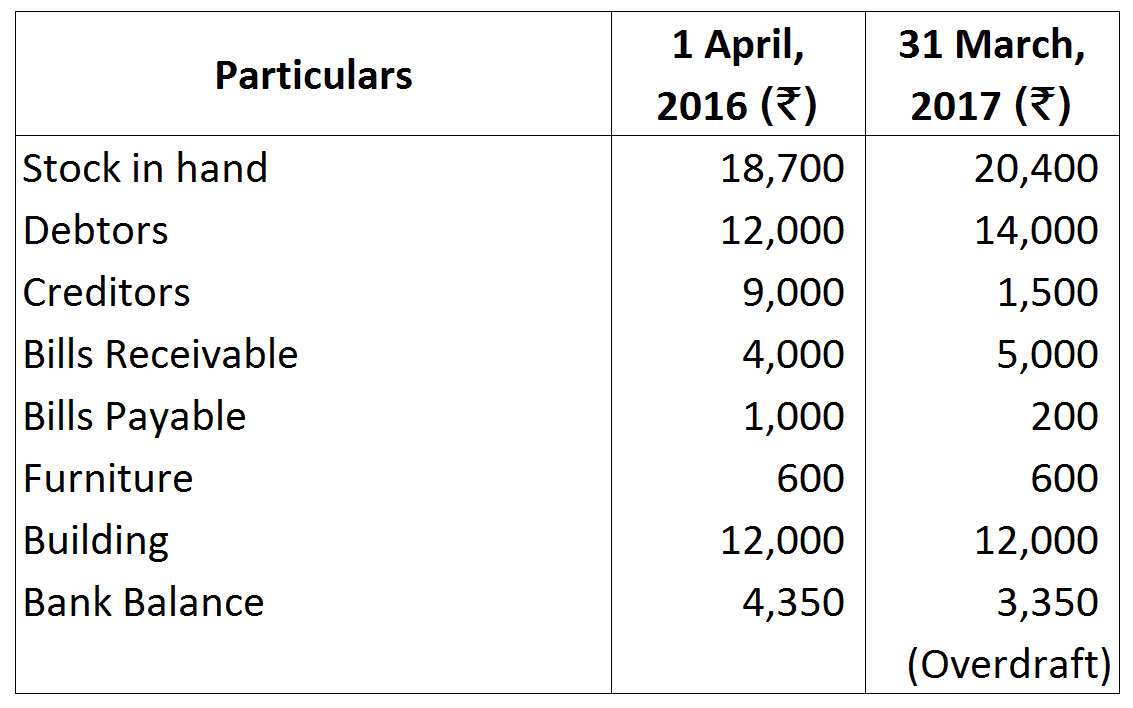
$X$ who keeps incomplete records, gives you the following information:
You are also given the following information:
  1. A provision of $₹\ 1,450$ is required for bad and doubtful debts.
  2. Depreciation $@ 5\%$ is to be written off on Building and furniture.
  3. Wages outstanding $₹\ 3,000$; salaries outstanding $₹\ 1,200.$
  4. Insurance has been prepaid to the extent of $₹\ 250.$
  5. Legal Expenses outstanding $₹\ 700.$
  6. Drawings of Mr. $X$ during the year were $₹\ 7,520.$
Prepare a statement of Profit as on $31^{st}$ March, $2017,$ and a final statement of affairs as at that date.
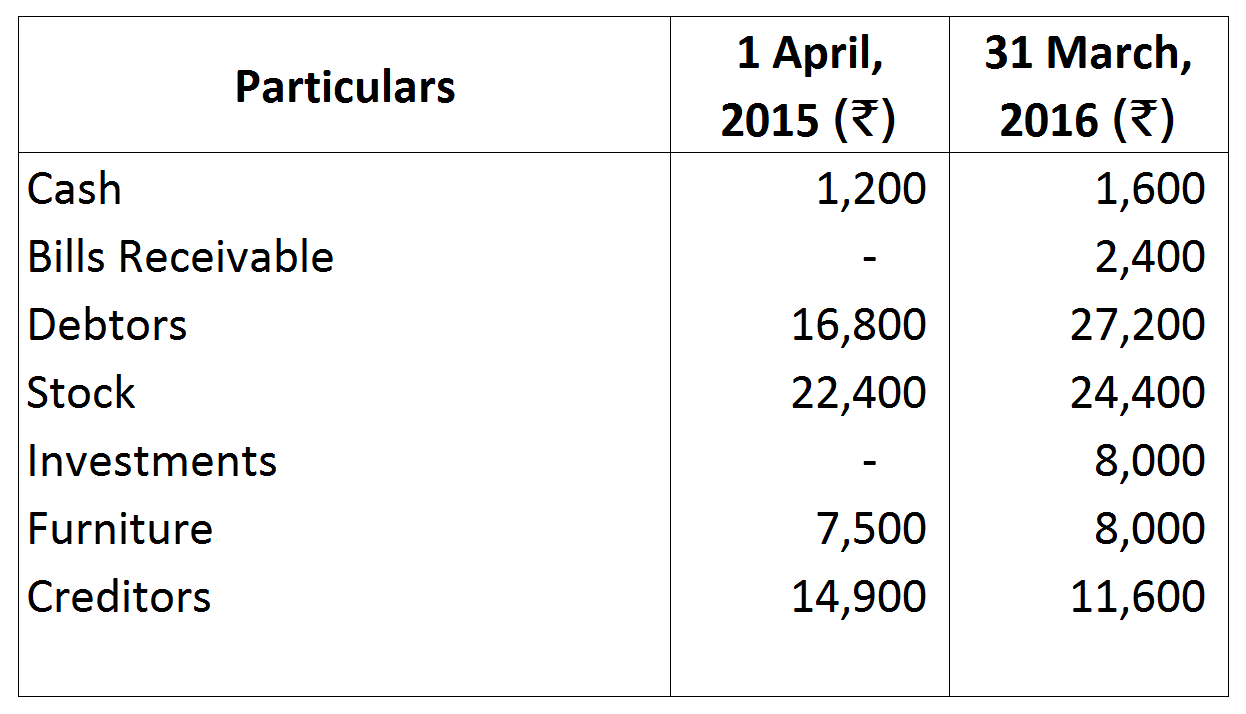
Shruti maintains her books of account from Incomplete Records. Her books provide the following information:
She withdrew ₹ 500 per month for personal expenses. She sold her Investments of ₹ 16,000 at 5% premium and introduced the amount into business.
You are required to prepare a Statement of Profit or Loss for the year ending 31st March, 2016.
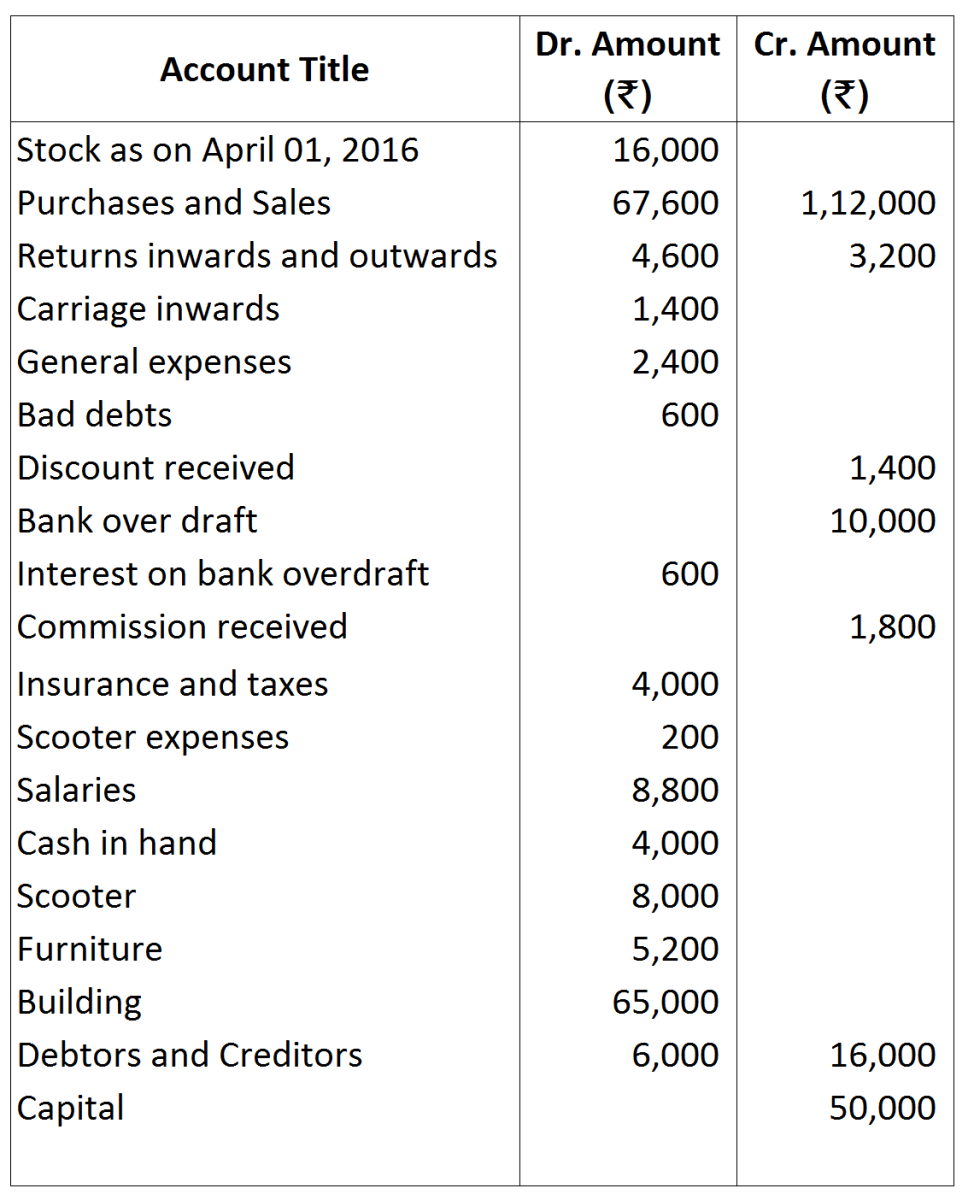
From the following trial balance of Mr. A. Lal, prepare trading, profit and loss account and balance sheet as on March 31, 2017.

Closing stock ₹ 15,000.