Question
Describe the working of Carnot engine. Obtain an expression for its efficiency.

Answer

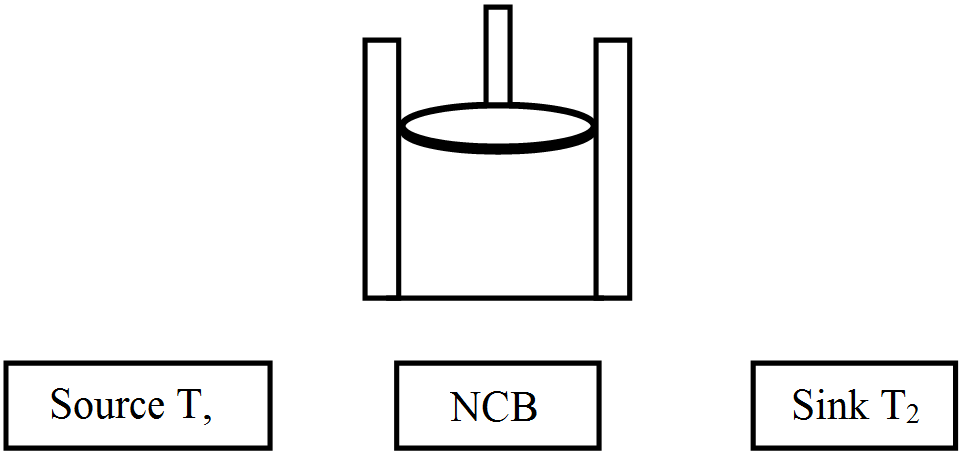
Carnot used a set of four devices—a source at a high temperature (say T1), a sink at a low temperature (say T2), a non-conducting base and a cylinder with a working substance, frictionless piston made of conducting base and non-conducting walls and piston.
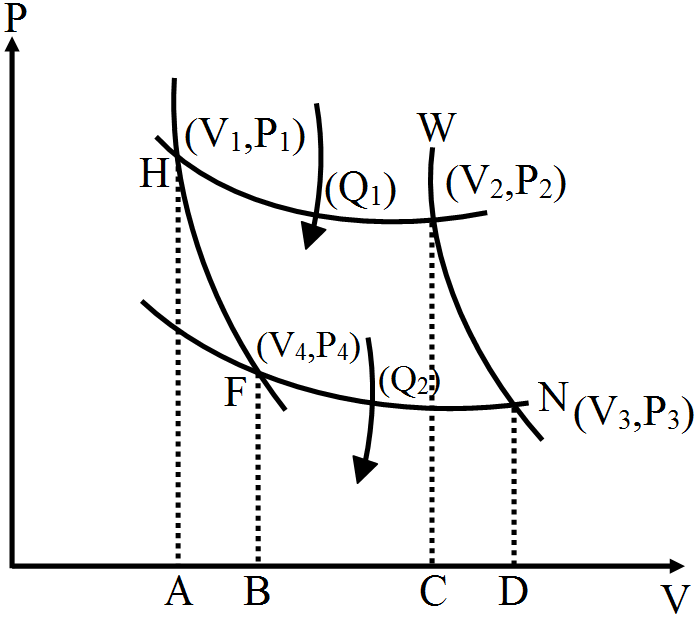
He carried the system through a step of four processes to complete a cycle as shown here.
Process I-HW is an isothermal expansion. Q1 energy flows in and temperature is maintained at T1 by placing the cylinder over the source.

Process II-WN is an adiabatic processes at a temperature flow from T1 to T2 conducted with cylinder over (NCB = Non conducting base).
Process III-NF is an isothermal process at T2 which gives out an energy Q2 with cylinder over sink
Process IV-FH is an adiabatic process which changes the temperature from T2 to T1 conducted with the cylinder placed over (NCB = Non conducting base).

In the process, a net work equalling the area HWNFH is done with the net heat intake,
Q1 - Q2 So, Efficiency $=\frac{\text{Work done}}{\text{heat supplied}}$
$=\frac{\text{Q}_1-\text{Q}_2}{\text{Q}_1}=1-\frac{\text{Q}_2}{\text{Q}_1}=1-\frac{\text{T}_2}{\text{T}_1}$

Need a full question paper?

Generate a complete, print-ready paper with questions like this in minutes — across 16+ boards, with answer keys.
Start Generating Free

Similar questions

Find the expression for kinetic energy, potential energy and total energy of a particle executing SHM.
A projectile is fired with a speed u at an angle $\theta$ above a horizontal field. The coefficient of restitution of collision between the projectile and the field is e. How far from the starting point, does the projectile makes its second collision with the field?
10kg mass is attached to one end of a copper wire 3m long and 1mm in diameter. Calculate the lateral compression produced in it (Poisson's ratio is 0.25 and Young's modulus of the material of the wire is 12.5 × 10¹⁰N/ m2).
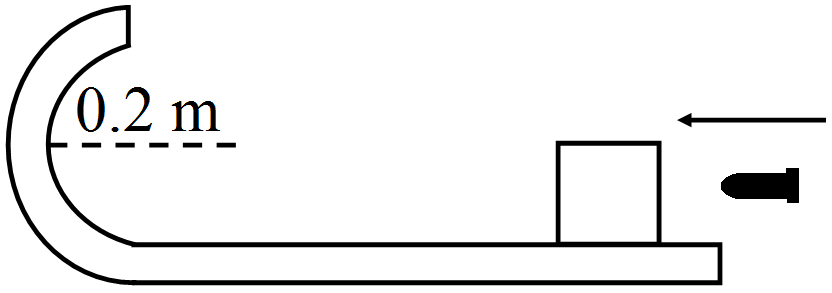
A bullet of mass 10g moving horizontally at a speed of 5017m/s strikes a block of mass 490g kept on a frictionless track as shown in figure. The bullet remains inside the block and the system proceeds towards the semicircular track of radius 0.2m. Where will the block strike the horizontal part after leaving the semicircular track ?

A mild steel wire of length 1.0m and cross-sectional area 0.50 × 10⁻²cm2 is stretched, well within its elastic limit, horizontally between two pillars. A mass of 100g is suspended from the mid-point of the wire. Calculate the depression at the midpoint.
State, for each of the following physical quantities, if it is a scalar or a vector : volume, mass, speed, acceleration, density, number of moles, velocity, angular frequency, displacement, angular velocity.
Find the change in the internal energy of 2kg of water as it is heated from 0°C to 4°C. The specific heat capacity of water is 4200Jkg-1 K-1 and its densities at 0°C and 4°C are 999.9kgm-3 and 1000kgm-3 respectively. Atmospheric pressure = 10-6Pa.
A pitcher with 1mm thick porous walls contains 10kg of water. Water comes to its outer surface and evaporates at the rate of 0.1gs-1. The surface area of the pitcher (one side)= 200cm2. The room temperature = 42°C, latent heat of vaporization $ =2.27\times10^6\text{Jkg}^{-1},$ and the thermal conductivity of the porous walls $=0.80\text{Js}^{-1}\text{m}^{-1}{^{\circ}}\text{C}^{-1}.$ Calculate the temperature of water in the pitcher when it attains a constant value.
The escape speed of a projectile on the earth’s surface is 11.2km s-1. A body is projected out with thrice this speed. What is the speed of the body far away from the earth? Ignore the presence of the sun and other planets.
At what temperature is the root mean square speed of an atom in an argon gas cylinder equal to the rms speed of a helium gas atom at-20°C? (atomic mass of Ar = 39.9u, of He = 4.0u).