Question
Describe various methods of asexual reproduction in animals.

Answer

Asexual reproduction is common among single-celled organisms and animals with relatively simple organisation. In lower organisms like protists and monerans, the organism or the parent cell divides into two, to give rise to new individuals. Thus, in these organisms cell division is itself a mode of reproduction. Asexual reproduction in animals occurs by the following methods:
  1. Fission: It is the division of the parent body into two or more daughter individuals identical to the parent. It can occur by binary fission and multiple fission:
  • Binary fission: It is the division of the parent cell into two small, nearly equal sized daughter individuals, each of which rapidly grows into an adult. It occurs in single-celled animals like bacteria and protozoans, e.g. Amoeba, Paramecium, etc.
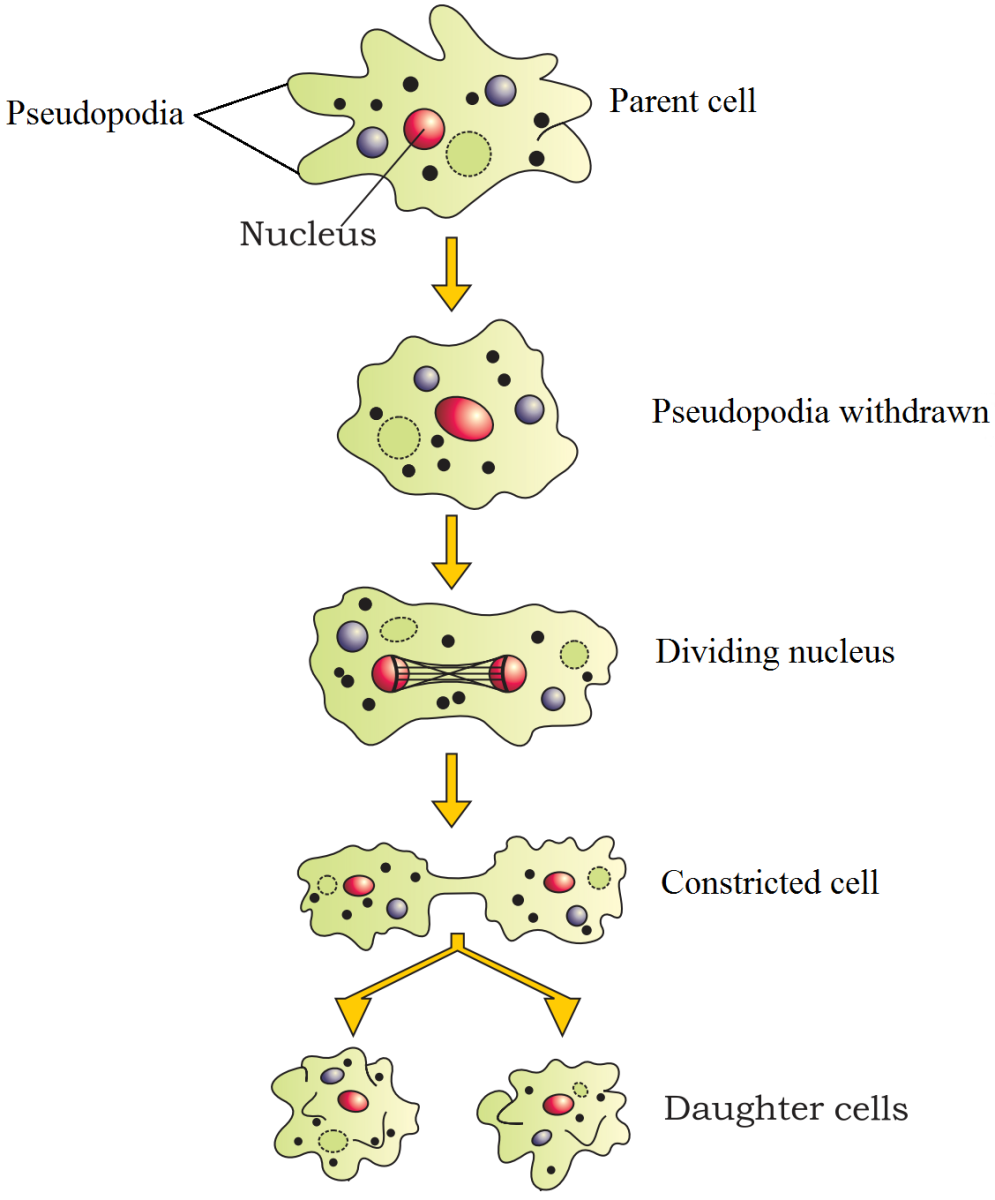
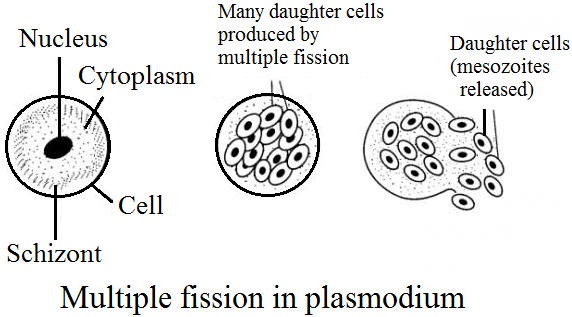
  • Multiple fission: It is the division of the parent body into many small daughter individuals simultaneously, each of which grows into an adult, e.g. Plasmodium (the malarial parasite), Amoeba (during unfavourable conditions), etc.
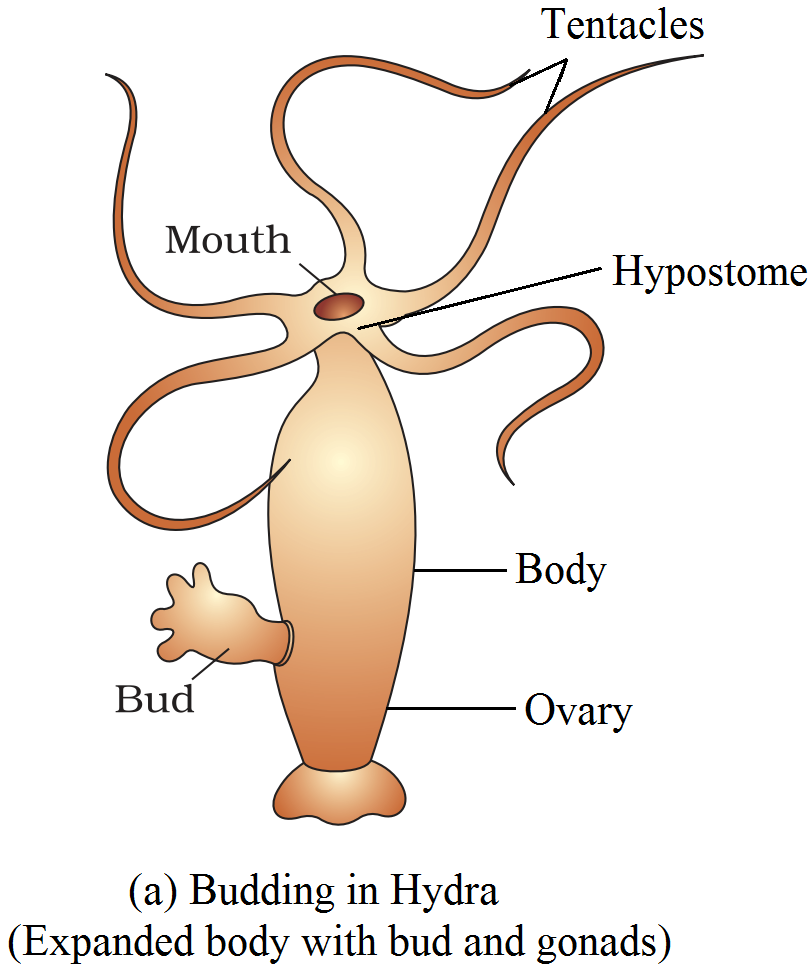
  1. Budding: It is a mode of asexual reproduction in which one or more unequal and small projections called buds are produced that remain attached initially to the parent cell, but eventually get separated and mature into new organisms (cells), e.g. yeast, Hydra, etc.
Depending on the place where the bud arises, budding can be of two types:
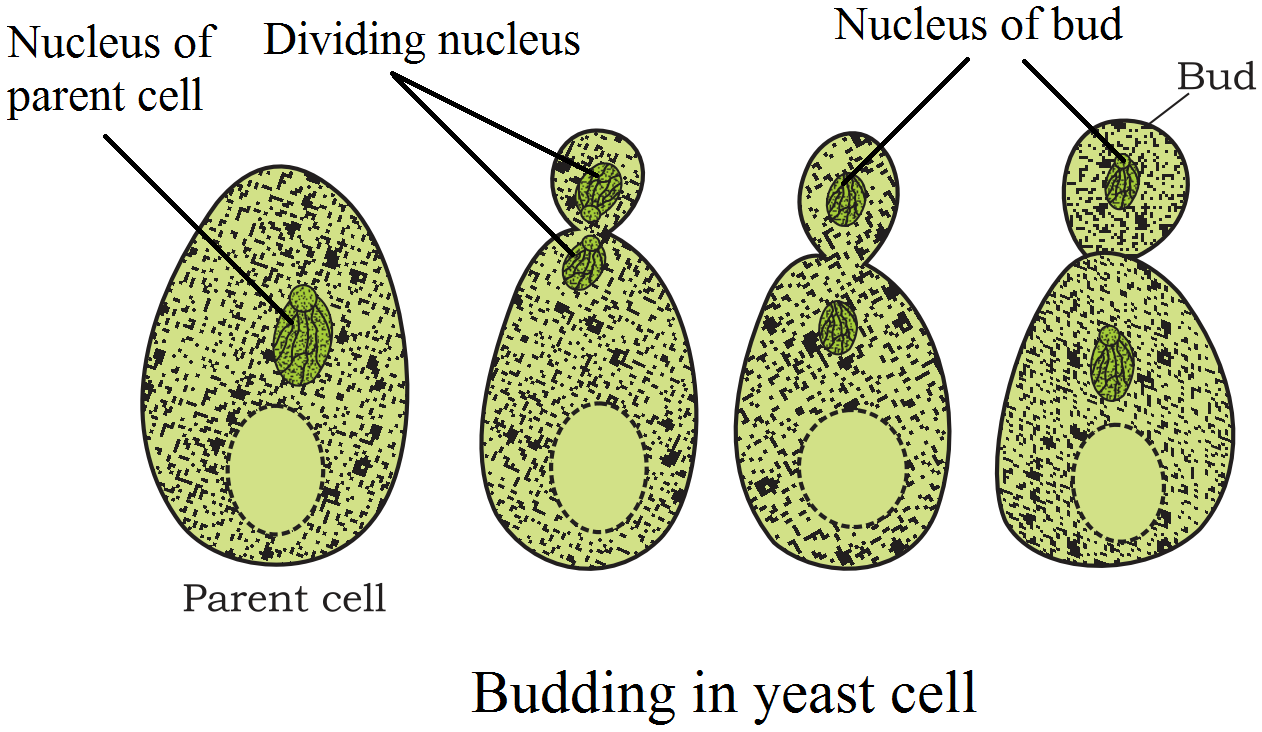
  • External budding (Hydra and yeast): In Hydra, (multicellular organism) regenerative cells are used for reproduction during budding. A bud develops as an outgrowth due to the repeated cell divisions at one specific site. These buds develop into tiny individuals which on getting fully matured, detach themselves from the parent body becoming new independent individuals.
​​​​​​​
The same process occurs in yeast, where nucleus divides by the process of budding into a new bud which gets detached from parent yeast.
  • Internal budding (Gemmule formation): A mass of cells enclosed within a common opaque envelop, rich in food, which germinates into a new plant, is called a gemmule.
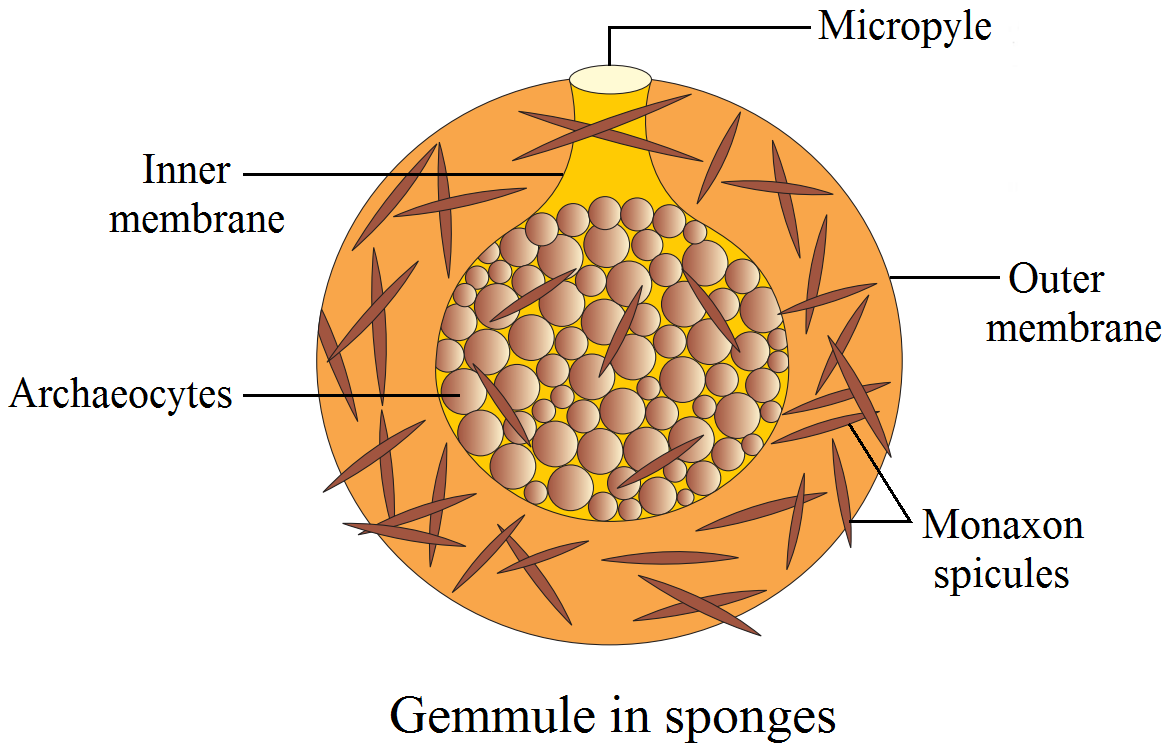
Gemmule formation is common in freshwater sponges (e.g. Spongilla) and a few marine sponges. Each gemmule has a group of cells called archaeocytes surrounded by the protective covering. During adverse environmental conditions, a mass of archaeocytes comes out via micropyle (a minute pore) that grows into a colony.
  1. Sporulation: Sometimes the products of multiple fission become individually surrounded by resistant coats, i.e. cyst walls before their release from parent, the process is known as sporulation and the encysted products are known as spores. It is not only the fastest method of reproduction but also helps to overcome unfavourable conditions. Sporulation is generally found in monera, protista, and Amoeba.
  2. Fragmentation: It is a mode of asexual reproduction in which parental body breaks into distinct pieces, each of which regenerates into an offspring. It is found in sponges, sea anemones (coelenterates) and echinoderms. It is also found in algae (e.g. Spirogyra), fungi, etc.

Need a full question paper?

Generate a complete, print-ready paper with questions like this in minutes — across 16+ boards, with answer keys.

Start Generating Free

Similar questions

  1. What is an ecological pyramid? Compare the pyramids of energy, biomass and numbers.
  2. Write any two limitations of ecological pyramids.
Read the following and answer any four questions from (i) to (v) given below:
Plants having foreign genes in their genome through genetic engineering are called transgenic plants. Genes can be incorporated either through a vector or through direct introduction of DNA. Bt cotton is a genetically modified organism which is pest resistant. It contain gene cry I Ac and cry II Ab of Bacillus thuringiensis. It is used to control lepidopterans, coleopterans and dipterans. Bt cotton can resist cotton bollworm and produce higher yields. Cry gene produces cry protein or Bt toxin. It is an endotoxin which remains as protoxin in plants and converted to active toxin after getting ingested by the insects. Alkaline pH of the insect gut solubilises the protein crystals, the activated toxin creates pores to the mid guts wall of the insects which cause them to death.
  1. Bt cotton crops are:
  1. Fungal resistant.
  2. Insect resistant.
  3. Drought resistant.
  4. All of these.
  1. Cotton bollwonns are killed by the protein encoded by the gene:
  1. cry I Ac
  2. cry I Ab
  3. cry I Ab
  4. Both (a) and (c).
  1. Which of the following is not an advantage of GM crops?
  1. GM plants enhance nutritional value of food.
  2. GM plants are more tolerant to abiotic stresses.
  3. GM plants have helped to reduce post harvest losses.
  4. GM plants can cause gene transfer to non-target plant species.
  1. Bacillus thuringiensis is a:
  1. Air borne bacteria.
  2. Soil borne bacteria.
  3. Soil borne fungus.
  4. Food borne bacteria.
  1. Assertion: Cotton bollworms are killed by ingesting the leaves of the transgenic plant.
Reason: Bt toxin binds with the midgut wall of the insect and make pores in them.
  1. Both assertion and reason are true and reason is the correct explanation of assertion.
  2. Both assertion and reason are true but reason is not the correct explanation of assertion.
  3. Assertion is true but reason is false.
  4. Both assertion and reason are false.
  1. A primary succession start on a bare rock and reach a climax community
Read the following and answer any four questions from (i) to (v) given below:
Transgenic animals can serve as factories that in some cases, may produce large amount of proteins more efficiently. Transgenic mice have been engineered to express human antibodies by introducing large segment of human DNA encoding human immunoglobulin genes. In transgenic large animals such as cow or sheep proteins of pharmaceutical value can be produced in large quantities in milk which is later purified. Transgenesis can be used to alter many phenotypic properties including growth rate, fat composition, milk production, hair texture, etc.
  1. The production of transgenic animals includes
  1. Identification and separation of desired gene.
  2. Combining the desired gene with appropriate vector.
  3. Introduction of vector in cells, tissues or embryos.
  4. All of these.
  1. In transgenic animals, i.e., cow and sheep proteins of pharmaceutical value are produced in large quantities in the
  1. Blood.
  2. Accumulated fat.
  3. Mammary glands.
  4. None of these.
  1. Mouse is mostly preferred animal for studies on gene transfer because.
  1. Short oestrous cycle.
  2. Long gestation period.
  3. Short generation time.
  4. Production of one or two offspring per pregnancy.
  1. Both (A) and (C)
  2. Both (A) and (B)
  3. Only D
  4. Both (C) and (D).
  1. Transgenic genes alter many phenotypic properties including:
  1. Growth rate.
  2. Fat composition.
  3. Milk production.
  4. All of these.
  1. Assertion: Transgenic mice have been engineered to express human antibodies.
Reason: Large segment of human DNA encoding human immunoglobulin have been transferred to mice.
  1. Both assertion and reason are true and reason is the correct explanation of assertion.
  2. Both assertion and reason are true but reason is not the correct explanation of assertion.
  3. Assertion is true but reason is false.
  4. Both assertion and reason are false.
(a) Draw the diagram of human sperm and label the cellular component. Also mention the functions of three components.
(b) Where does the head of sperm remain embedded in spermatogenesis.
Explain the events upto fertilisation that occur in a flower after the pollen grain has landed on its compatible stigma.
A flower of tomato plant following the process of sexual reproduction produce 240 viable seeds.
Answer the following questions giving reasons:
What is the minimum number of pollen grains that must have been involved in the pollination of its pistil?
A true breeding homozygous pea plant with green pods and axial flowers as dominant characters, is crossed with a recessive homozygous pea plant with yellow pods and terminal flowers. Work out the cross up to $F_2$ generation giving the phenotypic ratios of $F_1$ and $F_2$ generation respectively.
i. How and why is charging of tRNA essential in the process of translation?
ii. State the function of ribosome as a catalyst in bacteria during the process of translation.
iii. Explain the process of binding of ribosomal units to mRNA during protein synthesis.
Answer the following questions:
Explain how recombinants and non-recombinants are differentiated on the basis of colour production in the presence of a chromogenic substrate. Name that procedure.