Question
Describe/Explain single slit diffraction using a simple day to day life example.
###
Describe a simple experiment (/activity) to see single slit diffraction.

Answer

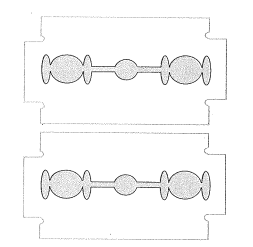
Image

It is very easy to see the single-slit diffraction pattern for oneself.
The equipment needed can be found in most homes-two razor blades and one clear glass electric bulb preferably with a straight filament.
One has to hold two blades so that the edges are parallel and have a narrow slit in between. This is easily done using the thumb and forefingers (fig.)
Keep the slit parallel to the filament, right in front of the eye. Use the spectacles if you normally do. With slight adjustment of the width of the slit and the parallelism of the edges, the pattern should be seen with its bright and dark bands.
Since the position of all the bands (except the central one) depends on wavelength, they will show some colours.
Using a filter for red or blue will make the fringes clearer. With both filters available, the wider fringes for red compared to blue can be seen.
→Another example :
In case of a dark room, where there is some light entering from outside, if the door is kept slightly open, the diffraction pattern can be seen on the tiles.
Need a full question paper?

Generate a complete, print-ready paper with questions like this in minutes — across 16+ boards, with answer keys.

Start Generating Free

Similar questions

If the potential difference used to accelerate electrons is tripled, by what factor does de Broglie wavelength of electrons beam change?
Why is there no dispersion in the light refracted through a rectangular glass slab?
Write two properties of a material suitable for making (a) a permanent magnet, and (b) an electromagnet.
Obtain the expression of electric field at any point by continuous distribution of charge on a line.
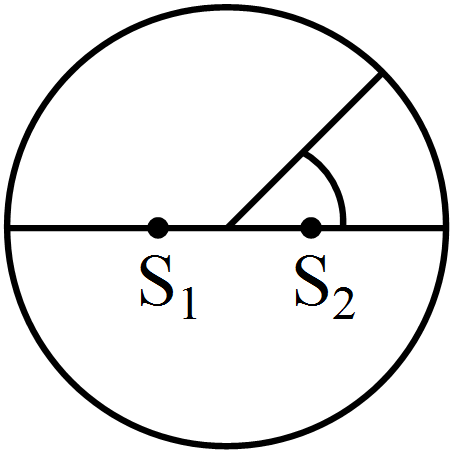
Figure, shows two coherent sources S1 and S2 which emit sound of wavelength $\lambda$ in phase. The separation between the sources is $3\lambda.$ A circular wire of large radius is placed in such a way that S1S2 lies in its plane and the middle point of S1S2 is at the centre of the wire. Find the angular positions $\theta$ on the wire for which constructive interference takes place.

Define wavefront of a travelling wave. Using Huygens principle, obtain the law of refraction at a plane interface when light passes from a denser to rarer medium.
State factors on which the resistance of a conductor depends.
What will be the effect on the magnetic flux associated with a coil located in any external magnetic field when
(i) Number of turns in the coil are increased?
(ii) Area of plane of the coil is increased?
(iii) Intensity of magnetic field of the coil is increased
A concave lens is placed in water. Will there be any change in focal length? Give reason.
An $\alpha-\text{particle}$ and a proton of the same kinetic energy are in turn allowed to pass through a magnetic field $\overrightarrow{\text{B}},$acting normal to the direction of motion of the particles. Calculate the ratio of radii of the circular paths described by them.