Question
Write two properties of a material suitable for making (a) a permanent magnet, and (b) an electromagnet.
Answer

  1. For making permanent magnet:
  1. High retentivity.
  2. High coercitivity.
  3. High permeability.
  1. For making electromagnet:
  1. High permeability.
  2. Low retentivity.
  3. Low coercivity.

Need a full question paper?

Generate a complete, print-ready paper with questions like this in minutes — across 16+ boards, with answer keys.

Start Generating Free

Similar questions

How much positive and negative charge is there in a cup of water?
The ground state energy of hydrogen atom is – 13·6 eV. If an electron makes a transition from an energy level – 1·51 eV to – 3·4 eV, calculate the wavelength of the spectral line emitted and name the series of hydrogen spectrum to which it belongs.
A 100W bulb together with its power supply is suspended from a sensitive balance. Find the change in the mass recorded after the bulb remains on for 1 year.
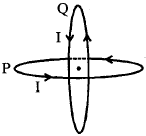
Two identical circular wires P and Q each of radius R and carrying current 'I' are kept in perpendicular planes such that they have a common centre as shown in the figure. Find the magnitude and direction of the net magnetic field at the common centre of the two coils.

The length and the radius of a cylinder measured with a slide callipers are found to be 4.54cm and 1.75cm respectively. Calculate the volume of the cylinder.
A thin spherical shell of radius R lying on a rough horizontal surface is hit sharply and horizontally by a cue. Where should it be hit so that the shell does not slip on the surface?
Explain the unit of mass.
A ferry boat has internal volume 1m3  and weight 50kg.
  1. Neglecting the thickness of the wood, find the fraction of the volume of the boat immersed in water.
  2. If aleak develops in the bottom and water starts coming in, what fraction of the boat's volume will be filled with water before water starts coming in from the sides?
Explain Magnetic flux with figure.
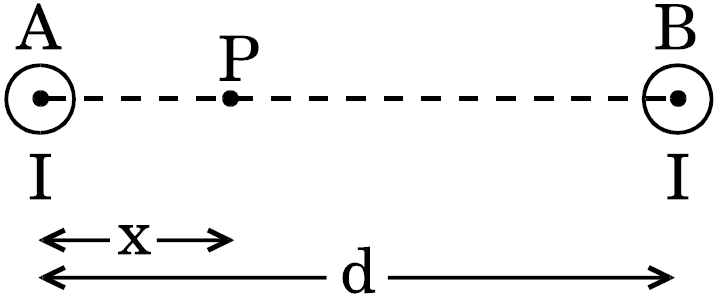
Two long straight parallel wires A and B separated by a distance d, carry equal current I flowing in same direction as shown in the figure.

  1. Find the magnetic field at a point P situated between them at a distance x from one wire.
  2. Show graphically the variation of the magnetic field with distance x for 0 < x < d.