Question
Determine, by drawing graphs, whether the following system of linear equations has a unique solution or not:
2x - 3y = 6, x + y = 1.

Answer

The given equations are
2x - 3y = 6 .......(i)
x + y = 1 ..........(ii)
Putting x = 0 in equation (i), we get,
⇒ 2 × 0 - 3y = 6
⇒ y = -2
⇒ x = 0, y = -2
Putting y = 0 in equation (i), we get,
⇒ 2x - 3 × 0 = 6
⇒ x = 3
⇒ x = 3, y = 0
Use the following table to draw the graph.
x
0
3
y
-2
0
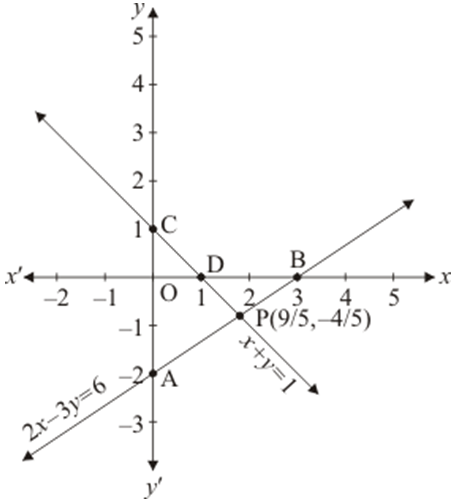
Draw the graph by plotting the two points A(0, -2), B(3, 0) from table.

Graph of the equation.
x + y = 1 .......(ii)
Putting x = 0 in equation (ii), we get,
⇒ 0 + y = 1
⇒ y = 1
$\therefore$ x = 0, y = 1
Putting y = 0 in equation (ii), we get,
⇒ x + 0 =1
⇒ x = 1
⇒ x = 1, y = 0
Use the following table to draw the graph.
x
0
1
y
1
0
Draw the graph by plotting the two points C(0, 1), D(1, 0) from table. The two lines intersect at point $\text{P}\Big(\frac{9}{5},\frac{-4}{5}\Big).$
Hence the equations have unique solution.

Need a full question paper?

Generate a complete, print-ready paper with questions like this in minutes — across 16+ boards, with answer keys.
Start Generating Free

Similar questions

If the sum of first m terms of an AP is $(2m^2+ 3m)$ then what is its second term?
Evaluate the following:
$\frac{\sin30^\circ-\sin90^\circ+2\cos0^\circ}{\tan30^\circ\tan60^\circ}$
In $\triangle\text{ABC},$ AD and BE are altitudes. Prove that: $\frac{\text{ar}(\triangle\text{DEC})}{\text{ar}(\triangle\text{ABC})}=\frac{\text{DC}^2}{\text{AC}^2}$
Solve the following systems of equations graphically:
2x - 3y + 13 = 0
3x - 2y + 12 = 0
Find the zeros of the following quadratic polynomial and verify the relationship between the zeros and the coefficients:
$3x^2 - x - 4$
Let there be an $A.P.$ with first term $'a\ ',$ common difference $'d\ '.$ If $a_n$ denotes its $n^{\text {th }}$ term and $S_n$ the sum of first $n$ terms, find. $n$ and $S _{ n } ,$ if $a =5, d=3$ and $a _{ n }=50.$
The $26^{th}, 11^{th}$​​​​​​​ and last term of an A.P. are 0, 3 and $-\frac{1}{5},$ respectively. Find the common difference and the number of terms.
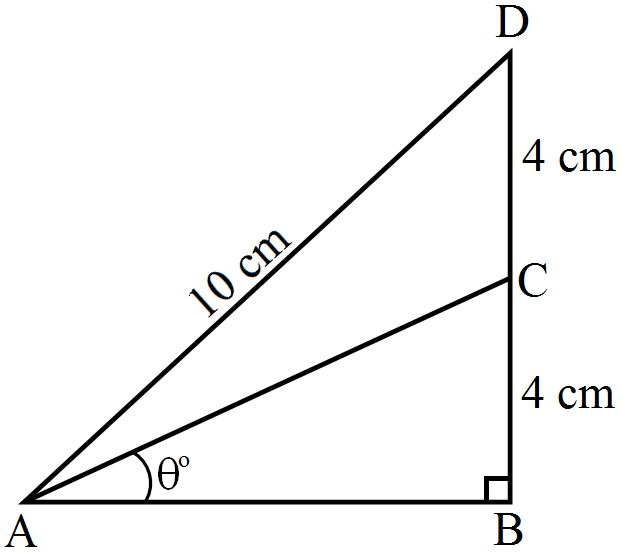
In the adjoining figure, $\angle\text{B}=90^\circ,\angle\text{BAC}=\theta,\text{BC}=\text{CD}=4\text{cm}$ and AD = 10cm. Find
  1. $\sin\theta$
  2. $\cos\theta.$
Hint: $\text{AB}^2=\big(\text{AD}^2-\text{BD}^2\big)=36\text{cm}^2$ $\therefore\text{AB}=6\text{cm}.$ $\text{AC}^2=\big(\text{AB}^2+\text{BC}^2\big)=52\text{cm}^2$ $\therefore\text{AC}=2\sqrt{13}\text{cm}.$ Thus, AB = 6cm and $\text{AC}=2\sqrt{13}\text{cm}.$
4 chairs and 3 tables cost Rs 2100 and 5 chairs and 2 tables cost Rs 1750. Find the cost of one chair and one table separately.
Solve the following quadratic equation:
$\Big(\frac{\text{4x}-3}{\text{2x}+1}\Big)-10\Big(\frac{\text{2x}+1}{\text{4x}-3}\Big)=3,$ $\text{x}\neq\frac{-1}{2},\ \frac{3}{4}$