Question
Solve the following systems of equations graphically:
2x - 3y + 13 = 0
3x - 2y + 12 = 0

Answer

We have,
2x - 3y + 13 = 0
3x - 2y + 12 = 0
Now, 2x - 3y + 13 = 0
⇒ 2x = 3y - 13
$\Rightarrow\text{x}=\frac{3\text{y}-13}{2}$
When y = 1, we have,
$\text{x}=\frac{3\times1-13}{2}=-5$
When y = 3, we have,
$\text{x}=\frac{3\times3-13}{2}=-2$
Thus, we have the following table giving points on the line 2x - 3y + 13 = 0
x
-5
-2
y
1
3
Now, 3x - 2y + 12 = 0
⇒ 3x = 2y - 12
$\Rightarrow\text{x}=\frac{2\text{y}-12}{3}$
When y = 0, we have,
$\Rightarrow\text{x}=\frac{2\times0-12}{3}=-4$
When y = 3, we have,
$\text{x}=\frac{2\times3-12}{3}=-2$
Thus, we have the following table giving points on the line 3y - 2y + 12 = 0
x
-4
-2
y
0
3
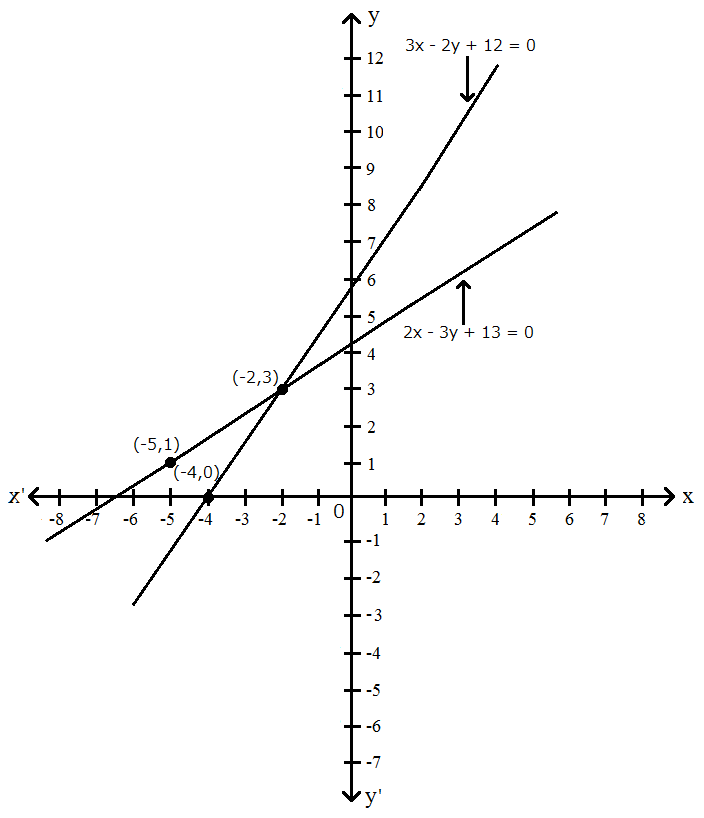
Graph of the given equations are,

Clearly, two lines intersect at (-2, 3)
Hence, x = -2, y = 3 is the solution of the given system of equations.

Need a full question paper?

Generate a complete, print-ready paper with questions like this in minutes — across 16+ boards, with answer keys.

Start Generating Free

Similar questions

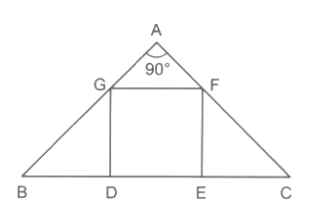
In the given figure, $\text{DEFG}$ is a square and $\angle B A C=90^{\circ}$. Prove that
$i. \triangle A G F \sim \triangle D B G$
$ii. \triangle A G F \sim \triangle E F C$
$iii. \triangle D B G \sim \triangle E F C$
$iv. D E^2=B D \times E C$
Image
If $(\cot\theta+\tan\theta)=\text{m}$ and $(\sec\theta-\cos\theta)=\text{n},$ prove that $\big(\text{m}^2\text{n}\big)^\frac23-\big(\text{m}\text{n}^2\big)^\frac23=1.$
In Fig, a square of diagonal 8cm is inscribed in a circle. Find the area of the shaded region.
In $\triangle\text{ABC},$ D and E are the mid-points of AB and AC respectively. Find the ratio of the areas of $\triangle\text{ADE}$ and $\triangle\text{ABC.}$
Solve graphically each of the following systems of linear equations. Also, find the co-ordinates of the points where the lines meet the axis of x in each system.
2x - y = 2,
4x - 2y = 8.
For going to a city B from city A, there is a route via city C such that $\text{AC}\perp\text{CB},$ AC = 2x km and CB = 2(x + 7)km. It is proposed to construct a 26km highway which directly connects the two cities A and B. Find how much distance will be saved in reaching city B from city A after the construction of the highway.
Solve the following quadratic equations by factorization:
$\text{x}^2-\big(\sqrt{2}+1\big)\text{x}+\sqrt{2}=0$
Find the zeroes of the following polynomials by factorisation method and verify the relations between the zeroes and the coefficients of the polynomials:
$7\text{y}^2-\frac{11}{3}\text{y}-\frac{2}{3}$.
If $\alpha$ and $\beta$ are the zeroes of the quadratic polynomial $f(x) = ax^2 + bx + c$, find evaluate:$\frac{\beta}{\text{a}\alpha+\text{b}}+\frac{\alpha}{\text{a}\beta+\text{b}} $
Ayush starts walking from his house to office. Instead of going to the office directly, he goes to a bank first, from there to his daughter’s school and then reaches the office. What is the extra distance travelled by Ayush in reaching his office? (Assume that all distances covered are in straight lines). If the house is situated at (2, 4), bank at (5, 8), school at (13, 14) and office at (13, 26) and coordinates are in km.