Question
Determine graphically the vertices of the triangle, the equations of whose sides are given below:
  1. 2y - x = 8, 5y - x = 14 and y - 2x = 1
  2. y = x, y = 0 and 3x + 3y = 10

Answer

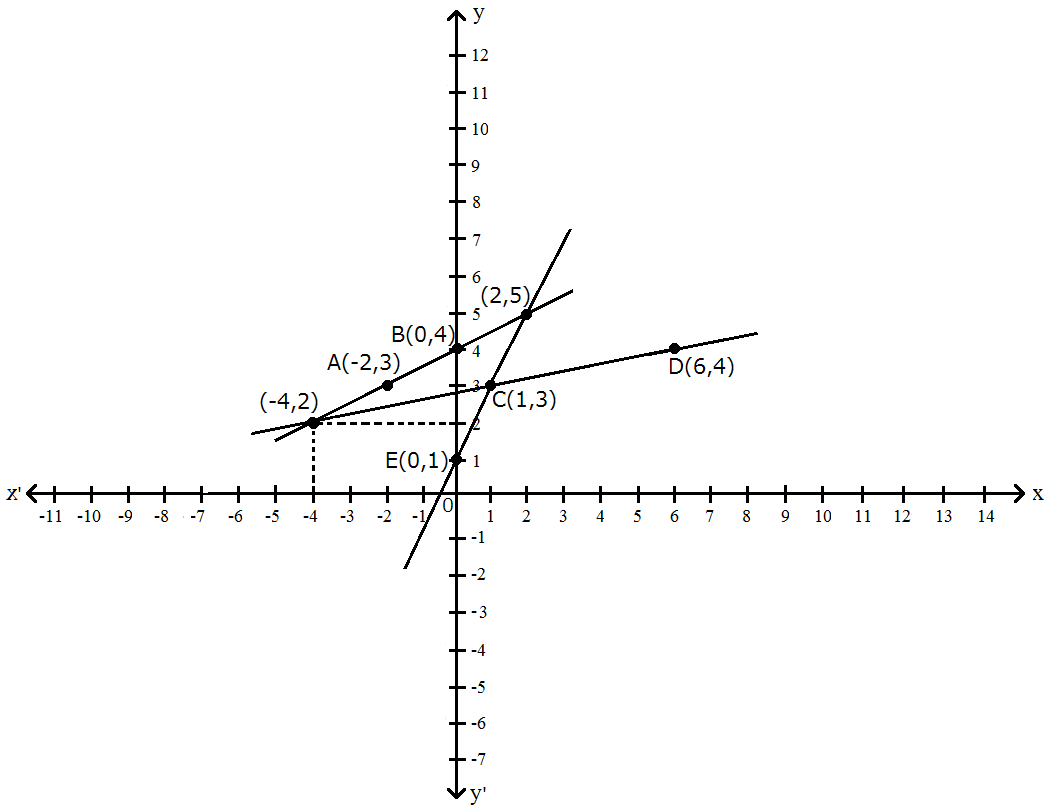
  1. First we take 2y - x = 8
$\Rightarrow\text{y}=\frac{\text{x}+8}{2}\ .....(\text{i})$

Putting x = -2 in (i), we get y = 3

Putting x = 0 in (i), we get y = 4

P lot points A(-2, 3) and B(0, 4) on graph paper and join them.

Now, 5y - x = 14

$\Rightarrow\text{y}=\frac{\text{x}+14}{5}\ ......(\text{ii})$

Putting x = 1 in (ii), we get y = 3

Putting x = 6 in (i), we get y = 4

P lot points C(1, 3) and D(6, 4) on graph paper and join then.

Now y - 2x = 1

⇒ y = 2x + 1

Putting x = 0 in (iii), we get y = 1

Putting x = 1 in (iii), we get y = 3

P lot points E(0, 1) and F(1, 3) on graph paper and join then.


Thus, the vertices of triangle are (-4, 2), (1, 3) and (2, 5)
  1. The given system of equations is,
y = x

y = 0

3x + 3y = 10

We have,

y = x

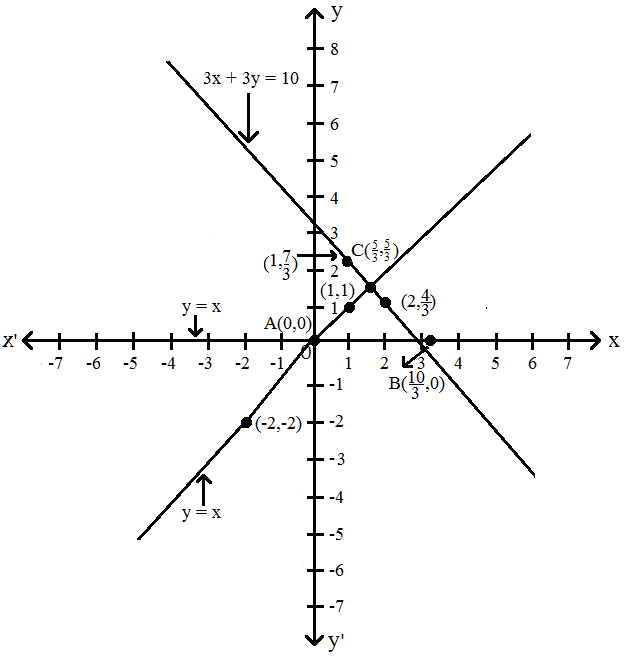
When x = 1, we have

y = 1

when x = -2, we have

y = -2

Thus, we have the following table giving points on the line y = x
x
1
-2
y
1
-2
We have,

3x + 3y = 10

⇒ 3y = 10 - 3x

$\Rightarrow\text{y}=\frac{10-3\text{x}}{3}$

When x = 1, we have,

$\Rightarrow\text{y}=\frac{10-3\times1}{3}=\frac{7}{3}$

When x = 2, we have,

$\Rightarrow\text{y}=\frac{10-3\times2}{3}=\frac{4}{3}$

Thus, we have the following table giving points on the line 3x + 3y = 10.
x
1
2
y
$\frac{7}{3}$
$\frac{4}{3}$
Graph of the given equations.


From the graph of the lines represented by the given equations, we observe that the lines taken in pairs intersect each other at points A(0, 0), $\text{B}\Big(\frac{10}{3},0\Big)$ and$\text{C}\Big(\frac{5}{3},\frac{5}{3}\Big).$

Hence, the required vertices of the triangle are A(0, 0), $\text{B}\Big(\frac{10}{3},0\Big)$ and $\text{C}\Big(\frac{5}{3},\frac{5}{3}\Big).$

Need a full question paper?

Generate a complete, print-ready paper with questions like this in minutes — across 16+ boards, with answer keys.

Start Generating Free

Similar questions

A 80m by 64m rectangular lawn has two roads, each 5m wide, running through its middle, one parallel to its length and the other parallel to its breadth. Find the cost of gravelling the roads at ₹ 40 per $m^2.$
In a $\triangle\text{ABC},\angle\text{B}=90^\circ$ and $\tan\text{A}=\frac{1}{\sqrt{3}}.$ Prove that:
  1. $\sin\text{A}\cdot\cos\text{C}+\cos\text{A}\cdot\sin\text{C}=1$
  2. $\cos\text{A}\cdot\cos\text{C}-\sin\text{A}\cdot\sin\text{C}=0$
If three circles of radius a each, drawn such that each touches the other two, prove that the area included between included between them is equal to $\frac{4}{25}\text{a}^2.$ $\big[\text{Take } \sqrt{3}=1.73\text{ and}\ \pi=3.14\big]$
Find the missing frequencies in the following frequency distribution if it is known that the mean of the distribution is 50.
x 10 30 50 70 90  
f 17 $f_1$​​​​​​​ 32 $f_2​​​​​​​$ 19 Total 120
How many numbers are there between 101 and 999, which are divisible by both 2 and 5?
The following table shows the age distribution of patients of malaria in a village during a particular month.
Age (in years) 5-14 15-24 25-34 35-44 45-54 55-64
No. of cases 6 11 21 23 14 5
Find the average age of the patients.
If the mean of the following data is 20.6. Find the value of p.
x 10 15 p 25 35
y 3 10 25 7 5
The area of a triangle is 5 sq.units. Two of its vertices are (2,1) and (3, -2). If the third vertex is $\Big(\frac{7}{2},\text{y}\Big),$ find the value of y.
If $\tan\theta=\frac{1}{\sqrt{7}},$ show that $\frac{\big(\text{coses}^2\theta-\sec^2\theta\big)}{\big(\text{cosec}^2\theta+\sec^2\theta\big)}=\frac34.$
Find the area of $\triangle\text{ABC}$ with vertices A(0, -1), B(2, 1) and C(0, 3). Also, find the area of the triangle formed by joining the midpoints of its sides. Show that the ratio of the areas of two triangles is 4 : 1