Question
Determine the AP whose third term is 16 and the $7^{\text {th }}$ term exceeds the $5^{\text {th }}$ term by 12 .
Answer

$a_3 = 16$
$ \Rightarrow a + 2d = 16 ..... (i)$
$a_7 = a_5 + 12$
$ \Rightarrow a + 6d = a + 4d + 12$
$ \Rightarrow 2d = 12$
$ \Rightarrow d = 6$
Put the value of d in eq. (i)
$a + 2 \times 6 = 16$
$ \Rightarrow a = 16 - 12$
$ \Rightarrow a = 4$
$4, 10, 16....$

Need a full question paper?

Generate a complete, print-ready paper with questions like this in minutes — across 16+ boards, with answer keys.

Start Generating Free

Similar questions

Prove the following trigonometric identities.
$\text{cosec}^6\theta=\cot^6\theta+3\cot^2\theta\text{cosec}^2\theta+1$
Solve the following quadratic equation:$4x^2 + 5x = 0$
Solve the following quadratic equations for $x :4 x^2+4 b x-\left(a^2-b^2\right)=0$
Examine each of the following statements and comment:
If two coins are tossed at the same time, there are 3 possible outcomes-two heads, two tails, or one of each. Therefore, for each outcome, the probability of occurrence is $\frac{1}{3}$.
Write the denominator of the rational number $\frac{257}{5000}$in the form $2^m \times 5^n$, where m, n are non-negative integers. Hence, write its decimal expansion, without actual division.
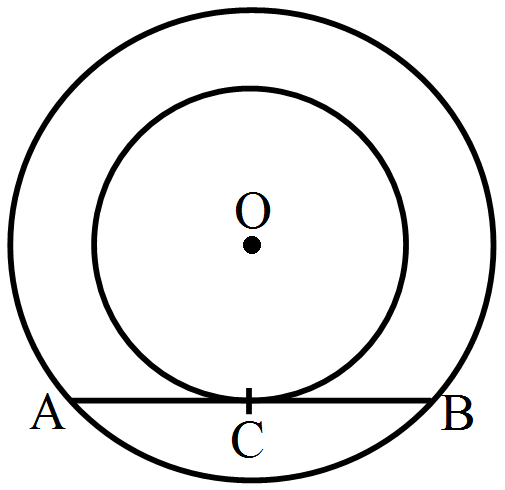
In the given figure, the chord AB of the larger of the two concentric circles, with centre O, touches the smaller circle at C. Prove that AC = CB.
Two unbiased dice are thrown. Find the probability that the total of the numbers on the dice is greater than 10.
A card is drawn at random from a pack of 52 cards. Find the probability that the card drawn is:
A ten.
The probability of selecting a red ball at random from a jar that contains only red, blue and orange balls balls is $\frac{1}{4}.$ The probability of selecting a blue ball at randome from the same jar is $\frac{1}{3}.$ If the jar contains 10 orange balls, find the total number of balls in the jar.