APPLICATION OF INTEGRALS — Maths STD 12 Science — Question
Gujarat BoardEnglish MediumSTD 12 ScienceMathsAPPLICATION OF INTEGRALS5 Marks
Question
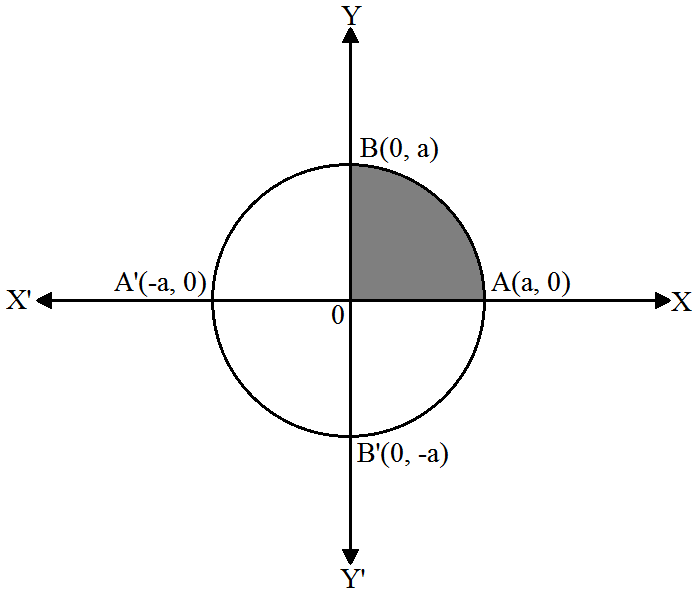
Determine the area under the cutve $\text{y}=\sqrt{\text{x}^{2}-\text{x}^{2}}$ included between the lines $x = 0$ and $x = a$.
✓
Answer
We have,
$\text{y}=\sqrt{\text{a}^{2}-\text{x}^{2}}$
$\Rightarrow \text{y}^{2}={\text{a}^{2}-\text{x}^{2}}$
$\Rightarrow \text{x}^{2}+\text{y}^{2}=\text{a}^{2}$
Since in the given equation $x^2 + y^2 = a^2$
all the powers of both x and y are even, the curve is symmetrical about both the axis.
$\therefore$ Area encloed by the curve and above x-axis = area A'BA = 2 × area enclosed by ellipse and x-axis in first quadrant
(a, 0), (-a, 0) are the points of intersection of curve and x-axis
(0, a), (0, a) are the points of intersection of curve and x-axis
Slicling the area in the first quadrant into vertical stripes of height = |y| and width = dx
$\therefore$ Area of approximating rectangle = |y| dx
Appoximating rectangle can move between x = 0 and x = a
A = Area of enclosed curve in the first $=\int\limits_{0}^{a}|\text{y}|\text{dx} $
$\Rightarrow \text{A}=\int\limits_{0}^{a}\sqrt{\text{a}^{2}-\text{x}^{2}}\text{dx}$
$\Rightarrow \Bigg[\frac{1}{2}\text{x}\sqrt{\text{a}^{2}-\text{x}^{2}}+\frac{1}{2}\text{a}^{2}\sin^{-1}\frac{\text{x}}{\text{a}}\Bigg]^{\text{a}}_{0}$
$=\frac{1}{2}\text{a}^{2}\sin^{-1}1$
$=\frac{1}{2}\text{a}^{2}\frac{\pi}{2}$
$=\frac{\text{a}^{2}\pi}{4}\ \text{sq.}\ \text{units}$
Need a full question paper?
Generate a complete, print-ready paper with questions like this in minutes — across 16+ boards, with answer keys.