Question
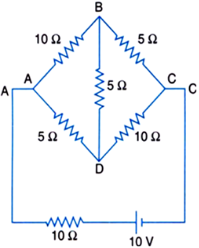
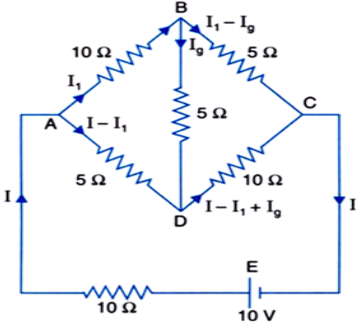
Determine the current in each branch of the network shown in Fig.:

Answer

Consider the mesh ABDA,

Now, Applying Kirchhoff's loop rule we get,

$-10\text{I}_1-5\text{I}_\text{g}+(\text{I}-\text{I}_1)5=0$

$\Rightarrow\ \ 3\text{I}_1-\text{I}+\text{I}_\text{g}=0\ \ ...\text{(i)}$

Consider the mesh BDCB,

Again, applying Kirchhoff's loop rule we get,

$-5\text{I}_\text{g}-10(1-\text{I}_\text{l}+\text{I}_\text{g})+5(\text{I}_\text{I}-\text{I}_\text{g})=0$

$\Rightarrow\ \ 3\text{I}_1-2\text{I}-4\text{I}_\text{g}=0\ \ ...\text{(ii)}$

Applying Kirchhoff's loop rule to the mesh ABCEA,

$-10\text{I}_1-5(\text{I}_1-\text{I}_\text{g})-10\text{I}+10=0$

$\text{or}\ \ 3\text{I}_1+2\text{I}-\text{I}_\text{g}=2\ \ ...{(\text{iii})}$

Equations (i), (ii) and (iii) are simultaneous equations. On solving these equations, we will find the unknown values of current.

Adding (i) and (iii), we get

$6\text{I}_\text{1}+\text{I}=2\ \ ...(\text{iv})$

Multiplying (i) by 4 and adding in (ii), we get

$15\text{I}_\text{1}-6\text{I}0=0\ \ ...\text{(v)}$

Solving equations (iv) and (v), we get

$\text{I}_1=\frac{4}{17}\text{A}=0.235\ \text{A}$

So, current in branch AB is 0.235 A.

Putting the value of I1 in equation (v) and simplifying, we get

Total current, $\text{I}=\frac{10}{17}=0.588\ \text{A}$

Putting the values of I and I1 in equation (iii) and simplifying, we get

$\text{I}_\text{g}=\frac{2}{17}\text{A}=-0.118\ \text{A}$

The negative sign indicates that the direction of current is opposite to that shown in Fig. above. So, current in branch BD is -0.118 A.

Current in branch BC is $(\text{I}_1-\text{I}_\text{g})\text{i.e}.,\frac{4}{17}-\Big(-\frac{2}{17}\Big)$

$\text{i.e.,}\frac{6}{17}\ \text{or}\ 0.353\ \text{A}.$

Current in branch AD is (I - I1)

$\text{i.e.,}\Big(\frac{10}{17}-\frac{4}{17}\Big)\text{A i.e.,}\ \frac{6}{17}\text{A or}\ 0.353\ \text{A}$

Current in branch DC is (I1 - I1 + Ig)

$\text{i.e.,}\frac{6}{17}+\Big(-\frac{2}{17}\Big)​​\text{A or}\ \frac{4}{17}\text{A or}\ 0.235\ \text{A}.$

Need a full question paper?

Generate a complete, print-ready paper with questions like this in minutes — across 16+ boards, with answer keys.
Start Generating Free

Similar questions

  1. Draw a ray diagram to show the image formation by a combination of two thin convex lenses in contact. Obtain the expression for the power of this combination in terms of the focal lengths of the lenses.
  2. A ray of light passing from air through an equilateral glass prism undergoes minimum deviation when the angle of incidence is $\frac{3}{4}$th of the angle of prism. Calculate the speed of light in the prism.
A charged particle is accelerated through a potential difference of 12kV and acquires a speed of 1.0 × 10⁶m s−1. It is then injected perpendicularly into a magnetic field of strength 0.2T. Find the radius of the circle described by it.
What is the minimum energy that must be given to a H atom in ground state so that it can emit an $\text{H}_\gamma$ line in Balmer series. If the angular momentum of the system is conserved, what would be the angular momentum of such $\text{H}_\gamma$ photon?
A biconvex thick lens is constructed with glass $(\mu=1.50)$ Each of the surfaces has a radius of 10cm and the thickness at the middle is 5cm. Locate the image of an object placed far away from the lens.
A biconvex lens with its two faces of equal radius of curvature R is made of a transparent medium of refractive index $\mu_1$. It is kept in contact with a medium of refractive index $\mu_2$ as shown in the figure.
Image

a. Find the equivalent focal length of the combination.
b. Obtain the condition when this combination acts as a diverging lens.
c. Draw the ray diagram for the case $\mu_1>\frac{\left(\mu_2+1\right)}{2}$, when the object is kept far away from the lens. Point out the nature of the image formed by the system.
Define electric potential difference and prove that the electric potential at any point inside the electric field is equal to the ratio of the work W done in bringing a test charge from infinity to that point and the value of the test charge $q_0$.
Figure shows three equidistant slits being illuminated by a monochromatic parallel beam of light. Let $\text{BP}_0-\text{AP}=\frac{\lambda}{3}$ and $\text{D}>\lambda.$
  1. Show that in this case $\text{d}=\sqrt{\frac{2\lambda\text{D}}{3}}.$
  2. Show that the intensity at P, is three times the intensity due to any of the three slits individually.

Will the focal length of a lens for red light be more, same or less than that for blue light?
Two charges -q each are fixed separated by distance 2d. A third charge q of mass m placed at the mid-point is displaced slightly by x (x < < d) perpendicular to the line joining the two fixed charged as shown in Fig. Show that q will perform simple harmonic oscillation of time period.

$\text{T}=\Big[\frac{8\pi^3\in_0\text{md}^3}{\text{q}^2}\Big]^\frac{1}{2}$.
Prove : $n_{12}=\frac{1}{n_{21}}$