Question
What is the minimum energy that must be given to a H atom in ground state so that it can emit an $\text{H}_\gamma$ line in Balmer series. If the angular momentum of the system is conserved, what would be the angular momentum of such $\text{H}_\gamma$ photon?
Answer

$\text{H}_\gamma$ in Balmer series corresponds to transition n = 5 to n = 2. So, the electron in ground state n = 1 must first be put in state n = 5.
Energy required = E1 - E5 = 13.6 - 0.54 = 13.06eV
If angular momentum is conserved, angular momentun of photon = change in angular momentum of electron = L5 - L2 = 5h - 2h = 3 × 1.06 × 10-34 = 3.18 × 10-34 = 3.18 × 10-38kh m2/s.

Need a full question paper?

Generate a complete, print-ready paper with questions like this in minutes — across 16+ boards, with answer keys.

Start Generating Free

Similar questions

Consider an electron in front of metallic surface at a distance d (treated as an infinite plane surface). Assume the force of attraction by the plate is given as $\frac{1}{2}\frac{\text{q}^2}{4\pi\in_0\text{d}^2}$
Calculate work in taking the charge to an infinite distance from the plate. Taking d = 0.1nm, find the work done in electron volts. [Such a force law is not valid for d < 0.1nm].
  1. Derive an expression for the force between two long parallel current carrying conductors.
  2. Use this expression to define S.I. unit of current.
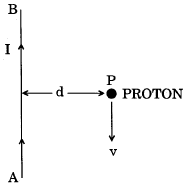
  3. A long straight wire AB carries a current I. A proton P travels with a speed v, parallel to the wire, at a distance d from it in a direction opposite to the current as shown in the figure. What is the force experienced by the proton and what is its direction?

The position, velocity and acceleration of a particle executing simple harmonic motion are found to have magnitudes 2cm, 1m/s and 10m/s2 at a certain instant. Find the amplitude and the time period of the motion.
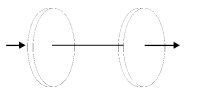
The given figure shows a capacitor made of two circular plates each of radius 12 cm, and separated by 5.0 cm. The capacitor is being charged by an external source (not shown in the figure). The charging current is constant and equal to 0.15 A.
(a) Calculate the capacitance and the rate of change of potential difference between the plates.
(b) Obtain the displacement current across the plates.
(c) Is Kirchhoff's first rule (junction rule) valid at each plate of the capacitor? Explain.
Image
The gravitational attraction between electron and proton in a hydrogen atom is weaker than the coulomb attraction by a factor of about 10–40. An alternative way of looking at this fact is to estimate the radius of the first Bohr orbit of a hydrogen atom if the electron and proton were bound by gravitational attraction. You will find the answer interesting.
A small block of superdense material has a mass of 3 × 1024kg. It is situated at a height h (much smaller than the earth's radius) from where it falls on the earth's surface. Find its speed when its height from the earth's surface has reduced to $\frac{\text{h}}{2}.$ The mass of the earth is 6 × 1024kg.
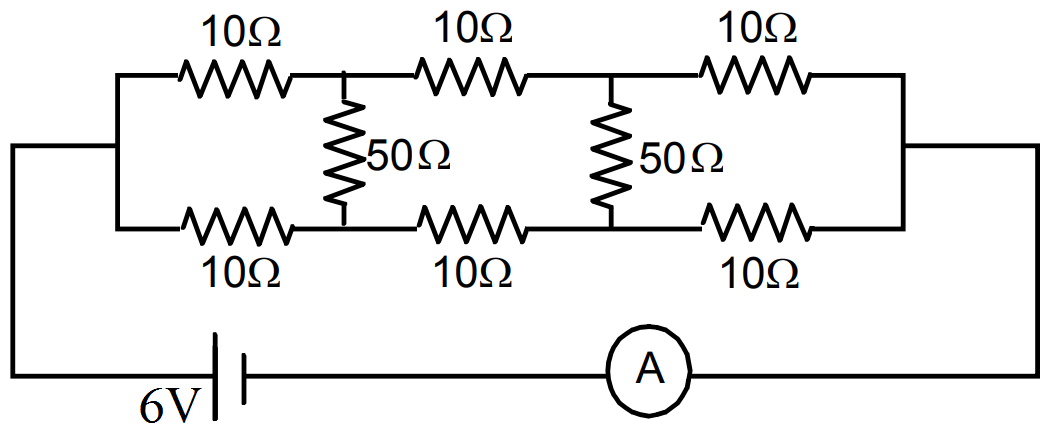
Find the current measured by the ammeter in the circuit shown in the figure.

A copper wire having resistance 0.01 ohm in each metre is used to wind a 400-turn solenoid of radius 1.0cm and length 20cm. Find the emf of a battery which when connected the solenoid will eauee a magnetic field of 1.0 × 10⁻²T near the centre of the solenoid.
Two coherent point sources S1 and S2 vibrating in phase emit light of wavelength $\lambda$. The separation between the sources is $2\lambda$. Consider a line passing through S2 and perpendicular to the line S1S2. What is the smallest distance from S2 where a minimum of intensity occurs?
A rectangular conducting loop consists of two wires on two opposite sides of length l joined together by rods of length d. The wires are each of the same material but with cross-sections differing by a factor of 2. The thicker wire has a resistance R and the rods are of low resistance, which in turn are connected to a constant voltage source V0. The loop is placed in uniform a magnetic field B at 45° to its plane. Find $\tau$, the torque exerted by the magnetic field on the loop about an axis through the centres of rods.