Question
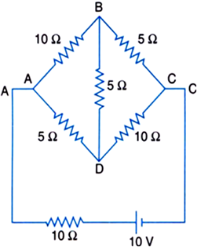
Determine the current in each branch of the network shown in Fig.:

Answer

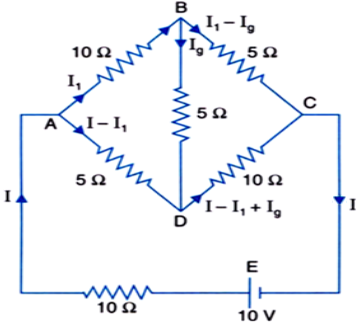
Consider the mesh ABDA, Now, Applying Kirchhoff's loop rule we get, $-10\text{I}_1-5\text{I}_\text{g}+(\text{I}-\text{I}_1)5=0$ $\Rightarrow\ \ 3\text{I}_1-\text{I}+\text{I}_\text{g}=0\ \ ...\text{(i)}$

Consider the mesh BDCB, Again, applying Kirchhoff's loop rule we get,
$-5\text{I}_\text{g}-10(1-\text{I}_\text{l}+\text{I}_\text{g})+5(\text{I}_\text{I}-\text{I}_\text{g})=0$
$\Rightarrow\ \ 3\text{I}_1-2\text{I}-4\text{I}_\text{g}=0\ \ ...\text{(ii)}$
Applying Kirchhoff's loop rule to the mesh ABCEA, $-10\text{I}_1-5(\text{I}_1-\text{I}_\text{g})-10\text{I}+10=0$$\text{or}\ \ 3\text{I}_1+2\text{I}-\text{I}_\text{g}=2\ \ ...{(\text{iii})}$
Equations (i), (ii) and (iii) are simultaneous equations. On solving these equations,
we will find the unknown values of current.
Adding (i) and (iii), we get $6\text{I}_\text{1}+\text{I}=2\ \ ...(\text{iv})$ Multiplying (i) by 4 and adding in (ii),
we get $15\text{I}_\text{1}-6\text{I}0=0\ \ ...\text{(v)}$
Solving equations (iv) and (v), we get $\text{I}_1=\frac{4}{17}\text{A}=0.235\ \text{A}$
So, current in branch AB is 0.235 A.
Putting the value of $I_1$ in equation (v) and simplifying,
we get Total current, $\text{I}=\frac{10}{17}=0.588\ \text{A}$
Putting the values of I and $ I_1$ in equation (iii) and simplifying,
we get $\text{I}_\text{g}=\frac{2}{17}\text{A}=-0.118\ \text{A}$
The negative sign indicates that the direction of current is opposite to that shown in Fig.
above. So, current in branch BD is -0.118 A.
Current in branch BC is $(\text{I}_1-\text{I}_\text{g})\text{i.e}.,\frac{4}{17}-\Big(-\frac{2}{17}\Big)$
$\text{i.e.,}\frac{6}{17}\ \text{or}\ 0.353\ \text{A}.$
Current in branch AD is $(I - I_1)$
$\text{i.e.,}\Big(\frac{10}{17}-\frac{4}{17}\Big)\text{A i.e.,}\ \frac{6}{17}\text{A or}\ 0.353\ \text{A}$
Current in branch DC is $(I_1 - I_1 + I_g)$
$\text{i.e.,}\frac{6}{17}+\Big(-\frac{2}{17}\Big)​​\text{A or}\ \frac{4}{17}\text{A or}\ 0.235\ \text{A}.$

Need a full question paper?

Generate a complete, print-ready paper with questions like this in minutes — across 16+ boards, with answer keys.
Start Generating Free

Similar questions

A closed coil having 100 turns is rotated in a uniform magnetic field $B = 4.0 \times 10^{-4}T$ about a diameter which is perpendicular to the field. The angular velocity of rotation is 300 revolutions per minute. The area of the coil is $25cm^2$ and its resistance is $4.0\Omega.$ Find
  1. The average emf developed in half a turn from a position where the coil is perpendicular to the magnetic field.
  2. The average emf in a full turn.
  3. The net charge displaced in part (a).
  1. Draw a schematic sketch of a cyclotron. Explain clearly the role of crossed electric and magnetic field in accelerating the charge. Hence derive the expression for the kinetic energy acquired by the particles.
  2. An α–particle and a proton are released from the centre of the cyclotron and made to accelerate.
    1. Can both be accelerated at the same cyclotron frequency? Give reason to justify your answer.
    2. When they are accelerated in turn, which of the two will have higher velocity at the exit slit of the dees?
A long straight horizontal cable carries a current of 2.5 A in the direction 10° south of west to 10° north of east. The magnetic meridian of the place happens to be 10° west of the geographic meridian. The earth’s magnetic field at the location is 0.33 G, and the angle of dip is zero. Locate the line of neutral points (ignore the thickness of the cable). (At neutral points, magnetic field due to a current-carrying cable is equal and opposite to the horizontal component of earth’s magnetic field.)
The electric field associated with a light wave is given by $\text{E}=\text{E}_0\sin[(1.57\times10^7\text{m}^{-1})(\text{x}-{\text{ct}})].$ Find the stopping potential when this light is used in an experiment on photoelectric effect with the emitter having work function 1.9eV.
Explain the shortcomings of Rutherford's Atomic Model.###Write two shortcomings of Rutherford's Atomic Model.
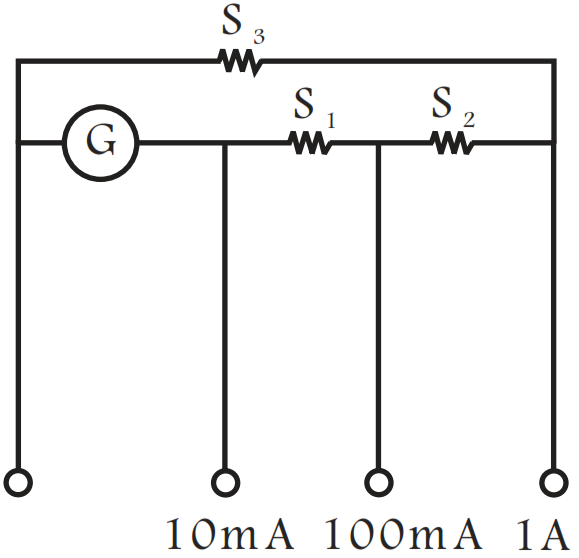
A multirange current meter can be constructed by using a galvanometer circuit as shown in Fig. We want a current meter that can measure 10mA, 100mA and 1A using a galvanometer of resistance 10Ω and that prduces maximum deflection for current of 1mA. Find $S_1, S_2$ and $S_3$ that have to be used.
  1. Using the Bohr’s model calculate the speed of the electron in a hydrogen atom in the n = 1, 2, and 3 levels.
  2. Calculate the orbital period in each of these levels.
A particle executes a simple harmonic motion of amplitude 1.0cm along the principal axis of a convex lens of focal length 12cm. The mean position of oscillation is at 20cm from the lens. Find the amplitude of oscillation of the image of the particle.
A rod, when suspended in a magnetic field, stays in the east-west direction. Can we be sure that the field is in the east-west direction? Can it be in the north-south direction?
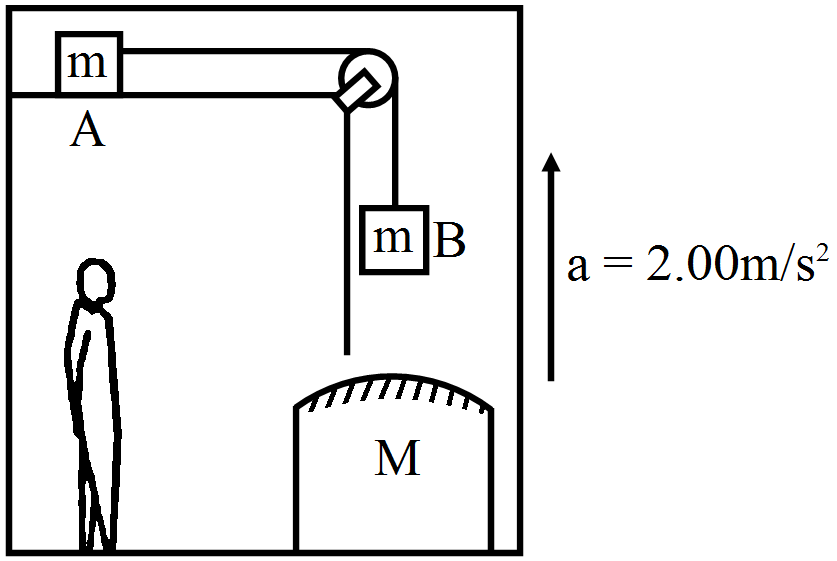
Consider the situation shown in figure. The elevator is going up with an acceleration of $2.00m/s^2$ and the focal length of the mirror is 12.0cm. All the surfaces are smooth and the pulley is light. The mass-pulley system is released from rest (with respect to the elevator) at t = 0 when the distance of B from the mirror is 42.0cm. Find the distance between the image of the block B and the mirror at t = 0.200s. Take $g = 10m/s^2.$​​​​​​​