Question
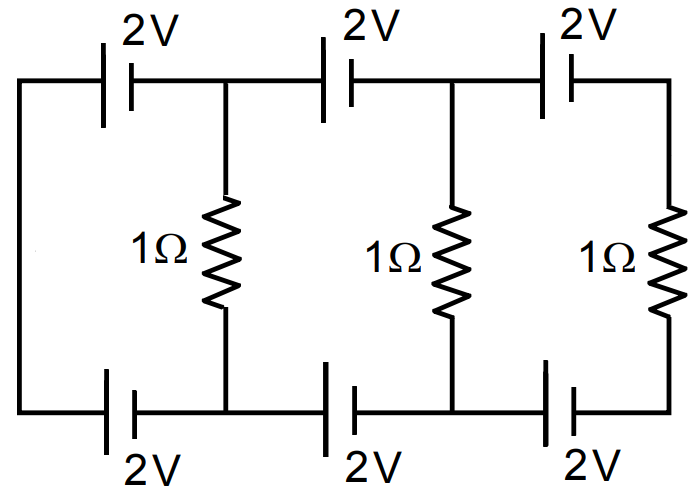
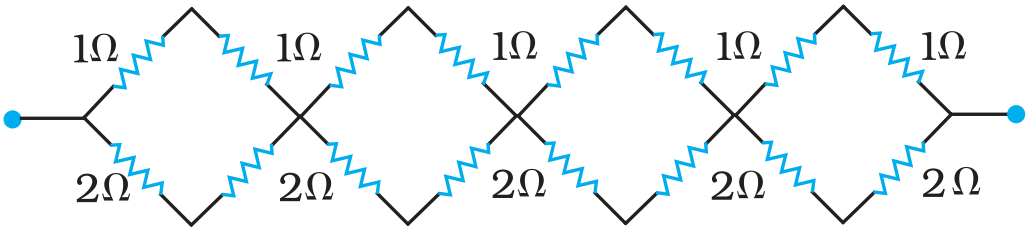
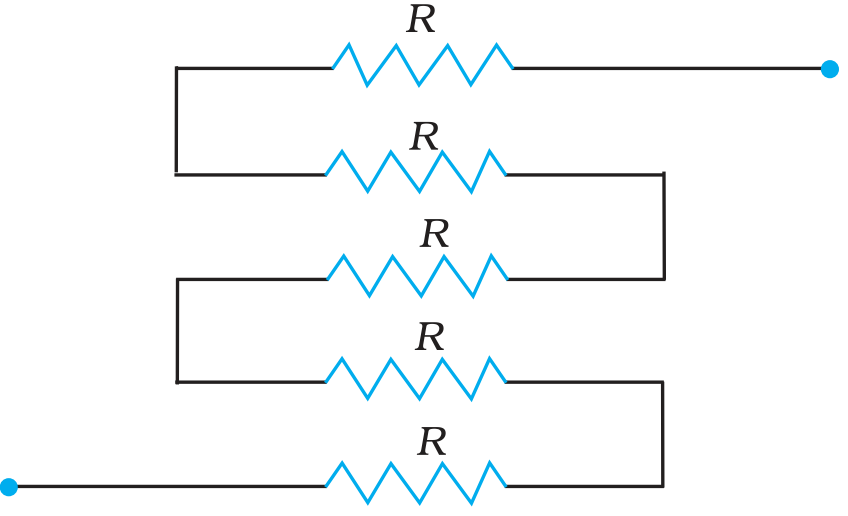
Determine the equivalent resistance of networks shown in Fig.

Answer

  1. It can be observed from the given circuit that in the first small loop, two resistors of resistance $1\ \Omega$ each are connected in series.
Hence, their equivalent resistance $=(1+1)=2\ \Omega$
It can also be observed that two resistors of resistance $2\ \Omega$ each are connected in series.
Hence, their equivalent resistance $=(2+2)=4\ \Omega$
Therefore, the circuit can be redrawn as

It can be observed that $2\ \Omega\ \text{and}\ 4\ \Omega$ resistors are connected in parallel in all the four loops. Hence, equivalent resistance (R') of each loop is given by,
$\text{R}=\frac{2\times4}{2+4}=\frac{8}{6}=\frac{4}{3}\Omega$
The circuit reduces to,

All the four resistors are connected in series.
Hence, equivalent resistance of the given circuit is $\frac{4}{3}\times4=\frac{16}{3}\Omega$
  1. It can be observed from the given circuit that five resistors of resistance R each are connected in series.
Hence, equivalent resistance of the circuit = R + R + R + R + R
= 5 R

Need a full question paper?

Generate a complete, print-ready paper with questions like this in minutes — across 16+ boards, with answer keys.
Start Generating Free

Similar questions

Obtain the amount of $^{60}_{27}\text{Co}$ necessary to provide a radioactive source of 8.0 mCi strength. The half-life of $^{60}_{27}\text{Co}$ is 5.3 years.
A particle A having a charge of $2.0 \times 10^{-6}C$ is held fixed on a horizontal table. A second charged particle of mass 80g stays in equilibrium on the table at a distance of 10cm from the first charge. The coefficient of friction between the table and this second particle is $\mu=0.2.$ Find the range within which the charge of this second particle may lie.
Find the circuit in the three resistors shown in the figure.
It is found that yellow light does not eject photoelectrons from a metal. Is it advisable to try with orange light? With green light?
A 5mm high pin is placed at a distance of 15cm from a convex lens of focal length 10cm. A second lens of focal length 5cm is placed 40cm from the first lens and 55cm from the pin. Find
  1. The position of the final image.
  2. Its nature.
  3. Its size.
The capacitance between the adjacent plates shown in figure is 50nF. A charge of $1.0\mu\text{C}$ is placed on the middle plate:
  1. What will be the charge on the outer surface of the upper plate?
  2. Find the potential difference developed between the upper and the middle plates.
Two wires of equal length, one of aluminium and the other of copper have the same resistance. Which of the two wires is lighter? Hence explain why aluminium wires are preferred for overhead power cables.
$(\rho_{\text{A}1}=2.63\times10^{-8}\Omega\ \text{m,}\ \text{Relative density of Al}=2.7,\ \text{of Cu}=8.9)$
The separation between the plates of a parallel-plate capacitor is 0.500cm and its plate area is $100cm^2$. A 0.400cm thick metal plate is inserted into the gap with its faces parallel to the plates. Show that the capacitance of the assembly is independent of the position of the metal plate within the gap and find its value.
A metallic ring of mass m and radius l (ring being horizontal) is falling under gravity in a region having a magnetic field. If z is the vertical direction, the z-component of magnetic field is $\text{B}_\text{z}=\text{B}_0(1+\lambda\text{z})$. If R is the resistance of the ring and if the ring falls with a velocity v, find the energy lost in the resistance. If the ring has reached a constant velocity, use the conservation of energy to determine v in terms of $\text{m},\text{B},\lambda$ and acceleration due to gravity g.
Draw the complete I-V characteristic curve for an ideal P-N junction diode. Define the dynamic resistance in the forward bias state.