Question
It is found that yellow light does not eject photoelectrons from a metal. Is it advisable to try with orange light? With green light?

Answer

Photoelectrons are emitted from a metal's surface if the frequency of incident radiation is more than the threshold frequency of the given metal surface. As yellow light does not eject photoelectrons from a metal it means that the threshold frequency of the metal is more than the frequency of yellow light. Since the frequency of orange light is less than the frequency of yellow light, therefore it will not be able to eject photoelectrons from the metal's surface. The frequency of green light is more than the frequency of yellow light. Hence, when it is incident on the metal surface, it will eject electrons from the metal.
Need a full question paper?

Generate a complete, print-ready paper with questions like this in minutes — across 16+ boards, with answer keys.

Start Generating Free

Similar questions

Draw a neat and labelled diagram of a cyclotron. State the underlying principle and explain how a positively charged particle gets accelerated in this machine. Show mathematically that the cyclotron frequency does not depend upon the speed of the particle.
Answer the following question:
Long distance radio broadcasts use short-wave bands. Why?
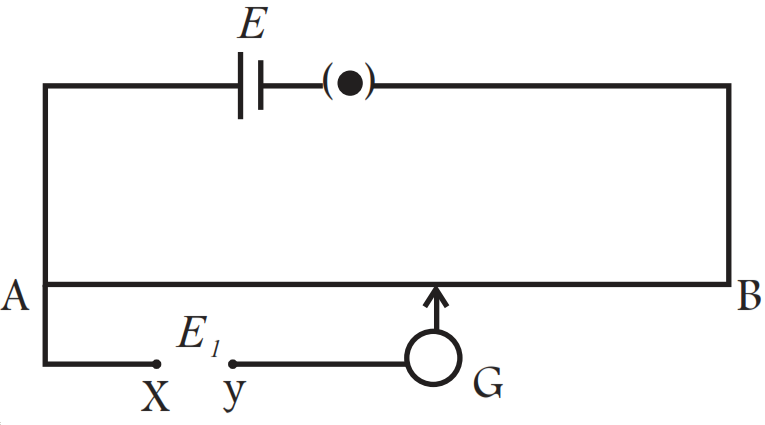
While doing an experiment with potentiometer (Fig.) it was found that the deflection is one sided and (i) the deflection decreased while moving from one end A of the wire to the end B; (ii) the deflection increased. while the jockey was moved towards the end B.
  1. Which terminal +or -ve of the cell $E_1,$ is connected at X in case (i) and how is $E_1$ related to E?
  2. Which terminal of the cell $E_1$ is connected at X in case (ii)?
A spherical ball of surface area $20cm^2$ absorbs any radiation that falls on it. It is suspended in a closed box maintained at 57°C.
  1. Find the amount of radiation falling on the ball per second.
  2. Find the net rate of heat flow to or from the ball at an instant when its temperature is 200°C. Stefan constant $= 6.0 \times 10^{-8}Wm^{-2}K^{-4}.$
The work function of caesium metal is 2.14 eV. When light of frequency $6 \times 10^{14}$Hz is incident on the metal surface, photoemission of electrons occurs. What is the
  1. Maximum kinetic energy of the emitted electrons,
  2. Stopping potential, and
  3. Maximum speed of the emitted photoelectrons?
  1. State the principle of working of a potentiometer.
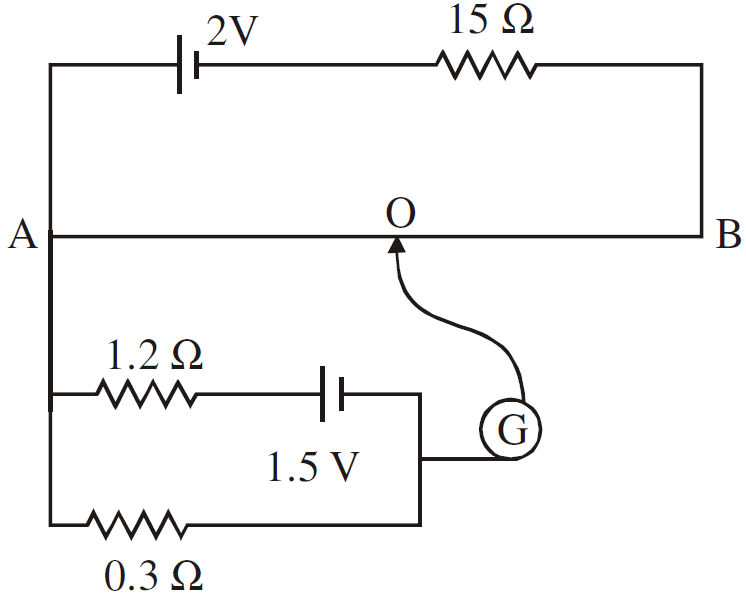
  2. In the following potentiometer circuit, AB is a uniform wire of length 1 m and resistance 10Ω. Calculate the potential gradient along the wire and balance length AO ( = l).
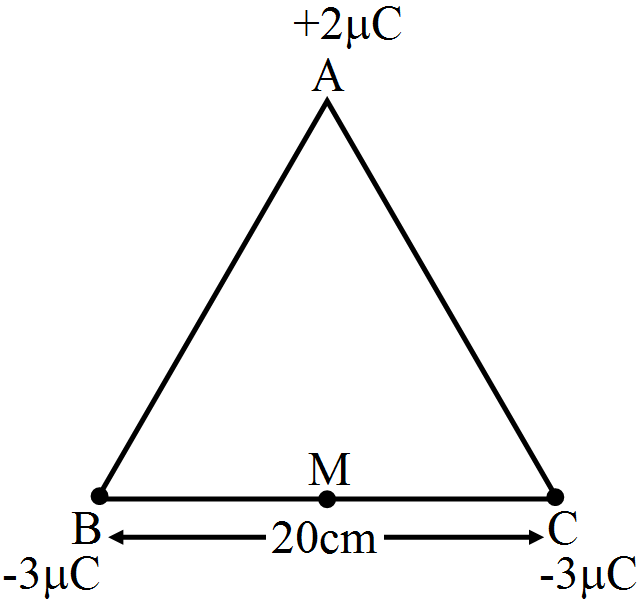
Three point charges of $+2\mu\text{C}, -3\mu\text{C}$ and $-3\mu\text{C}$ are kept at the vertices A, B and C respectively of an equilateral triangle of side 20cm as shown in figure. What should be the sign and magnitude of charge to be placed at the midpoint M of side BC so that charge at A remains in equilibrium?
A polariod (I) is placed in front of a monochromatic source. Another polatiod (II) is placed in front of this polaroid (I) and rotated till no light passes. A third polaroid (III) is now placed in between (I) and (II). In this case, will light emerge from (II). Explain.
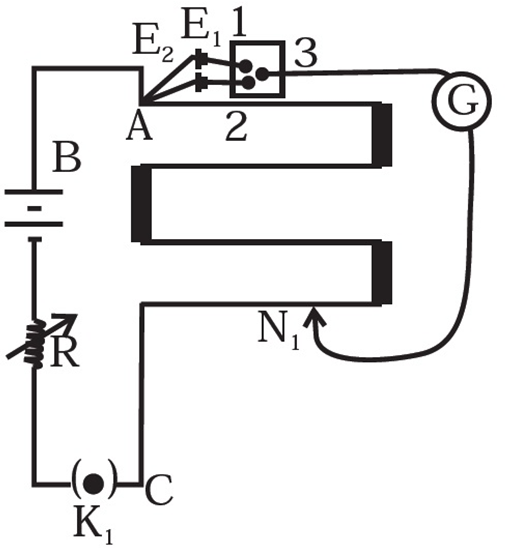
In an experiment with a potentiometer, VB = 10V. R is adjusted to be 50Ω (Fig.). A student wanting to measure voltage $E_1$ of a battery (approx. 8V) finds no null point possible. He then diminishes R to 10Ω and is able to locate the null point on the last $(4^{th})$ segment of the potentiometer. Find the resistance of the potentiometer wire and potential drop per unit length across the wire in the second case.
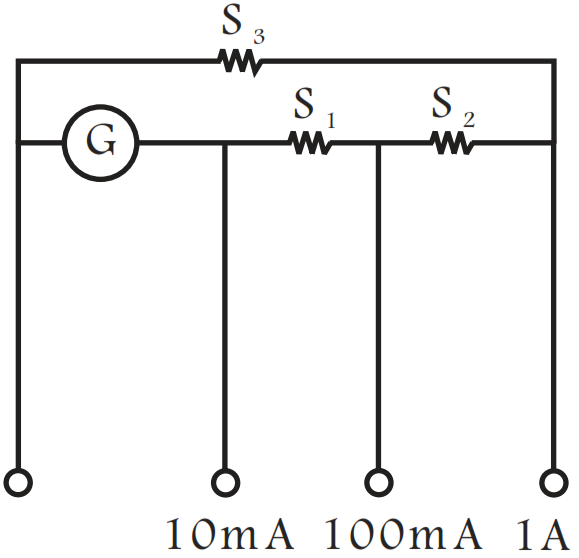
A multirange current meter can be constructed by using a galvanometer circuit as shown in Fig. We want a current meter that can measure 10mA, 100mA and 1A using a galvanometer of resistance 10Ω and that prduces maximum deflection for current of 1mA. Find $S_1, S_2$ and $S_3$ that have to be used.