Question
Determine the maximum distance that the man can travel.
Answer


We have to maximize z = x + y subject to constraints.
$2\text{x}+3\text{y}\leq120,8\text{x}+5\text{y}\leq400,\text{x}\geq0,\text{y}\geq0$
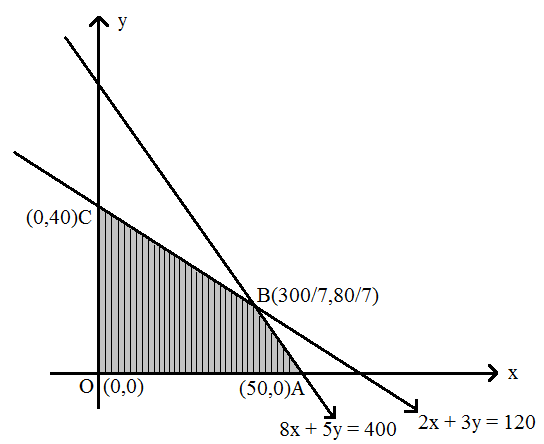
These inequalities are plotted as shown in the following figure.
From the figure shaded region is bounded with the corner points O(0, 0), A(50, 0), $\text{B}\Big(\frac{300}{7},\frac{80}{7}\Big),$ C(0, 0)
Corner points
Corresponding value of Z = x + y
(0, 0)
0
(50, 2)
50
$\Big(\frac{300}{7},\frac{80}{7}\Big)$
$\frac{380}{7}=54\frac{2}{7}\text{km (maximum)}$ 
(0, 40)
40
 Hence, the maximum distance that the man can travel is $54\frac{2}{7}\text{km}.$

Need a full question paper?

Generate a complete, print-ready paper with questions like this in minutes — across 16+ boards, with answer keys.

Start Generating Free

Similar questions

Evaluate the following integrals:$\int\frac{\text{x}^2\tan^{-1}\text{x}}{1+\text{x}^2}\text{dx}$
Evaluate the following integrals:
$\int\cos^3\sqrt{\text{x}}\text{dx}$
If f, $\text{f, g : R}\rightarrow \text{R}$ be two functions defined as $\text{f}(x) = |x| + x \text{ and } \text{g} (x) = |x| - x, \forall \text{ }x \in \text{R}.$Then find fog and gof. Hence find fog(–3), fog(5) and gof (–2).
Given $\text{A}=\begin{bmatrix}5 & 0 & 4 \\2 & 3 & 2 \\ 1 & 2 & 1\end{bmatrix},\text{B}^{-1}=\begin{bmatrix}1 & 3 & 3 \\1 & 4 & 3 \\ 1 & 3 & 4\end{bmatrix}.$ Compute $(AB)^{-1}.$
Find the integrals of the functions in Exercises:
$\sin\text{x } \sin2\text{x }\sin3\text{x}$
Find $\text{y}=\text{Ae}^{-\text{kt}}\cos\text({pt}+\text{c})$prove that $\frac{\text{d}^2\text{y}}{\text{dt}^2}+2\text{k}\frac{\text{dy}}{\text{dt}}+\text{n}^2\text{y}=0,$Where $\text{n}^2=\text{p}^2+\text{k}^2.$
If $\text{x}=\text{a}\sin\text{t}-\text{b}\cos\text{t},\text{y}=\text{a}\cos\text{t}+\text{b}\sin\text{t},$ Prove that $\frac{\text{d}^2\text{y}}{\text{dx}^2}=-\frac{\text{x}^2+\text{y}^2}{\text{y}^2}$ 
Two like parallel forces $\overrightarrow{a}$ and$\overrightarrow{b}$ act on a rigid body at A and B respectively. If $\overrightarrow{P}$ and $\overrightarrow{Q}$ are interchanged in position, show that the point of application of the resultant will be displaced through a distance $\frac{P -Q}{P + Q}.AB$
The total area of a page is $150\ cm^2.$ The combined width of the margin at the top and bottom is $3\ cm$ and the side $2\ cm.$ What must be the dimensions of the page in order that the area of the printed matter may be maximum?
Find the shortest distance between the lines
$\frac{\text{x}+1}{7}=\frac{\text{y}+1}{-6}=\frac{\text{z}+1}{1}$ and $\frac{\text{x}-3}{1}=\frac{\text{y}-5}{-2}=\frac{\text{z}-7}{1}$