Question
Determine the maximum distance that the man can travel.
Answer


We have to maximize z = x + y subject to constraints.
$2\text{x}+3\text{y}\leq120,8\text{x}+5\text{y}\leq400,\text{x}\geq0,\text{y}\geq0$
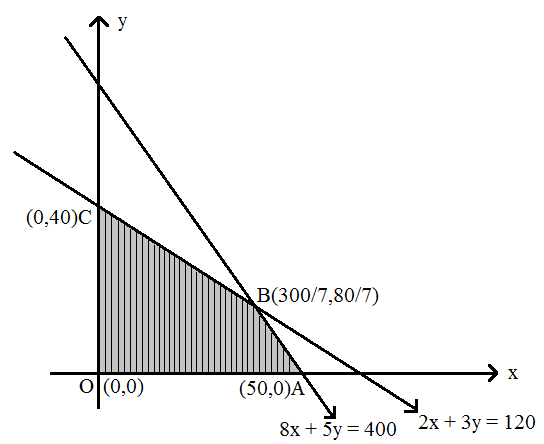
These inequalities are plotted as shown in the following figure.
From the figure shaded region is bounded with the corner points O(0, 0), A(50, 0), $\text{B}\Big(\frac{300}{7},\frac{80}{7}\Big),$ C(0, 0)
Corner points
Corresponding value of Z = x + y
(0, 0)
0
(50, 2)
50
$\Big(\frac{300}{7},\frac{80}{7}\Big)$
$\frac{380}{7}=54\frac{2}{7}\text{km (maximum)}$
(0, 40)
40
Hence, the maximum distance that the man can travel is $54\frac{2}{7}\text{km}.$

Need a full question paper?

Generate a complete, print-ready paper with questions like this in minutes — across 16+ boards, with answer keys.

Start Generating Free

Similar questions

Prove the following results:
$\sin^{-1}\frac{5}{13}+\cos^{-1}\frac{3}{5}=\tan^{-1}\frac{63}{16}$
Find the coordinates of the foot of the perpendicular and the perpendicular distance of the point P(3, 2, 1) from the plane 2x - y + z + 1 = 0. Also, find the image of the point in the plane.
In order to supplement daily diet, a person wishes to take some X and some wishes Y tablets. The contents of iron, calcium and vitamins in X and Y(in milligrams per tablet) are given as below:
Tablets
Iron
Calcium
Vitamin
x
6
3
2
y
2
3
4
The person needs at least 18 milligrams of iron, 21 milligrams of calcium and 16 milligram of vitamins. The price of each tablet of X and Y is Rs. 2 and Rs. 1 respectively. How many tablets of each should the person take inorder to satisfy the above requirement at the minimum cost?
$\overrightarrow{\text{n}}$ is a vector of magnitude $\sqrt{3}$ and is equally inclined to an acute angle with the coordinate axes. Find the vector and cartesian form of the equation of a plane which passes through (2, 1, -1) and is normal to $\overrightarrow{\text{n}}$
Find the points on the curve $y = x^3 - 2x^2 - 2x$ at which the tangent lines are parallel to the line $y = 2x - 3.$
Evaluate the following integrals:
$\int_{0}^\limits{{\frac{\pi}{4}}}(\tan\text{x}+\cot\text{x})^{-2}\text{ dx}$
Find $\int \frac{2x}{(x^{2} + 1)(x^{2} + 2)^{2}} \text{d}x.$
If $\text{y}=\text{a}\{\text{x}+\sqrt{\text{x}^2+1}\}^\text{n}+\text{b}\{\text{x}-\sqrt{\text{x}^2+1}\}^{-\text{n},}$ prove that $(\text{x}^2-1)\frac{\text{d}^2\text{y}}{\text{dx}^2}+\text{x}\frac{\text{dy}}{\text{dx}}-\text{n}^2\text{y}=0.$
A chemical company produces two compounds, A and B. The following table gives the units of ingredients, C and D per kg of compounds A and B as well as minimum requirements of C and D and costs per kg of A and B. Find the quantities of A and B which would give a supply of C and D at a minimum cost.
 
Compound
Minimum requirement
A
B
 
Ingredient C
1
2
80
Ingredient D
3
1
75
Coist (in Rs.) per Kg
4
6
 
Evaluate the following integrals:$\int\frac{\log\text{x}}{(\text{x}+1)^2}\text{dx}$