Determine the pressure difference in tube of non$-$uniform cross sectional area as shown in figure. $\Delta P =?$ (in $pa$)
$d_{1}=5\, cm , V_{1}=4\, cm , d_{2}=2\, cm , V_{2}=?$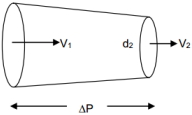
AIIMS 2019, Medium
Download our app for free and get started
Apply the equation of continuity.
$A _{1} v _{1}= A _{2} v _{2}$
$5^{2} \times 4=2^{2} \times v _{2}$
$v _{2}=25$
Apply the energy equation at both the ends.
$P _{1}+\frac{1}{2}\rho v _{1}^{2}= P _{2}+\frac{1}{2}\rho v _{2}^{2}$
$P_{1}-P_{2}=\frac{1}{2}\rho \left(v_{2}^{2}-v_{1}^{2}\right)$
$=\frac{1}{2} \times 10^{3}\left(25^{2}-4^{2}\right)$
$=304500 Pa$

Download our appand get started for free
Experience the future of education. Simply download our apps or reach out to us for more information. Let's shape the future of learning together!No signup needed.*
Similar Questions
- 1View SolutionWater containing air bubbles flows without turbulence through a horizontal pipe which has a region of narrow cross-section. In this region, the bubbles
- 2View SolutionIn a turbulent flow, the velocity of the liquid molecules in contact with the walls of the tube is
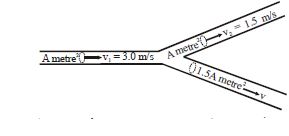
- 3An incompressible liquid flows through a horizontal tube as shown in the figure. Then, the velocity $v$ of the fluid is ......... $m/s$View Solution
- 4View SolutionSelect incorrect statement regarding turbulent flow
- 5A uniform cylinder of length $L$ and mass $M$ having crosssectional area $A$ is suspended, with its length vertical, from a fixed point by a massless spring such that it is half submerged in a liquid of density $\sigma$ at equilibrium position. The extension $x_0$ of the spring when it is in equilibrium isView Solution
- 6A vessel contain a liquid has a constant acceleration $19.6 \,m / s ^2$ in horizontal direction. The free surface of water get sloped with horizontal at angle ..........View Solution
- 7A large tank is filled with water to a height $H$. A small hole is made at the base of the tank. It takes ${T_1}$ time to decrease the height of water to $\frac{H}{\eta }\,(\eta > 1)$; and it takes ${T_2}$ time to take out the rest of water. If ${T_1} = {T_2}$, then the value of $\eta $ isView Solution
- 8View SolutionWater falls from a tap, down the streamline
- 9View SolutionWater falls from a tap, down the streamline.
- 10A small sphere of radius $r$ falls from rest in a viscous liquid. As a result, heat is produced due to viscous force. The rate of production of heat when the sphere attains its terminal velocity, is proportional toView Solution