A small sphere of radius $r$ falls from rest in a viscous liquid. As a result, heat is produced due to viscous force. The rate of production of heat when the sphere attains its terminal velocity, is proportional to
NEET 2018, Diffcult


Download our appand get started for free
Experience the future of education. Simply download our apps or reach out to us for more information. Let's shape the future of learning together!No signup needed.*
Similar Questions
- 1Water is flowing through a horizontal tube having cross-sectional areas of its two ends being $A$ and $A'$ such that the ratio $A/A'$ is $5$ છે.જો If the pressure difference of water between the two ends is $3 \times 10^5\, N\, m^{-2}$, the velocity of water with which it enters the tube will be ......... $m s^{-1}$ (neglect gravity effects)View Solution
- 2View SolutionBernoulli's principle does not explain
- 3Under a constant pressure head, the rate of flow of liquid through a capillary tube is $V$. If the length of the capillary is doubled and the diameter of the bore is halved, the rate of flow would becomeView Solution
- 4A cylindrical vessel of height $500 \mathrm{~mm}$ has an orifice (small hole) at its bottom. The orifice is initially closed and water is filled in it up to height $\mathrm{H}$. Now the top is completely sealed with a cap and the orifice at the bottom is opened. Some water comes out from the orifice and the water level in the vessel becomes steady with height of water column being $200 \mathrm{~mm}$. Find the fall in height (in ${m m}$ ) of water level due to opening of the orifice.View Solution
|Take atmospheric pressure $=1.0 \times 10^5 \mathrm{~N} / \mathrm{m}^2$, density of water $=1000 \mathrm{~kg} / \mathrm{m}^3$ and $g=10 \mathrm{~m} / \mathrm{s}^2$. Neglect any effect of surface tension.]
- 5An incompressible fluid flows steadily through a cylindrical pipe which has radius $2r$ at point $A $ and radius $r $ at $B $ further along the flow direction. If the velocity at point $A$ is $v, $ its velocity at point $B$ isView Solution
- 6$A U-$ tube having horizontal arm of length $20$ $cm$, has uniform cross-sectional area $=1\ cm^2$. It is filled with water of volume $60$ $cc$. What volume of a liquid of density $4$ $g/cc$ should be poured from one side into the $U -$ tube so that no water is left in the horizontal arm of the tube ........ $cc$ ?View Solution
- 7$Assertion :$ The velocity of flow of a liquid is smaller when pressure is larger and vice-versa.View Solution
$Reason :$ According to Bernoulli’s theorem, for the stream line flow of an ideal liquid, the total energy per unit mass remains constant. - 8A tiny spherical oil drop carrying a net charge $q$ is balanced in still air with a vertical uniform electric field of strength $\frac{81 \pi}{7} \times 10^5 \mathrm{Vm}^{-1}$. When the field is switched off, the drop is observed to fall with terminal velocity $2 \times 10^{-3} \mathrm{~ms}^{-1}$. Given $\mathrm{g}=9.8 \mathrm{~ms}^{-2}$, viscosity of the air $=1.8 \times 10^{-5} \mathrm{Ns} \mathrm{m}^{-2}$ and the density of oil $=$ $900 \mathrm{~kg} \mathrm{~m}^{-3}$, the magnitude of $\mathrm{q}$ isView Solution
- 9View SolutionA tank filled with fresh water has a hole in its bottom and water is flowing out of it. If the size of the hole is increased, then
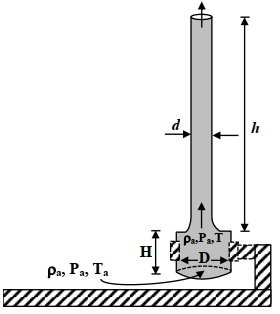
- 10A cylindrical furnace has height $(H)$ and diameter $(D)$ both $1 \mathrm{~m}$. It is maintained at temperature $360 \mathrm{~K}$. The air gets heated inside the furnace at constant pressure $P_a$ and its temperature becomes $T=360 \mathrm{~K}$. The hot air with density $\rho$ rises up a vertical chimney of diameter $d=0.1 \mathrm{~m}$ and height $h=9 \mathrm{~m}$ above the furnace and exits the chimney (see the figure). As a result, atmospheric air of density $\rho_a=1.2 \mathrm{~kg} \mathrm{~m}^{-3}$, pressure $P_a$ and temperature $T_a=300 \mathrm{~K}$ enters the furnace. Assume air as an ideal gas, neglect the variations in $\rho$ and $T$ inside the chimney and the furnace. Also ignore the viscous effects.View Solution
[Given: The acceleration due to gravity $g=10 \mathrm{~ms}^{-2}$ and $\pi=3.14$ ]
(image)
($1$) Considering the air flow to be streamline, the steady mass flow rate of air exiting the chimney is
. . . . .$\mathrm{gm} \mathrm{s}^{-1}$.
($2$) When the chimney is closed using a cap at the top, a pressure difference $\Delta P$ develops between the top and the bottom surfaces of the cap. If the changes in the temperature and density of the hot air, due to the stoppage of air flow, are negligible then the value of $\Delta P$ is. . . . .$\mathrm{Nm}^{-2}$.