Question
Determine whether the following statement patterns is a tautology or a contradiction or a contingency:
[~(p ∧ q) → p] ↔ [(~p) ∧ (~q)]

Answer

[~(p ∧ q) → p] ↔ [(~p) ∧ (~q)]
Image
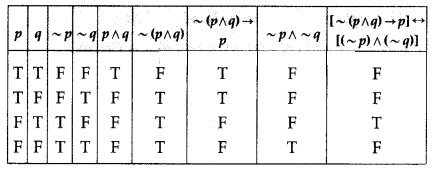
The entries in the last column of the above truth table are neither all T nor all F.
∴ [~(p ∧ q) → p] ↔ [(~p) ∧ (~q)] is a contingency.

Need a full question paper?

Generate a complete, print-ready paper with questions like this in minutes — across 16+ boards, with answer keys.

Start Generating Free

Similar questions

Solve the following differential equations : $\frac{d y}{d x}+ y =3$
Find the Price Index Number using the Simple Aggregate Method.
Use 2000 as the base year in the following problem.
CommodityPrice (in Rs.) for year 2000Price (in Rs.) for year 2006
Watch9001475
Shoes18002300
Sunglasses6001040
Mobile45008500
Check whether following matrices are invertible or not: $\left[\begin{array}{lll}3 & 4 & 3 \\ 1 & 1 & 0 \\ 1 & 4 & 5\end{array}\right]$
Find the differential equation by eliminating arbitrary constant from the relation $x^2+y^2=2 a x$.
Prepare truth table for (p ˄ q) ˅ ~ r

(p ∧ q) ∨ ~ r

If p ↔ q and p → q both are true, then find truth values of the following with the help of activity

p ˄ q

$p \leftrightarrow q$ and $p \rightarrow q$ both are true if $p$ and $q$ has truth value $\square, \square$ or $\square, \square$
$p \wedge q$
i. If both $p$ and $q$ are true, then $p \wedge q =\square \wedge \square=\square$
ii. If both $p$ and $q$ are false, then $p \wedge q =\square \wedge \square=\square$
Obtain the differential equation by eliminating arbitrary constants from the following equations : $y^2=(x+c)^3$
Obtain the differential equation by eliminating arbitrary constants from the following equations : $y=A e^{3 x}+B e^{-3 x}$
If $A = {2, 3, 4, 5, 6, 7, 8}$, determine the truth value of each of the following statements:
(i) $∃ x \in A,$ such that $3x + 2 > 9$.
(ii) $\forall x \in A, x^2 < 18.$
(iii) $∃x \in A,$ such that $x + 3 < 11$.
(iv) $∀x \in A, x^2 + 2 \geq 5$.
A Company manufactures two types of chemicals A and B. Each chemical requires two types of raw materials P and Q. The table below shows a number of units of P and Q required to manufacture one unit of A and one unit of B.
Raw Materials \ FertilizersABAvailability
P32120
Q25160
The company gets profits of ₹ 350/- and ₹ 400/- by selling one unit of A and one unit of B respectively. Formulate the problem as LPP to maximize the profit.